Table of Contents
Why Your Old Resume Hurts
Most people trying to switch industries make the same mistake: they take their old resume, swap out a few job titles, and expect callbacks. That does not work because a career change resume is not a revised version of what you already have; it is a completely different document built for a completely different audience.
Recruiters scan resumes in seconds, and they are looking for job-title alignment, industry keywords, and a clear career arc. If your old resume is still centered on your previous field, it will make your pivot look confusing instead of intentional.
If you want to experiment with multiple layouts before sending applications, use Resumeera — the free resume builder — to build and download your resume without account creation.
Best Career Change Resume Format
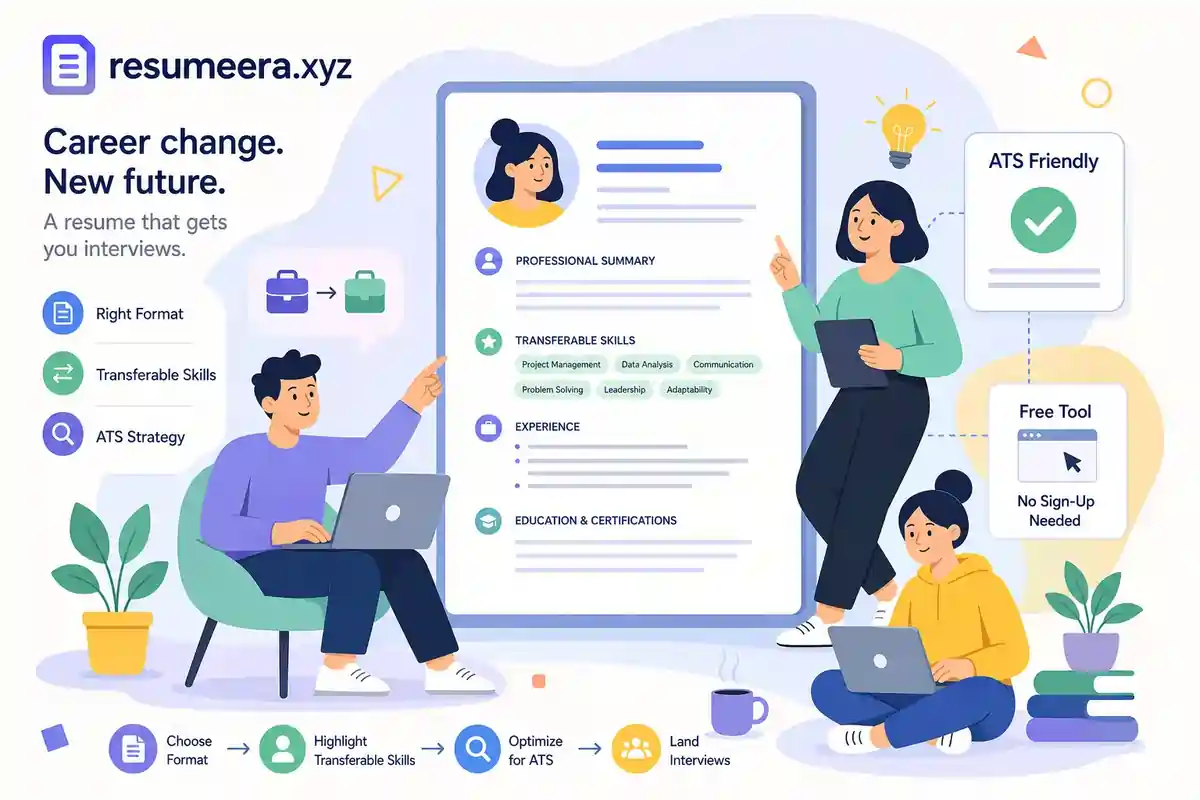
There are three standard resume formats: chronological, functional, and combination. For most career changers, the combination resume format is the strongest choice because it leads with relevant skills and achievements, then supports them with reverse-chronological work history.
Which format to use
| Format | Best for | Why it works |
|---|---|---|
| Chronological | Small career shifts or strong overlap | Shows timeline clearly |
| Functional | Large gaps or highly unrelated experience | Puts skills first |
| Combination | Most career changers | Balances skills and work history |
The combination format answers two questions at once: “Do you have the right skills?” and “What is your work history?” That is exactly why it is usually the safest format for switching industries.
A functional resume can work when your work history is weak, highly unrelated, or full of gaps, but some recruiters find it evasive and some ATS platforms struggle with it. A straight chronological format usually works against career changers because it puts the least relevant jobs first.
For a deeper structure guide, interlink this section to Resume Formats Guide, Functional Resume Format, and Combination Resume Format.
How To Map Skills
The core of a career change resume is transferable skills. Start by studying three to five job descriptions in your target role and noting the skills and phrases that repeat across them. Then compare those requirements with what you actually did in your previous roles.
Common transferable skills include:
-
Project management.
-
Data analysis.
-
Stakeholder communication.
-
Process improvement.
-
Cross-functional collaboration.
| Old Field Example | New Field Translation |
|---|---|
| Managed retail staff schedules | Coordinated team operations and resource planning |
| Handled customer complaints | Improved stakeholder communication and issue resolution |
| Tracked store performance | Analyzed performance metrics and identified process gaps |
For a supporting skill framework, link to Key Skills for Resume, Personal Skills for Resume, and Resume Achievements.
How To Rewrite Bullets
Your old bullets should not describe your old industry; they should prove the skills your target industry needs. The strongest bullet formula is: action verb + transferable skill + specific context + measurable result.
| Weak Bullet | Strong Bullet |
|---|---|
| Worked on customer operations | Reduced customer wait times by 18% by reorganizing workflow handoffs |
| Helped with team meetings | Coordinated cross-functional meetings that cut project delays by 20% |
This matters because hiring managers want evidence, not job descriptions. A bullet only earns its place if it helps tell the story of why you fit the new role.
Place your strongest and most relevant bullets near the top of each job entry. Cut old bullets that add no value to the new story, even if they were important in your previous role.
For stronger phrasing, connect this section with Resume Work Experience and Project on the Resume.
Summary Formula
The summary is the most important section on a career change resume because it controls the narrative immediately. It should do three things in two to three sentences:
-
Name the target role.
-
Highlight transferable competencies.
-
Include one measurable proof point.
Simple formula
Target role + transferable strengths + measurable result
Example:
“Operations professional transitioning into project management, with eight years of experience in coordination, process improvement, and stakeholder communication, and a record of reducing turnaround time by 20%.”
Avoid vague openings like “I am looking to transition into…” because they signal uncertainty. Keep the summary tight, specific, and role-focused.
For more support, interlink this with Profile Summary Resume and Resume Contact Information.
ATS Keywords For Career Change
Career changers face a special ATS challenge: the system is looking for terms from the target industry, while your resume is full of old-industry wording. The fix is to pull keywords directly from real job postings and use them across the summary, skills section, and bullet points.
Where to place keywords
| Section | How to use keywords |
|---|---|
| Summary | Use natural keyword-rich sentences |
| Skills | List tools, certifications, and core terms |
| Experience bullets | Reinforce the same terms in real achievements |
Use exact phrasing where possible. For example, if a posting says “project management,” do not replace it with “managing projects” unless both truly fit your background.
Do not keyword-stuff. A resume that reads unnaturally may look suspicious to ATS tools and weak to the recruiter who eventually reads it.
For interlinking, add:
-
ATS-Friendly Resume Format for Beginners
-
ATS Resume Tips
-
How to Build an ATS-Friendly Resume
-
Free ATS Resume Checker
How To Test Format
Career changers should test at least two resume versions side by side:
-
Combination format for stronger transferable skills.
-
Functional format for weaker or more fragmented timelines.
That is where Resumeera is especially useful. You can build, edit, and download a resume quickly without signup, which makes it easier to test different formats before choosing the one that frames your background best. Use Resumeera as the central CTA and keep the wording consistent across the article.
Also add links to:
-
How to Fix Your Resume in 2026
Career Change Examples
You can make almost any background work if you reframe it correctly. The goal is not to hide your old experience; it is to translate it into the language of your new industry.
| Old Role | Target Role | Resume Angle |
|---|---|---|
| Retail supervisor | Operations coordinator | Team scheduling, process control, service quality |
| Teacher | Corporate trainer | Curriculum design, facilitation, learning outcomes |
| Accountant | Finance analyst | Reporting, analysis, compliance, accuracy |
| Lab technician | Quality analyst | Testing, documentation, precision |
| Customer support | Client success | Communication, retention, issue resolution |
For niche-specific support, interlink to these Resumeera guides:
-
Accountant Resume Format 2026
-
Teacher Resume Format for Fresher
-
Civil Engineer Resume Format
-
Mechanical Engineer Resume Format 2026
Conclusion
A career change resume is not a modified old resume. It is a new document built to tell a new story in the language of a new industry. The three decisions that matter most are format, transferable-skill framing, and ATS keyword targeting.
If you get those three right, your resume stops looking like a mismatch and starts reading like a qualified candidate who simply comes from a different direction. Use Resumeera — the free resume builder — to test your format, refine your story, and download an ATS-friendly version without friction.
Recommended internal links to add naturally throughout the article:
-
How to Change Careers: A Complete Guide for Indian Professionals
-
Combination Resume Format
-
ATS-Friendly Resume Format for Beginners
Most people lose jobs before the interview — not because they lack skills,
but because their resume looks average.
Fix that in 5 minutes.
⚡ No signup required • 100% Free • Works on mobile
Pick a template → fill details → download resume.
You’re not failing.
Your resume is.
Get shortlisted faster