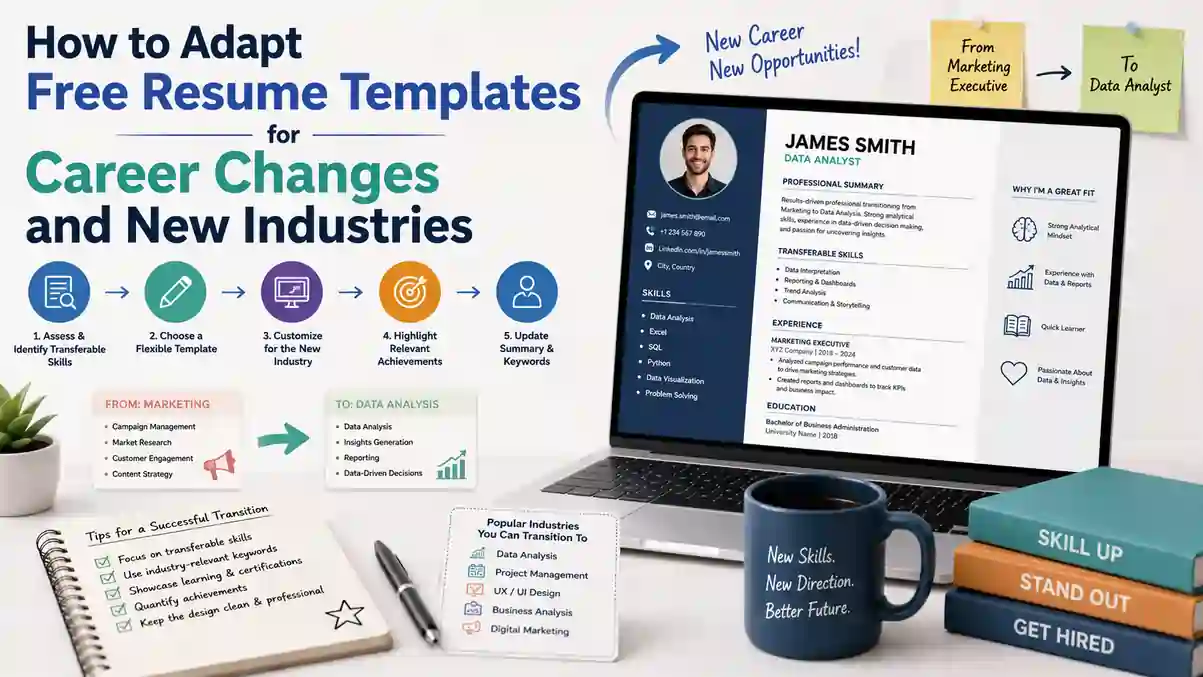
Switching fields can feel like starting over, but it doesn't have to. The fastest way to get traction is adapting resume templates for career change so your value maps cleanly to the job you want, not the job you had.
In this guide, you'll see the exact edits that make a templated resume feel targeted, credible, and ready to pass screening — covering layout choices, ATS must-dos, and practical examples you can copy right away.
Table of Contents
- Know the Target Role and Translate Your Experience
- Map Your Skills to the Job Requirements
- Choosing and Editing the Right Layout
- Layout Tweaks That Matter
- Make It ATS-Friendly Without Losing Personality
- ATS Checks Before You Apply
- Tailor Your Sections With Real Examples
- Examples: Rewrite Bullets With Impact
- Write Content Recruiters Can Trust
- Polish, Proof, and Prepare to Share
- Quick Setup Checklist
- Frequently Asked Questions
- Conclusion
Know the Target Role and Translate Your Experience
Start by picking a clear job title and reading 5–7 recent postings from companies you respect. Highlight repeated skills, tools, and outcomes. Then reframe your past wins using those same signals so a recruiter can spot the fit in seconds.
This groundwork is the same discipline covered in our guide to tailoring your resume for every job application, where matching language before writing bullets saves hours of rework later.
Map Your Skills to the Job Requirements
If you're building a career transition resume, lead with a focused summary and a skills block tied to the new role's keywords. Pair each core skill with a proof point, like a project, metric, or tool you've actually used.
Use a concise profile line that reads naturally, like a resume for changing careers that emphasizes transferable results: process improvements, customer impact, faster delivery, or revenue influence.
For a deeper list of what transfers well, see our guide to transferable skills on a resume.
Adapting Resume Templates for Career Change: Choosing and Editing the Right Layout
Pick from clean, readable professional resume templates that use clear section headers, enough white space, and a single column for the main content. Fancy visuals can wait; clarity and relevance win interviews.
Our overview of 9 basic resume templates for 2026 breaks down which layouts hold up best when your work history isn't linear.
Adapting Resume Templates for Career Change: Layout Tweaks That Matter
A career change resume template should support a prominent Skills or Core Competencies section near the top. Keep it tight — 8–12 items — and mirror terminology seen across your target postings.
When you start from a resume template for job change, rename sections to fit your story: "Selected Projects," "Related Experience," or "Industry Coursework," so non-linear paths still read as intentional and relevant.
| Generic Section Name | Career-Change Friendly Rename |
|---|---|
| Work Experience | Related Experience |
| Projects | Selected Projects / Portfolio Highlights |
| Education | Industry Coursework & Certifications |
| Skills | Core Competencies |
Make It ATS-Friendly Without Losing Personality
Stick with an ATS resume template that uses standard headings (Summary, Skills, Experience, Education), a single body font, and no text boxes for crucial content. Save as .docx or PDF per the employer's instructions.
This structure aligns with the principles in our guide to building an ATS-friendly resume that passes the bots.
ATS Checks Before You Apply
Before you upload, scan the resume text with your cursor to confirm everything is selectable, then run the file name and section order through a quick sanity check.
- Match your title line to the target role (e.g., "Project Coordinator").
- Echo the most repeated keywords from the job description, but only where they're true.
- Use simple bullets that start with action verbs and end with numbers when possible.
- Drop images, charts, or icons that could confuse parsing.
- Avoid columns for the main content unless the template is built for ATS parsing.
For keyword strategy specifically, see our industry-wise resume keywords guide for 2026.
Tailor Your Sections With Real Examples
When working with resume templates for new industry roles, convert past achievements into outcomes that matter in the new field: customer satisfaction, cycle time, cost per unit, error rate, or pipeline growth.
If you're starting from free resume templates for career change, make the Summary specific to one role, not three, and keep it to 3–4 compact lines packed with skills the postings repeat.
Many free resume templates include generic bullet prompts — replace those with crisp, quantified results and the tools you actually used, even if they were entry-level or part of a pilot project.
Examples: Rewrite Bullets With Impact
After: "Standardized intake checklist across 4 clinics using Airtable; cut intake time 22% in 60 days."
For bullets, use a simple formula: action + scope + tool + measurable impact. It's specific and verifiable — the same formula detailed in our resume work experience writing guide.
Write Content Recruiters Can Trust
Select the best resume templates for career change that make space for a Projects or Portfolio section. Short, outcome-focused snapshots help bridge gaps when your titles don't match the target role.
- Prioritize recent, relevant wins over older, bigger titles.
- Translate internal jargon into common industry terms.
- If a skill is new, show proof (coursework, certification, live demo, or GitHub).
- Keep bullets to one or two lines so each achievement lands at a glance.
Our guide on adding projects to your resume covers exactly how to structure this section for maximum credibility.
Polish, Proof, and Prepare to Share
When you customize documents, compare two or three of the best resume templates for career change and borrow the sections that best showcase your proof. The right structure makes every edit easier.
Proofread aloud. Check dates, job titles, and links. Then sanity-check your Summary against the job's top three requirements. If the match isn't obvious in five seconds, keep trimming and sharpening.
Finally, save a master version and create a role-specific copy for each application. Track changes in a simple spreadsheet so you can see what lands interviews and what needs refinement — a workflow also outlined in our complete 2026 career change resume tips guide.
Adapting Resume Templates for Career Change: Quick Setup Checklist
- Summary: 3–4 lines, one target role, keywords from real postings.
- Skills: 8–12 items, mirrored from job description language.
- Sections: rename to fit your story (Related Experience, Selected Projects).
- Bullets: action + scope + tool + measurable impact, 1–2 lines each.
- Format: single column, standard headings, ATS-tested export.
Frequently Asked Questions
1. Which resume template is best for a career change?
A single-column, ATS-friendly template with a prominent Skills or Core Competencies section near the top works best, since it lets transferable skills stand out before your job titles.
2. Should I rename standard resume sections for a career change?
Yes, renaming sections like "Work Experience" to "Related Experience" or "Projects" to "Selected Projects" helps non-linear career paths read as intentional rather than scattered.
3. How long should my summary be when changing careers?
Keep it to 3–4 compact lines focused on one target role, packed with skills and outcomes that match the language used in real job postings.
4. Can I use a free resume template for a career change resume?
Yes, free resume templates work well as long as you replace generic bullet prompts with quantified, role-specific results and keep the layout ATS-compatible.
5. How do I prove a new skill if I don't have work experience in it?
Show proof through coursework, certifications, a live demo, or a GitHub/portfolio link — recruiters trust verifiable evidence more than a listed skill alone.
Conclusion
Pick a clean layout, surface transferable wins early, and keep the language consistent with your target postings. With a few focused edits, adapting resume templates for career change becomes a repeatable process.
Ready to try this on your own roles? Grab a clean template, tailor one section at a time, and send a test application this week.
Build Your Career Change Resume Free