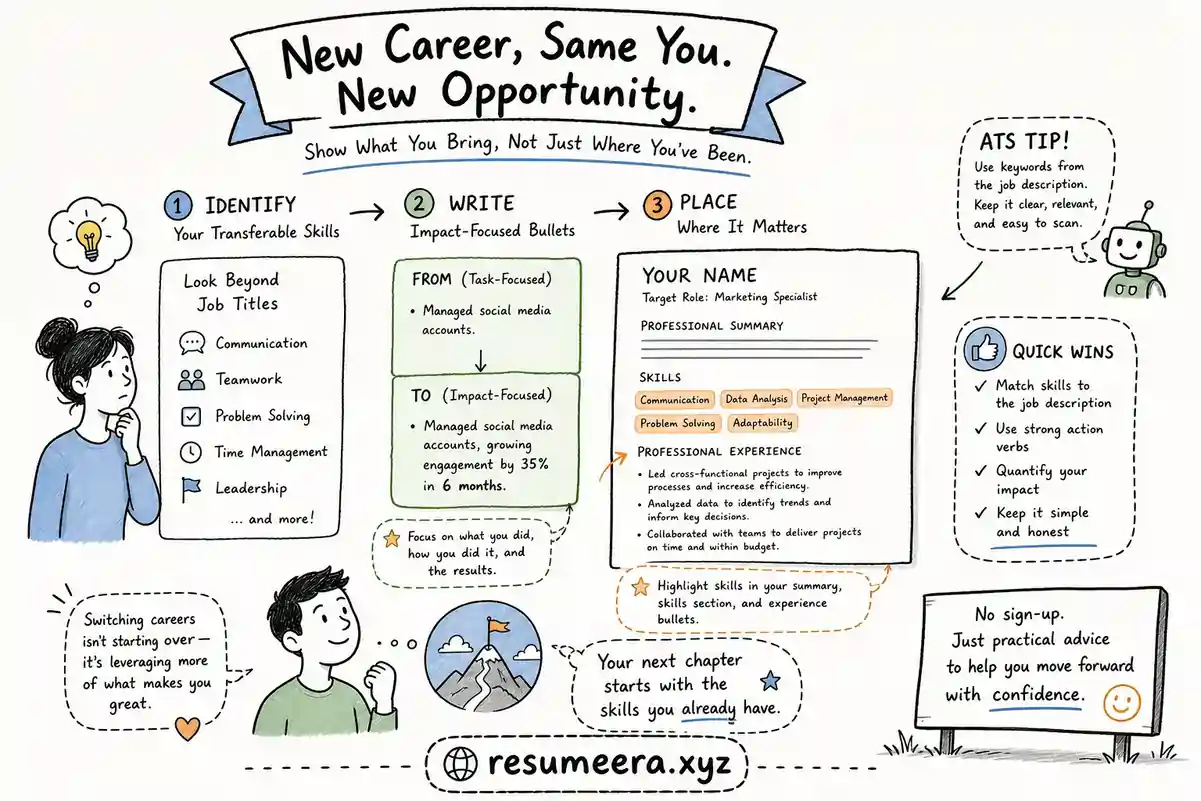
Many career changers hit the same wall: the job posting lists five years of industry experience they don't have, so they assume the application is dead before it starts. That assumption is costing them real opportunities. Every job you've held has required skills, and many of those skills don't stop working when you cross into a new industry. Communication is still communication whether you learned it in a classroom, a hospital, or a retail floor. Building a strong transferable skills resume is how you close that gap, and this guide shows you exactly how to do it.
This guide walks you through the full process: how to surface the skills already in your background, how to match them to a target job description, and how to write ATS-friendly resume bullets that make a recruiter stop and read. If you're restructuring your resume around a new direction, starting from a clean, well-organized template makes the whole process faster. Free Resume Builder offers customizable, ATS-ready templates with no account required and no cost, so you can focus on the writing rather than the formatting.
Free Resume Builder
Don’t let a weak resume decide your future.
Thousands of people are getting rejected — not because they’re bad, but because their resume doesn’t speak for them. Make a resume that actually gets shortlisted.
Your next job is closer than you think.
Start in 2 minutes.
No complicated forms. Just pick a template, fill details, And Apply.
Apply Now Your Job →Table of Contents
- Transferable Skills Resume: Why It Matters More Than You Think
- How to Identify Which of Your Skills Actually Cross Industries
- Starting With the Work You Do Every Day, Not Your Job Title
- Three Categories of Transferable Skills Worth Separating Out
- Career-Field Examples: What Crossing Industries Actually Looks Like
- From Retail and Customer Service to Tech, Operations, or Sales
- From Teaching and Education to Corporate Training, Project Coordination, or HR
- From Healthcare and Service Roles to Management, Admin, or Client-Facing Positions
- Writing Bullets That Prove Your Skills Rather Than Just Naming Them
- The Action + Task + Result Structure Every Bullet Needs
- Action Verbs Mapped to the Skills You're Trying to Demonstrate
- Eight Ready-to-Adapt Bullet Phrases for Career Changers
- Transferable Skills Resume: Placing and Formatting So Recruiters and ATS Both Notice
- Skills Section vs. Experience Bullets: Choosing the Right Place for Each
- Writing a Summary Statement That Leads With Your Career Change Story
- Reformatting Without Starting From Scratch
- The Case for Treating This as a One-Time Investment
- Conclusion
- Frequently Asked Questions
Transferable Skills Resume: Why It Matters More Than You Think
The biggest mistake career changers make is assuming that hiring managers read job postings the same way applicants do. When a posting says "5 years in SaaS sales," that's often an ideal, not a hard filter. Recruiters filling those roles regularly hire candidates from adjacent backgrounds when those candidates can demonstrate strong evidence of the underlying competency. Research on recruiter behavior consistently shows that postings frequently represent aspirational criteria, demonstrated skills often matter more than matching titles.
The 2026 labor market reinforces this. Across tech, operations, HR, and corporate training roles, the most requested skills in job postings aren't industry-specific. They're communication, problem-solving and critical thinking, adaptability, leadership, collaboration, and data analysis, skills that show up across industries because they reflect how a person thinks and operates, not just what software they've used or what their last title said. A candidate with tight, evidence-backed bullets showing problem-solving across a different industry is more likely to stand out to recruiters than a candidate with matching titles but bullets that read like a job description copy-paste.
How to Identify Which of Your Skills Actually Cross Industries
Before you write a single bullet for your transferable skills resume, run a self-audit on your actual work history. Most people describe their roles instead of their results, which buries the skills entirely. The goal is to move from "I was a shift supervisor" to "I trained 14 new hires and reduced onboarding time by three weeks." That second version names a skill, shows scope, and delivers a result.
Starting With the Work You Do Every Day, Not Your Job Title
List the recurring tasks from your last two or three roles. Then, for each one, ask: what capability does this task actually require? A retail associate who handles complicated returns is demonstrating negotiation, de-escalation, and policy interpretation. A teacher who builds a semester curriculum is demonstrating project planning, stakeholder communication, and instructional design. The task lives in one industry; the skill lives everywhere.
Three Categories of Transferable Skills Worth Separating Out
Organizing your skills into three buckets before you write anything makes placement decisions on your transferable skills resume much easier. Soft skills include communication, adaptability, leadership, and collaboration. Hard transferable skills include project management, budget oversight, training design, and process improvement. Digital and technical skills include CRM tools, data entry, spreadsheet analysis, learning management systems, and any platform-specific work that crosses industries. Each category lands in a different spot on the resume, so knowing which is which saves you time later. For an expanded list of transferable skills employers commonly look for, review a practical list of transferable skills employers look for.
Career-Field Examples: What Crossing Industries Actually Looks Like
Abstract advice only goes so far. Here are three realistic career-change paths with specific skill translations so you can see how the logic applies to your own background.
From Retail and Customer Service to Tech, Operations, or Sales
Retail workers handle inventory systems, de-escalate difficult customer situations, hit sales targets, train seasonal staff, and manage floor operations under pressure. Those experiences map cleanly to operations coordination, SaaS sales, customer success, and technical support. Here are three resume bullet examples you can adapt, with bracketed placeholders for your own numbers:
- Resolved [40+] daily customer issues by phone and in person, maintaining a [95%+] satisfaction rate through clear communication and accurate documentation.
- Trained [12] seasonal team members on service standards and POS workflows, reducing onboarding time by [2 weeks].
- Diagnosed and escalated product and account issues, reducing repeat contacts by [20%] through detailed case notes and follow-up.
From Teaching and Education to Corporate Training, Project Coordination, or HR
Teachers build learning objectives, deliver complex content to diverse audiences, manage 25-plus people simultaneously, track performance data, and communicate with administrators, families, and colleagues, all at once. Translate that into instructional design, learning and development, project coordination, or HR by shifting the vocabulary. "Lesson plans" become training modules. "Students" become learners or participants. "Parent communication" becomes stakeholder communication.
- Designed and delivered training sessions for groups of [25, 30], using structured activities and performance checkpoints to improve comprehension and retention.
- Coordinated schedules, materials, and stakeholder communication across [4] concurrent projects, ensuring on-time delivery with zero missed deadlines.
- Facilitated sensitive conversations with multiple stakeholders, resolving concerns through active listening, clear communication, and documented follow-through.
From Healthcare and Service Roles to Management, Admin, or Client-Facing Positions
Healthcare workers operate under pressure, document everything accurately, coordinate across departments, and manage competing priorities without room for error. Those habits translate directly to operations, office management, client services, and compliance work. The precision, the documentation culture, and the ability to communicate across hierarchies are exactly what administrative and client-facing roles need.
- Maintained accurate records across [150+] patient files per week, applying rigorous documentation standards that reduced errors and improved audit readiness.
- Coordinated with [5] cross-functional teams to manage competing priorities, ensuring consistent care delivery without delays or miscommunication.
- Communicated complex information clearly to patients and families under time pressure, adapting language and detail level to the audience.
Writing Bullets That Prove Your Skills Rather Than Just Naming Them
At this point you know what skills you have. The next step is translating them into resume language that holds up under both ATS screening and recruiter review. Most career changers list skills without supporting them, and that's exactly what a recruiter skips over.
The Action + Task + Result Structure Every Bullet Needs
Every strong bullet follows the same structure: a specific action verb, the task or context, and a measurable result. The result doesn't have to be a dramatic number. Timeframes count. Headcounts count. Frequency counts. Here's the same experience written two ways:
Weak: Responsible for managing customer complaints and resolving issues.
Strong: Resolved 40+ customer complaints per week through de-escalation and accurate policy application, maintaining a 96% satisfaction score across 12 consecutive months.
The weak version names a duty. The strong version names a skill, shows scale, and delivers proof. That's the difference between a bullet a recruiter reads and one they don't.
Action Verbs Mapped to the Skills You're Trying to Demonstrate
The verb at the start of a bullet does heavy lifting for both ATS parsing and readability. Match your verb to the skill you're demonstrating, not just to whatever sounds impressive. Here's a quick reference by skill category:
- Leadership: led, directed, oversaw, coordinated, supervised
- Problem-solving: analyzed, resolved, identified, diagnosed, investigated
- Communication: facilitated, presented, advised, articulated, explained
- Process improvement: streamlined, standardized, implemented, reduced, optimized
- Adaptability: transitioned, learned, adapted, expanded
For a broader set of recommended verbs and how they map to resume impact, check a curated list of powerful resume verbs that help your bullets land.
Eight Ready-to-Adapt Bullet Phrases for Career Changers
These are starting points, not copy-paste templates. Replace the bracketed text with your actual numbers and context before using them on your transferable skills resume.
- Led a cross-functional team to deliver a project [3 weeks] ahead of schedule, improving stakeholder satisfaction through clear communication and coordination.
- Analyzed customer feedback across [200+] interactions, translating patterns into actionable recommendations that improved response rates by [30%].
- Designed and delivered training for [50+] employees, improving onboarding efficiency by [40%] through structured curriculum and consistent delivery.
- Streamlined a recurring process by identifying a root-cause inefficiency, reducing errors by [15%] and saving [X hours] per month.
- Facilitated team sessions to develop solutions to recurring service problems, improving consistency and reducing escalations.
- Coordinated logistics for [5+] staff and [200+] participants, increasing event attendance by [15%] while managing multiple competing priorities.
- Adapted quickly to new tools and workflows in a high-volume environment, independently maintaining service quality from week one.
- Revamped client-facing communication templates, increasing customer satisfaction scores by [20%] over two quarters.
Need more concrete achievement examples to tailor to your role? See Resume Achievements: 200+ Examples Across 70+ Careers [2026 Guide] for phrasing ideas you can adapt to your own results.
Transferable Skills Resume: Placing and Formatting So Recruiters and ATS Both Notice
Where skills appear on the resume matters as much as how they're written. ATS systems parse dedicated skills sections reliably because the section heading signals what the text contains. Recruiters scan for evidence of skills inside experience bullets. The strongest approach covers both.
Skills Section vs. Experience Bullets: Choosing the Right Place for Each
Hard and digital transferable skills belong in the dedicated skills section as explicit keywords: project management, CRM systems, training delivery, data analysis, and specific platforms. Soft and demonstrated skills belong inside experience bullets, backed by evidence. Listing "communication" in a skills section with nothing supporting it tells a recruiter nothing. Showing "Facilitated weekly stakeholder meetings for a 12-person team, reducing miscommunication and keeping three concurrent projects on schedule" tells them everything they need. For common ATS parsing pitfalls and how to avoid them, read this guide on ATS parsing mistakes to avoid.
Writing a Summary Statement That Leads With Your Career Change Story
The professional summary at the top of your resume is the most valuable real estate you have as a career changer. It frames your pivot before the recruiter reads a single bullet. Aim for two to three sentences: name the target role, translate your past experience into relevant skills, and close with one proof point that bridges the gap. For example: "Project coordinator with a background in K, 12 education, bringing instructional design, cross-functional communication, and stakeholder management to corporate training environments. Developed and delivered curriculum for 150+ participants over three years, consistently meeting program objectives on time."
Reformatting Without Starting From Scratch
Restructuring a resume around transferable skills usually means rearranging sections, rewriting bullets, and adjusting the visual hierarchy, not rebuilding from zero. If you want a clean starting point that's already structured for ATS compatibility, Free Resume Builder offers customizable templates with no account required, no cost, and no data stored. Pick a layout that places the skills section and summary where they need to be, adjust the template to match your target industry, and download a finished PDF immediately. For layout-specific advice and examples, see Thinking of a Career Switch in HSR Layout? How to Update Your Resume for Career Change | Resumeera, and for a full format walkthrough aimed at career changers, consult Career Change Resume Format 2026 | Best Resume for Switching Industries.
The Case for Treating This as a One-Time Investment
Career changers are not starting from zero. They're starting from a different angle, and the resume is where that angle gets communicated clearly. Once you break it into steps, the process becomes manageable: identify the skills from your actual work history, organize them into soft, hard, and technical categories, translate them into strong bullets using the action-task-result structure, and place them where both ATS systems and recruiters can find them. That's what a well-built transferable skills resume does, it makes your experience legible to a new audience.
The right template setup makes this faster and less intimidating. A well-organized transferable skills resume built around strong bullets and a clear summary statement is often more competitive than a resume with industry-specific titles and weak evidence behind them. Take one action today: pull three job postings for roles you're targeting, highlight the skill keywords that appear in all three, and match them to what you've actually done. That gap is usually smaller than it looks.
Conclusion
Changing careers does not mean starting from scratch. Every role you've held has helped you develop valuable skills that can be applied in new industries and positions. The key is learning how to identify those skills, translate them into measurable achievements, and present them in a way that both recruiters and ATS systems can understand.
A strong transferable skills resume focuses on evidence rather than job titles. By highlighting communication, leadership, problem-solving, project management, and other cross-industry skills, you can demonstrate your potential even when your background doesn't perfectly match the role. Take the time to align your experience with the requirements of your target job, write achievement-focused resume bullets, and create a clear professional summary that explains your career transition. With the right strategy, your existing experience can become one of your strongest advantages.
Most people lose jobs before the interview — not because they lack skills,
but because their resume looks average.
Fix that in 5 minutes.
⚡ No signup required • 100% Free • Works on mobile
Pick a template → fill details → download resume.
You’re not failing.
Your resume is.
Get shortlisted faster