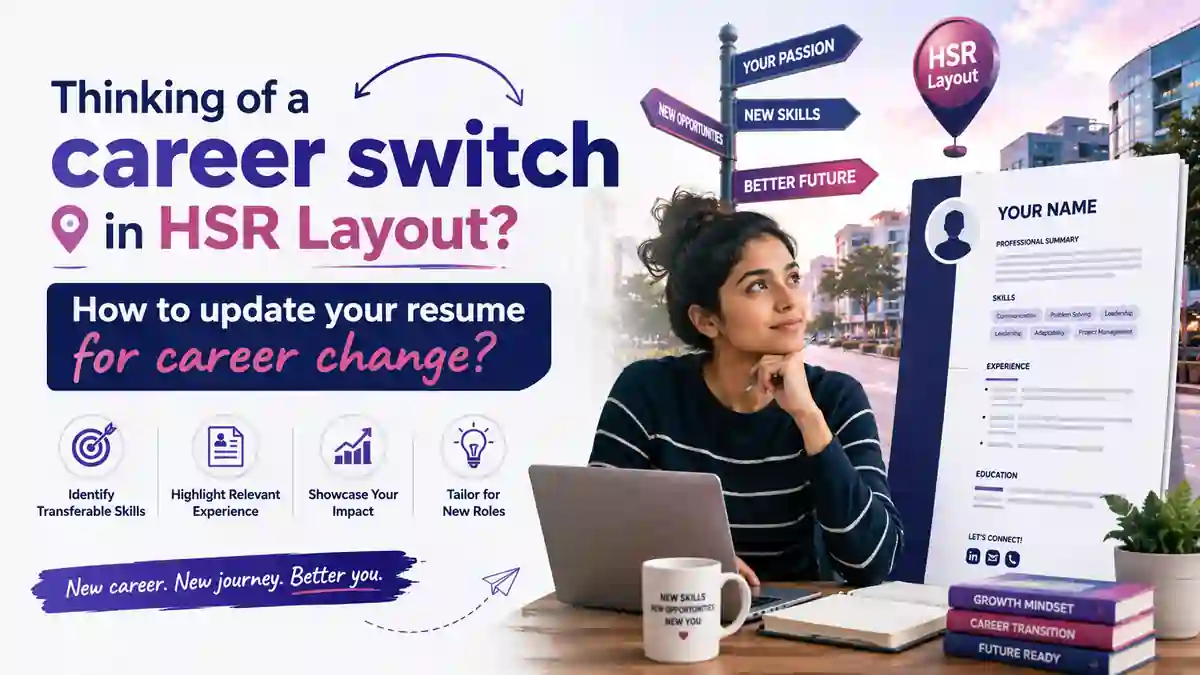
If you are planning a switch from HSR Layout, your resume for career change should highlight transferable skills, measurable achievements, and a clear reason for moving into a new field. The goal is not to hide your past experience, but to reframe it so recruiters see why you are a strong fit for the next role.
Introduction
Changing careers can feel risky, especially if you have spent years building experience in one domain and now want to enter another. But in 2026, career switching is much more common than before, particularly in fast-moving job markets like Bengaluru where professionals from HSR Layout often move between tech, operations, marketing, product, design, and support roles. A well-written resume for career change helps you bridge that gap by showing relevance, not just history.
The biggest mistake career changers make is writing a resume that looks like a chronological work diary. Recruiters do not need every old responsibility; they need proof that your past experience connects to the new role. This article shows how to rewrite your resume in a way that makes the switch feel natural, credible, and job-ready.
Table of Content
-
Why career change resumes are different
-
Best resume format for a career switch
-
How to write a strong summary
-
How to highlight transferable skills
-
How to rewrite work experience
-
What sections to add or remove
-
ATS tips for career changers
-
Sample career change resume structure
-
How Resumeera helps with career switch resumes
-
FAQ
-
Conclusion
[cta va
Why Career Change Resumes Differ
A regular resume shows progression within one field. A resume for career change must do something more important: it must create a bridge between your previous experience and your new target job. That means your resume should answer the recruiter’s biggest question: “Why should we consider this person for a role in a different industry or function?”
This is where many job seekers go wrong. They focus too much on old job titles and not enough on skills that transfer. For example, a customer support professional moving into operations should emphasize process improvement, coordination, reporting, and stakeholder communication rather than just call handling. A teacher moving into corporate training should emphasize presentation, content creation, facilitation, and learner engagement.
If you want a deeper understanding of broad switching strategy, the guide on how to change careers can help you shape the bigger picture before you fine-tune the resume itself.
Best Resume Format
For a resume for career change, the best format is usually a combination format or a skills-forward chronological format. This structure lets you showcase transferable strengths at the top before recruiters see the full work history. That is especially useful when your past job titles do not directly match the job you want now.
A good career switch resume usually begins with a strong summary, followed by skills, then relevant experience, and finally education and certifications. This order helps the recruiter understand your fit quickly. If you want to compare structures, read combination resume format ,functional resume format , and resume format 2026.
Format comparison
| Format | Best for | Strength | Weakness |
|---|---|---|---|
| Chronological | Same-field job seekers | Shows progression clearly | Weak for major career switches |
| Functional | Big career changers | Focuses on skills first | Some recruiters dislike it |
| Combination | Most career changers | Balances skills and history | Must be written carefully |
Write a Strong Summary
The summary is the first place where you make the career change feel logical. In a resume for career change, this section should explain who you are now, what you have done before, and how your background supports your new direction. Keep it short, confident, and specific.
For example, instead of saying “Seeking an opportunity in a new domain,” say “Operations professional with 6 years of experience in process coordination, client communication, and reporting, now transitioning into project management with strong stakeholder handling and workflow optimization skills.” That one statement gives the recruiter a reason to keep reading.
If you need more support writing this part, check profile summary resume and how to write a resume in 2026.
Highlight Transferable Skills
Transferable skills are the heart of a career change resume. These are the abilities you gained in one field that are still valuable in another. Common transferable skills include communication, project coordination, client handling, data analysis, team management, documentation, problem-solving, reporting, and process improvement.
The key is to align these skills with your target job. If you are switching to digital marketing, skills like content coordination, campaign support, Excel reporting, and stakeholder communication are useful. If you are moving into HR, focus on candidate coordination, confidentiality, documentation, and employee communication.
For ideas on which strengths to include, review key skills for resume,personal skills for resume, and resume achievements. These pages help you translate old experience into new value.
Transferable skill examples
-
Communication and client handling.
-
Project coordination and deadline tracking.
-
Data entry, Excel reporting, and analysis.
-
Team collaboration and stakeholder management.
-
Problem-solving and process improvement.
-
Documentation and quality control.
-
Training, mentoring, or presentation experience.
Rewrite Work Experience
Your work experience section should not simply repeat job duties. It should show how your past roles prepared you for the next one. In a resume for career change, every bullet should either prove a transferable skill or support the target role.
Use an achievement-based format: action + task + result. For example, instead of writing “Handled customer queries,” write “Resolved 80+ daily customer issues while improving first-response time by 20% through better ticket tracking and workflow organization.” That version is stronger because it shows measurable impact.
If your previous role was in an unrelated industry, keep the focus on outcomes and systems rather than industry jargon. To write these bullets better, the guide on resume work experience is useful, and resume achievement scan help you quantify your contributions.
Example rewrites
-
“Managed vendor coordination and invoice tracking” can become “Coordinated with 12+ vendors, maintained monthly invoice records, and reduced payment delays through better tracking.”
-
“Worked with team members” can become “Collaborated with cross-functional teams to deliver weekly reports and support deadline-driven tasks.”
-
“Handled training” can become “Trained new joiners on workflow tools, helping reduce onboarding time.”
Add the Right Sections
A resume for career change should include the sections that support your new target role. That may mean adding certifications, projects, freelance work, or short training courses. These sections help fill the gap between your previous career and your new direction.
Education is still important, but it should not dominate the page unless it directly supports the switch. For example, if you studied commerce and now want to enter business analysis, your degree still matters, but your analytics projects and Excel certifications may matter more.
If you are unsure what to include,10 essential resume sections in 2026 and project on the resumeare useful guides.
Sections to include
-
Professional summary.
-
Core skills.
-
Relevant work experience.
-
Career transition projects.
-
Certifications or courses.
-
Education.
-
Achievements.
Sections to remove or reduce
-
Very old irrelevant tasks.
-
Generic hobbies without value.
-
Personal details not needed in modern resumes.
-
Overly long descriptions of unrelated jobs.
ATS Tips for Career Changers
Applicant tracking systems can make career switching harder if your resume does not match the target job language. This is why a resume for career change must include keywords from the job description in a natural way. The more closely your resume matches the role, the better your chances of getting shortlisted.
Do not keyword-stuff the resume. Instead, use the exact phrases recruiters expect where they genuinely fit your experience. For example, if you are switching into project coordination, include terms like workflow management, reporting, stakeholder communication, and timeline tracking.
For a deeper ATS cleanup, read 11 ATS formatting mistakes,5 ways to get your resume past ATS in 2026, and ATS-friendly resume format for beginners.
ATS checklist
-
Use simple section headings.
-
Keep formatting clean and linear.
-
Use keywords from the target role.
-
Avoid charts, graphics, and icons.
-
Save the resume as PDF unless told otherwise.
-
Keep content readable by both software and humans.
Sample Career Change Structure
Here is a practical resume structure you can follow for a resume for career change:
Name
HSR Layout, Bengaluru | phone | email | LinkedIn
Summary
Operations executive with 5 years of experience in process management, reporting, and client communication, now transitioning into project coordination. Strong in stakeholder handling, task ownership, and deadline-driven execution.
Core Skills
Workflow tracking, reporting, Excel, client communication, documentation, process improvement, stakeholder coordination
Professional Experience
Operations Executive – ABC Company
-
Managed daily coordination across internal teams and external vendors.
-
Improved reporting accuracy by standardizing trackers and dashboards.
-
Supported senior management in deadline-based task delivery.
Certifications
Project Management Basics, Excel for Business, Communication Skills
Education
Bachelor of Commerce, XYZ College
This kind of structure keeps your transition clear and credible. It also helps the recruiter see your relevance before they focus on your past job title.
How Resumeera Helps
Resumeera is a free resume builder that can help career switchers in HSR Layout create a clean, effective draft without spending time fighting with design tools. It is especially useful when you are rebuilding your resume from scratch and want a professional layout that stays ATS-friendly.
If you want to compare tools and improve your chances of building a better transition resume, the following links naturally fit into the article: resumeera xyz review 2026,free resume builder no hidden fee, andbest resume builder India 2026.
You can also use AI support to refine your draft by reading 6 ways to use ChatGPT to review your resume.
Conclusion
A career switch is not a weakness; it is a strategy, and your resume should reflect that confidence. If you are changing paths from HSR Layout, the smartest move is to build a resume for career change that highlights transferable skills, measurable results, and a clear connection to your target role. Use Resumeera as a free resume builder to create a strong, ATS-friendly resume that makes your next move feel natural and professional.