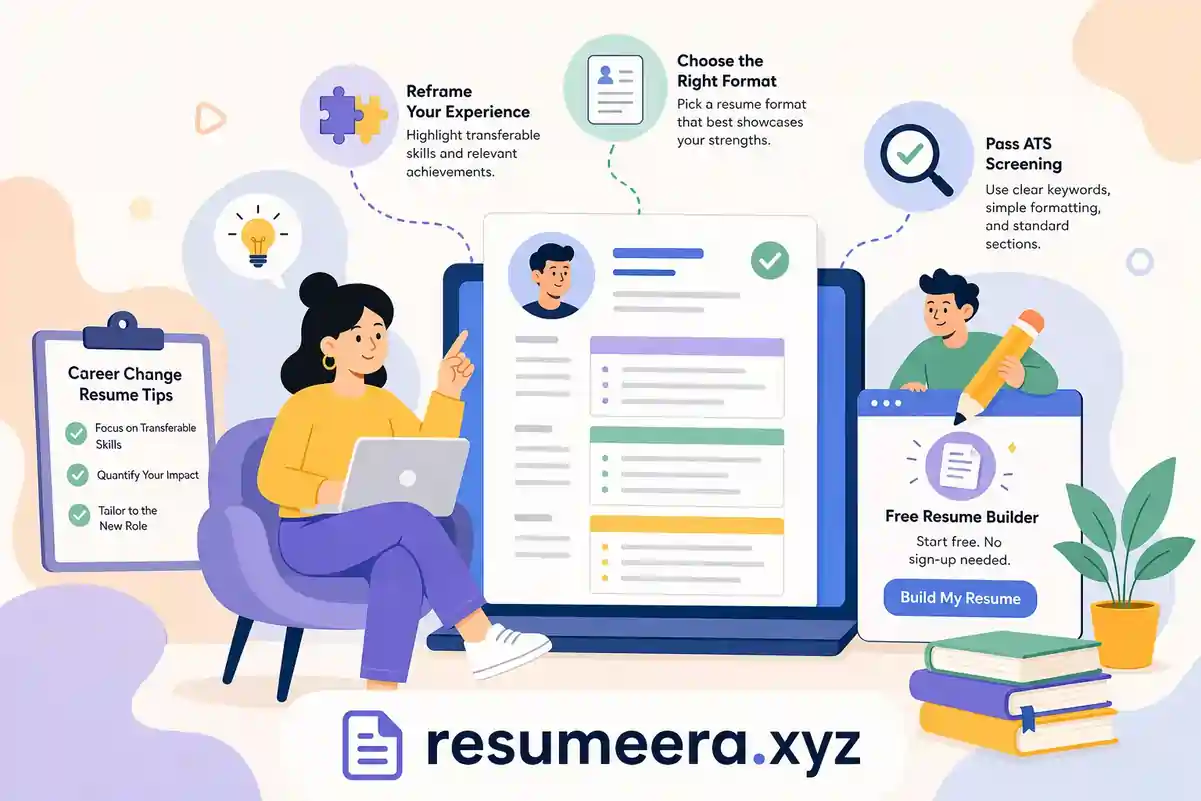
Updating an old resume rarely works for a career pivot. This guide walks Indian job seekers through a full rebuild — format, summary, transferable skills, ATS keywords, and more — section by section.
Updating an old resume for a new industry rarely works. The structure leads with irrelevant titles, the language is built around the wrong field, and the entire document tells the story of a career you're leaving rather than the one you're building. A career transition demands a full rebuild, not a quick polish and a new objective line. These career change resume tips will walk you through exactly how to do that rebuild, section by section — with practical guidance tailored for the Indian job market in 2026, whether you're targeting Naukri.com listings, LinkedIn India opportunities, or direct company applications.
Here's the honest reality: you have real skills and real results behind you. The problem isn't your experience. The problem is that your career pivot resume still reads like it belongs to someone who wants to stay where they are. Recruiters in the new field — whether it's IT, marketing, finance, or healthcare — don't know how to interpret your background, so they move on. This guide fixes that directly.
What this guide covers: How to choose a format that works in your favor, write a summary that reframes your whole story, surface transferable skills with actual evidence, and align every word with what ATS systems and hiring managers are looking for. Career changers can build, test, and download a free ATS-compatible resume on ResumeEra.xyz — no account or subscription required.
In This Guide
-
Pick the Right Format Before You Write Anything Else
-
Write a Career Pivot Summary That Reframes Your Story
-
Surface Transferable Skills with Evidence, Not Labels
-
Rewrite Your Work History in the New Field's Language
-
Prove Readiness with Projects, Certifications, and Coursework
-
ATS Optimization for Career Changers
-
Career Switch Resume Tips Specific to the Indian Job Market
-
Frequently Asked Questions
1. Pick the Right Format Before You Write Anything Else
The most common mistake career changers make is defaulting to a reverse-chronological format because it's familiar. That format leads with your most recent role — which is also the most irrelevant experience to the new field. You're essentially asking a recruiter to read past everything that doesn't apply before they reach anything that does. For a mid-career resume change or a complete industry switch, this format actively works against you.
Why the Combination Format Works Best for a Career Pivot
The combination resume — sometimes called a hybrid format — puts a skills-focused section at the top of the page and places your dated work history below it. This structure lets the recruiter see your transferable value immediately, before they reach the job titles that might not match their expectations. The work history section stays intact, which keeps the resume credible and easy to verify. For anyone following a career change resume format in 2026, the combination layout offers the strongest balance of credibility and relevance.
A purely functional resume hides the timeline and often raises red flags with both hiring managers and ATS systems that can't parse it cleanly. Some recruiters — especially in traditional Indian industries like banking, manufacturing, and government-adjacent roles — view functional resumes with suspicion because they obscure dates and timelines. Combination resumes signal that someone has thought carefully about how to present their experience. That distinction shapes how a recruiter reads everything that follows.
How to Structure a Combination Resume Layout
The basic skeleton looks like this: contact information, a career summary, a core skills or competencies section, professional experience with dates, and then education and certifications. The skills section at the top is where the pivot argument gets made — it's the first place the recruiter sees your value for the new role, before they ever reach the job history that might look unfamiliar. Build this section with intention, and the rest of the resume becomes much easier to read as supporting evidence.
| Format | Best For | Career Changer Risk | ATS Score |
|---|---|---|---|
| Reverse-Chronological | Same-field promotions | High — leads with irrelevant roles | ✅ Excellent |
| Functional | Employment gaps | Medium — hides timeline, raises suspicion | ⚠️ Poor |
| Combination / Hybrid | Career pivot (recommended) | Low — skills first, history second | ✅ Good |
? Build your career change resume free on ResumeEra.xyz — ATS-compatible combination and hybrid templates, instant PDF download, no signup needed.
2. Write a Career Pivot Summary That Reframes Your Entire Story
For a career changer, the summary section has one specific job to do: connect your past experience to future value in three to four sentences. If the recruiter doesn't see that connection quickly, they stop reading. A vague objective statement like "seeking a challenging opportunity" does nothing here — and in the competitive Indian job market of 2026, where recruiters on Naukri.com and LinkedIn India often scan hundreds of applications per week, you need specificity and forward momentum. This is one of the most critical career switch resume tips you'll apply — get this section right and the rest of the document becomes far easier to sell.
The Formula for a Strong Resume Summary for Career Change
A working summary has three parts. First, establish who you are in terms of the new role you're targeting. Second, name two or three transferable skills or accomplishments drawn directly from your background. Third, state what you're ready to deliver going forward. The vocabulary throughout needs to reflect the target industry, not the one you're leaving. Recruiters and ATS systems both respond to language that matches the job description. Using your old field's terminology signals that you haven't made the mental shift yet.
What Real Career Pivot Summaries Look Like
A teacher moving into corporate learning and development might write:
Example: Teacher → Instructional Designer

"Accomplished educator with 8 years of experience in curriculum development, group facilitation, and measuring learning outcomes, transitioning into instructional design. Skilled at simplifying complex material, adapting content for diverse audiences, and improving performance through structured training programs."
A sales professional pivoting to marketing might open with:
Example: Sales → Digital Marketing

"Results-driven sales professional with 6 years of experience analysing buyer behaviour and exceeding revenue targets, now transitioning into digital marketing. Brings persuasive communication, data-driven decision-making, and deep customer insight to campaign strategy and audience engagement."
Notice how each summary leads with value for the new employer — not an explanation of why the person is switching fields. For a broader roadmap on making this transition work, see the complete guide on how to change careers successfully in 2026 for Indian professionals.
3. Surface Your Transferable Skills with Evidence, Not Labels
The single biggest error in this section is listing generic skill labels with nothing to support them. "Strong communicator." "Natural leader." "Team player." These phrases appear on nearly every resume and mean nothing to a recruiter scanning for proof. Labels are claims. Evidence is what gets interviews — and what gets your job change resume past ATS filters.
Which Skills Carry Across Almost Any Industry
Communication, problem-solving, collaboration, adaptability, and project management show up on job descriptions across virtually every field in India — from IT services to FMCG, from banking to edtech. These aren't soft skills in the dismissive sense; they're the operational capabilities that make any role function. Every organisation needs people who can solve problems, work with others, and adapt when conditions change. They belong on a career transition resume, but they need to be shown, not just named.
How to Phrase Transferable Skills So They Actually Land
Turn every skill label into an accomplishment statement:
- "Strong communicator" → "Presented findings to senior stakeholders weekly, reducing meeting follow-up time by 30%"
- "Project management skills" → "Coordinated a cross-functional team of eight across two time zones to deliver a product launch two weeks ahead of schedule"
- "Data analysis" → "Built Excel dashboards tracking 15 KPIs that cut weekly reporting time from 4 hours to 45 minutes"
- "Leadership" → "Mentored 5 junior team members; 3 were promoted within 18 months"
Go back through your old job descriptions and look for the results you produced. Then repackage those results using the vocabulary of the new field. This is the moment the resume stops looking like a record of the past and starts looking like a case for hiring you.
4. Rewrite Your Work History in the New Field's Language
A work history written entirely in your old industry's terminology reads as irrelevant even when the underlying experience is genuinely strong. A former supply chain manager and a former hospital operations coordinator may have nearly identical functional skills — but if the supply chain manager's resume is full of logistics jargon and they're applying to healthcare operations in India, the connection disappears. The goal is translation, not fabrication.
Choose Action Verbs That Resonate with the Target Role
Pull your action verbs directly from job postings in the target field on Naukri.com, LinkedIn India, or Indeed India. Achievement verbs like delivered, improved, and optimised work across industries. Leadership verbs like led, coordinated, and spearheaded carry strong signals. Analysis verbs like assessed, evaluated, and implemented land well in data-adjacent and operations roles. ATS systems score based on verb-and-keyword combinations pulled from the job description, so the closer your language mirrors the posting, the stronger your match rate tends to be.
Reframe Job Title Descriptions and Bullet Points
Read three to five job postings in your target field and note the phrases that repeat most often. Then use those exact phrases in your experience bullets — applied honestly to what you actually did. A former teacher who "developed curriculum for 120 students" can accurately reframe that as: "designed and delivered training content for groups of up to 120, tracking performance outcomes and adjusting materials based on results data." The experience is the same. The framing speaks to the new employer. This is the core skill of writing a strong resume for career switchers: knowing which parts of your history to translate, and how.
5. Prove Readiness with Projects, Certifications, and Coursework
The common anxiety here is straightforward: what if none of my work experience is directly relevant to the new field? The answer is that projects, volunteer roles, certifications, and coursework can close that gap — provided they're placed and formatted to carry real weight. In the Indian job market, recruiters are increasingly accepting certifications from platforms like Coursera, NASSCOM FutureSkills, NIIT, and Simplilearn as valid proof of readiness, particularly for IT and digital marketing transitions.
Where These Credentials Belong on a Career Change Resume
Relevant volunteer work formatted exactly like a paid job entry belongs in the Professional Experience section, complete with a title, organisation name, dates, and accomplishment-focused bullets. Certifications from recognised issuers such as Google, HubSpot, AWS, CompTIA, PMI, NIIT, or NASSCOM FutureSkills get their own dedicated section with the issuer name and the date earned. Relevant coursework belongs as a subsection under Education when formal experience in the target field is thin.
How to Format Non-Traditional Experience So It Looks Credible
Use the same bullet structure and outcome focus that you use for paid work:
Example: Non-Traditional Entry

Volunteer UX Researcher | [Nonprofit Name] | 2025

Conducted usability testing with 12 participants and identified key navigation issues that measurably reduced drop-off. Delivered findings in a structured report adopted by the development team.
That kind of specificity reads completely differently from a vague mention of "some volunteer UX work." Consistent formatting and concrete detail are what turn non-traditional experience into credible proof. For guidance on building the right template structure, see career change resume format 2026 on ResumeEra.xyz.
6. ATS Optimization for Career Changers: Get Past the Filter
A career change resume with strong content can still get filtered out before a human ever reads it. ATS systems — used by most mid-size to large companies in India — match keyword strings against job descriptions, and a pivot resume often lacks the exact vocabulary the system is scanning for. Speaking the same language as the posting is how you fix that.
How to Extract the Right Keywords from Any Job Posting
Paste three to five job descriptions from your target role (from Naukri.com, LinkedIn India, or company career pages) into a text editor and look for the skills, tools, titles, and phrases that appear most often. Those are the terms ATS systems weight most heavily. Mirror that language in your summary, skills section, and experience bullets.
One important note: "project coordination" and "project management" are not interchangeable to many ATS systems — exact phrasing often carries more weight than a synonym you prefer. If the posting says "stakeholder communication," that exact phrase should appear in your resume.
Final Formatting Checks Before You Send
An ATS-friendly career change resume requires clean formatting. Avoid:
- Tables and text boxes that break parser logic
- Multi-column layouts that confuse ATS reading order
- Creative section headers (use "Work Experience," not something clever)
- Graphics, icons, or charts embedded in the resume document
Save and submit as a PDF unless the application specifically requests a DOCX file. ResumeEra.xyz's free ATS-compatible resume builder uses clean, parser-friendly templates by design — career changers can work through different layout options and download a polished version without creating an account.
7. Career Switch Resume Tips for the Indian Job Market
The Indian job market has specific conventions that a generic career change guide won't cover. Here are the additional considerations that matter for career change resume India 2026 applications.
Naukri.com and LinkedIn India Profile Alignment
In India, recruiters cross-check your resume against your Naukri.com profile and LinkedIn India profile as a matter of routine. Your career pivot summary, current title (you can use "Career Transition | [Target Role]"), and key skills should be consistent across all three documents. A mismatch between your resume and your Naukri profile raises immediate suspicion during screening.
Which Sectors Welcome Career Changers in India Right Now
As of mid-2026, the sectors with the highest mid-career entry tolerance in India include:
- IT services and SaaS: Candidates with domain knowledge from finance, healthcare, or manufacturing are valued for pre-sales and implementation roles
- Digital marketing: Performance marketing and SEO roles actively hire from sales, journalism, and content backgrounds
- Edtech and L&D: Teachers, trainers, and subject matter experts are in demand as instructional designers
- BFSI operations: Operations and compliance roles welcome candidates from regulated industries
- Startups (Series A–C): Indian startups often value cross-functional versatility over exact title matches
Certifications That Add Weight in India
Indian recruiters and ATS systems recognise these certification bodies as credible signals of readiness for a career switch:
- Google Career Certificates (IT Support, Data Analytics, Project Management, UX Design)
- AWS, Microsoft Azure, or Google Cloud (for IT transitions)
- HubSpot Academy (marketing and sales transitions)
- NASSCOM FutureSkills and NIIT courses (IT and digital transformation)
- PMI PMP or CAPM (for project management pivots)
- NISM certifications (for BFSI sector transitions)
If you're navigating a local job market, you may also find practical tips specific to your city and sector — for instance, how to update your resume for a career change in HSR Layout, Bengaluru.
Ready to Build Your Career Change Resume?
Use ResumeEra.xyz's free ATS-compatible resume builder — professional combination and hybrid templates for career switchers, with instant PDF download. No account, no subscription, no barriers.
Build My Career Change Resume — Free on ResumeEra.xyzTrusted by thousands of Indian job seekers · No sign-up required
Put These Moves Together and Start Sending
A career change is not a liability on a resume when the document is built to make the case for the new direction rather than document the old one. The format, the summary, the skills framing, and the keyword choices all work together to shift the recruiter's first impression — from "this person is from the wrong field" to "this person has exactly what we need." That shift is the entire goal of a well-built career switch resume.
Use these career change resume tips as you tailor each application: lead with a combination resume format optimised for 2026, write a summary that connects past to future, back up transferable skills with specific proof, reframe your work history in the target field's language, and confirm your ATS keyword alignment before you submit. Work from a specific job posting rather than writing in the abstract — the resume must be tailored to that role.