Page Summary
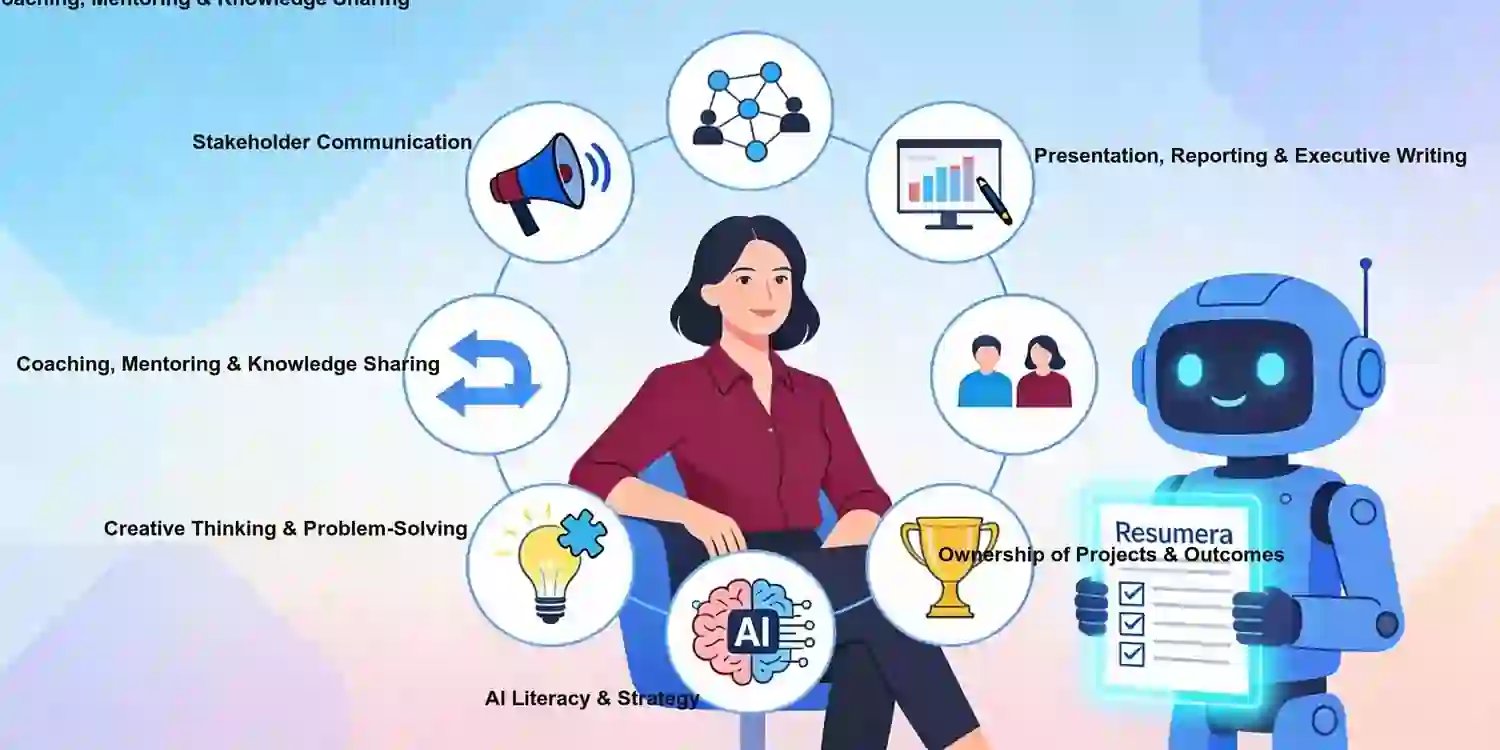
Transitioning into a leadership role in 2026 doesn't require a traditional management title—it requires demonstrating leadership behaviors and competencies on your resume. This comprehensive guide reveals the seven essential skills employers seek when evaluating candidates for management positions: stakeholder communication, stakeholder management, executive presentation skills, coaching and mentoring, creative problem-solving, AI literacy, and ownership mentality. You'll discover how to reframe your existing experience to showcase leadership potential, even without formal headcount responsibility. Learn the exact resume bullet points, power verbs, and formatting strategies that transform an individual contributor resume into a leadership-ready document. Whether you're aiming for your first management role or advancing to senior leadership, this article provides actionable frameworks to position yourself as a qualified leader in India's competitive 2026 job market.
Table of Contents
-
Introduction: Leadership Is About Behaviors, Not Just Titles
-
What Are Leadership Skills in 2026?
-
Why Leadership Skills Matter on Your Resume
-
The 7 Essential Leadership Skills for Your Resume
-
Skill 1: Stakeholder Communication
-
Skill 2: Stakeholder Management
-
Skill 3: Presentation, Reporting & Executive Writing
-
Skill 4: Coaching, Mentoring & Knowledge Sharing
-
Skill 5: Creative Thinking & Problem-Solving
-
Skill 6: AI Literacy & Strategy
-
Skill 7: Ownership of Projects & Outcomes
-
-
Power Verbs That Demonstrate Leadership
-
How to Format Leadership Skills on Your Resume
-
Resume Examples for Leadership Roles
-
Key Takeaways
-
Frequently Asked Questions
-
Conclusion
Introduction: Leadership Is About Behaviors, Not Just Titles
One of the biggest misconceptions about climbing the career ladder is that you need a management title to prove you're leadership material. The truth? Leadership is demonstrated through behaviors, competencies, and outcomes—not hierarchical positions.
In 2026, employers are actively seeking candidates who exhibit leadership qualities regardless of their formal job titles. Whether you're an individual contributor eyeing your first management role, a team lead aiming for senior leadership, or a professional pivoting into a managerial track, your resume must reflect leadership potential through concrete evidence.
Global research shows that job advertisements increasingly emphasize "power skills" including leadership, communication, and strategic thinking. The World Economic Forum's Future of Jobs Report consistently highlights leadership and social influence as top competencies needed in the evolving workplace. Indian companies, from startups to multinational corporations, are prioritizing candidates who can inspire teams, drive results, and navigate complexity—all leadership hallmarks.
This guide breaks down the seven critical skills you must showcase on your resume to position yourself for leadership opportunities in 2026. You'll learn exactly how to frame your experience, which action verbs amplify your impact, and the specific bullet point formulas that hiring managers look for when evaluating leadership potential.
Before we dive in, ensure your resume foundation is solid by reviewing our guide on how to write a resume in 2026 and understanding ATS-friendly resume formats that get past applicant tracking systems.
What Are Leadership Skills in 2026?
Leadership skills are the competencies and behaviors that enable you to guide people, manage projects, make strategic decisions, and deliver organizational outcomes. Unlike technical skills specific to a job function, leadership skills are transferable across industries and roles.
Core Components of Leadership
When stripped to essentials, leadership encompasses:
-
People Management: Motivating, coaching, and developing individuals and teams
-
Strategic Thinking: Setting direction, making decisions aligned with organizational goals
-
Stakeholder Influence: Building relationships, managing expectations, driving consensus
-
Accountability: Taking ownership of outcomes—both successes and failures
-
Communication: Translating vision into action through clear, compelling messaging
-
Adaptability: Navigating change, uncertainty, and complexity with resilience
Leadership in the Age of AI
2026 brings a unique dimension to leadership: AI integration. Modern leaders must understand how to leverage artificial intelligence tools while maintaining the human-centric skills that technology cannot replicate. This means combining data-driven decision-making with emotional intelligence, using AI for efficiency while preserving creativity and original thinking.
Employers now evaluate leadership candidates on their ability to:
-
Implement AI workflows ethically and strategically
-
Balance automation with human judgment
-
Lead teams through digital transformation
-
Upskill themselves and others in emerging technologies
Pro tip: If you're wondering whether to use AI for your resume, read our comprehensive guide on should you use AI to write your resume to understand best practices.
Why Leadership Skills Matter on Your Resume The Hiring Manager's Perspective
When recruiters review resumes for leadership positions, they scan for evidence that you can:
-
Drive Results: Deliver measurable outcomes beyond individual contributions
-
Influence Without Authority: Lead peers, cross-functional teams, or projects without formal reporting lines
-
Scale Impact: Move from executing tasks to enabling others to execute
-
Think Strategically: Consider broader organizational implications, not just immediate deliverables
-
Grow Talent: Develop others through mentorship, coaching, and knowledge transfer
The Indian Job Market Context
India's corporate landscape in 2026 increasingly values leadership pipeline development. Companies are looking to promote from within, identifying high-potential employees who demonstrate leadership behaviors early in their careers. This is especially true in:
-
Tech startups scaling rapidly and needing managers who can build teams
-
Traditional corporations undergoing digital transformation requiring change leaders
-
Service industries (IT, consulting, BPO) where client-facing leadership is critical
-
Manufacturing and logistics sectors needing operational excellence leaders
Your resume is your first opportunity to signal that you're not just performing your current role well—you're ready for the next level.
For insights into high-growth career paths, explore our article on 21 high-paying in-demand jobs for the future.
The 7 Essential Leadership Skills for Your Resume
Skill 1: Stakeholder Communication
What It Is:
Stakeholder communication is the ability to tailor your message to different audiences—peers, team members, senior executives, clients, external partners, and even regulatory bodies. Effective leaders translate complex concepts into language that resonates with each stakeholder's priorities and knowledge level.
Why It Matters:
Leadership roles require constant communication across organizational hierarchies. You might present high-level strategic updates to C-suite executives in the morning, explain technical details to your team in the afternoon, and negotiate with vendors in the evening. Each conversation demands a different communication approach.
How to Demonstrate It:
Showcase instances where you:
-
Presented to senior leadership or boards
-
Communicated project updates across departments
-
Translated technical jargon for non-technical audiences
-
Facilitated cross-functional meetings or workshops
-
Represented your team or department in company-wide forums
Resume Bullet Point Examples:
✅ "Presented quarterly business reviews to VP-level stakeholders, summarizing project progress, risks, and resource requirements"
✅ "Delivered technical training to 50+ non-technical staff members, simplifying complex data analytics concepts into actionable insights"
✅ "Coordinated communication between engineering, product, and sales teams to align on product launch timelines and customer expectations"
Power Verbs: Presented, communicated, facilitated, coordinated, translated, delivered
Common Mistakes to Avoid:
❌ "Assisted with presentations" (passive, diminishes your role)
❌ "Attended stakeholder meetings" (no demonstration of active contribution)
For more on structuring your resume sections effectively, see our guide on 10 essential resume sections in 2026.
Skill 2: Stakeholder Management
What It Is:
Stakeholder management goes beyond communication—it's the art of balancing competing priorities, managing expectations, negotiating trade-offs, and building consensus among groups with different interests. This skill is critical in matrix organizations where you must influence without direct authority.
Why It Matters:
Projects rarely succeed in isolation. Leaders must navigate organizational politics, align diverse perspectives, and secure buy-in from stakeholders who may have conflicting goals. Strong stakeholder management accelerates decision-making and reduces friction.
How to Demonstrate It:
Highlight experiences where you:
-
Managed expectations across multiple departments
-
Negotiated resources or timelines with competing teams
-
Built consensus among stakeholders with different viewpoints
-
Served as liaison between technical and business units
-
Resolved conflicts or misalignments between groups
Resume Bullet Point Examples:
✅ "Acted as primary liaison between finance, operations, and marketing departments to deliver $2M product launch, resolving 15+ conflicting requirements through structured negotiation"
✅ "Managed stakeholder expectations across 8 regional offices, aligning on unified implementation strategy that reduced deployment time by 30%"
✅ "Navigated competing priorities between engineering and customer success teams to balance feature development with bug fixes, improving customer satisfaction scores by 25%"
Power Verbs: Managed, negotiated, aligned, coordinated, balanced, resolved
Pro Tip: Quantify the number of stakeholders, departments, or competing priorities you managed to demonstrate scope and complexity.
Skill 3: Presentation, Reporting & Executive Writing Skills
What It Is:
Executive-level communication requires the ability to distill complex information into clear, decision-oriented documents. This includes creating executive summaries, board presentations, business cases, strategic recommendations, and data-driven reports that inform leadership decisions.
Why It Matters:
As you move into leadership, you'll spend less time executing tasks and more time communicating strategy, analyzing performance, and recommending actions. Senior leaders don't have time for lengthy explanations—they need concise, structured insights that support decision-making.
How to Demonstrate It:
Show evidence of:
-
Creating executive summaries or board decks
-
Writing business cases or proposals
-
Producing recurring reports for leadership review
-
Developing strategic recommendations based on data analysis
-
Documenting lessons learned or post-mortem analyses
Resume Bullet Point Examples:
✅ "Prepared monthly executive dashboards for C-suite summarizing key performance metrics, risk factors, and strategic recommendations, directly influencing $5M budget allocation decisions"
✅ "Authored 10+ business cases for new initiatives, resulting in approval of 7 projects worth $12M in total investment"
✅ "Developed quarterly performance reports analyzing sales trends, competitive landscape, and market opportunities, informing go-to-market strategy adjustments"
Power Verbs: Prepared, authored, developed, produced, documented, analyzed
For guidance on creating compelling career documents, check our article on how to write a cover letter that gets you hired.
Skill 4: Coaching, Mentoring & Knowledge Sharing
What It Is:
Even without formal direct reports, you can demonstrate people development skills through peer mentoring, onboarding support, knowledge transfer, and providing constructive feedback. This skill shows you can elevate others' performance—a core leadership responsibility.
Why It Matters:
Leaders are force multipliers. Your value isn't just in your individual output but in your ability to develop talent, build institutional knowledge, and create learning cultures. Employers assess leadership potential by looking for evidence that you've helped others grow.
How to Demonstrate It:
Include examples of:
-
Mentoring junior colleagues or new hires
-
Creating training materials or documentation
-
Leading lunch-and-learn sessions or workshops
-
Providing peer feedback or conducting code/work reviews
-
Onboarding team members or cross-training colleagues
Resume Bullet Point Examples:
✅ "Mentored 5 junior analysts through 12-month onboarding program, resulting in 40% faster ramp-up time and 95% retention rate compared to non-mentored hires"
✅ "Developed comprehensive training curriculum for new sales representatives, reducing time-to-first-deal from 90 to 60 days"
✅ "Led weekly knowledge-sharing sessions on advanced Excel techniques, upskilling 20+ team members and improving reporting efficiency by 35%"
Power Verbs: Mentored, coached, trained, developed, guided, upskilled
Important: Even if you've never had direct reports, peer mentoring and knowledge sharing demonstrate leadership readiness. For those returning to the workforce, our guide on writing the perfect return-to-workforce resume offers valuable insights.
Skill 5: Creative Thinking & Problem-Solving
What It Is:
Creative problem-solving involves approaching challenges with fresh perspectives, designing innovative solutions, and thinking beyond established processes. In 2026, this is ranked as the #1 essential skill for the future of work—especially as AI handles routine tasks, leaving humans to tackle novel, complex problems.
Why It Matters:
Leaders are expected to navigate ambiguity, solve unprecedented challenges, and drive innovation. Employers look for candidates who demonstrate initiative, original thinking, and the ability to create systems or processes that didn't exist before.
How to Demonstrate It:
Showcase instances where you:
-
Identified problems others overlooked
-
Created new processes or systems that improved efficiency
-
Proposed innovative solutions to longstanding challenges
-
Took initiative beyond your job description
-
Redesigned workflows or approaches for better outcomes
Resume Bullet Point Examples:
✅ "Identified bottleneck in customer onboarding process and designed automated workflow using Zapier, reducing onboarding time from 5 days to 2 days and eliminating 15 hours of manual work weekly"
✅ "Spearheaded implementation of agile methodology in traditionally waterfall environment, shortening product development cycles by 40% and improving team collaboration scores by 50%"
✅ "Created predictive analytics dashboard combining sales, marketing, and customer data to forecast churn risk 30 days in advance, enabling proactive retention interventions"
Power Verbs: Identified, designed, spearheaded, created, innovated, reimagined, pioneered
AI Context: In the age of AI-generated content, your originality and creative direction as a human problem-solver become even more valuable. For AI-related career strategies, explore 15 best AI tools for job seekers.
Skill 6: AI Literacy & Strategy
What It Is:
AI literacy in leadership context goes far beyond using ChatGPT or copying AI-generated content. It encompasses understanding AI's strategic applications, ethical implications, workflow integration, risk management, and knowing when human judgment must override automation.
Why It Matters:
2026 leaders must navigate the AI revolution—implementing tools that enhance productivity while maintaining quality, ethics, and human-centric decision-making. Employers seek candidates who can lead digital transformation, not just participate in it.
How to Demonstrate It:
Highlight experiences with:
-
Implementing AI tools or automation workflows
-
Evaluating AI solutions for business applications
-
Training teams on AI tool usage
-
Developing AI governance or ethical frameworks
-
Measuring AI impact on productivity or outcomes
-
Balancing automation with human oversight
Resume Bullet Point Examples:
✅ "Designed and implemented AI-powered customer service chatbot using Dialogflow, handling 60% of routine inquiries and freeing support team to focus on complex issues, improving first-response time by 45%"
✅ "Led cross-functional task force to evaluate AI content generation tools, developing governance framework that balanced efficiency gains with brand quality standards"
✅ "Created automated reporting system using Python and machine learning algorithms, reducing monthly reporting time from 20 hours to 2 hours while improving forecast accuracy by 15%"
Power Verbs: Implemented, designed, led, developed, automated, optimized, integrated
Strategic Approach: Don't just list AI tools you've used—explain the strategic thinking behind implementation and the measurable business impact. Learn more about leveraging AI effectively in 6 ways to use ChatGPT to review your resume.
Skill 7: Ownership of Projects & Outcomes
What It Is:
Ownership means taking full accountability for results—celebrating successes humbly and learning from failures transparently. It involves driving projects from conception to completion, making decisions with imperfect information, and viewing challenges as personal responsibility rather than external obstacles.
Why It Matters:
Leaders are ultimately responsible for outcomes, not just activities. Employers assess your readiness for leadership by evaluating whether you take initiative, see projects through completion, and demonstrate accountability when things don't go as planned.
How to Demonstrate It:
Include examples where you:
-
Drove end-to-end project delivery
-
Took initiative without being asked
-
Recovered projects from setbacks or failures
-
Made critical decisions with limited guidance
-
Delivered results despite resource constraints
-
Conducted post-mortems and implemented lessons learned
Resume Bullet Point Examples:
✅ "Managed end-to-end delivery of CRM implementation project ($500K budget, 6-month timeline), coordinating 15 stakeholders across 4 departments and delivering on-time, on-budget with 100% user adoption within 60 days"
✅ "Took ownership of failing customer retention initiative, conducted root-cause analysis, redesigned approach based on customer feedback, and improved retention rate from 65% to 82% within one quarter"
✅ "Initiated and led cost-reduction analysis without directive, identifying $200K in annual savings through vendor consolidation and process optimization"
Power Verbs: Managed, drove, delivered, spearheaded, led, orchestrated, executed, achieved
Accountability Demonstration: When possible, include how you handled setbacks or pivoted strategies—this shows mature leadership thinking.
Power Verbs That Demonstrate Leadership
Words matter on your resume. The verbs you choose either amplify or diminish your leadership presence.
Avoid These Passive Phrases:
❌ "Assisted with..."
❌ "Supported..."
❌ "Helped with..."
❌ "Was responsible for..."
❌ "Participated in..."
❌ "Involved in..."
These phrases suggest you were a contributor but not the driver—acceptable for junior roles, but problematic when positioning for leadership.
Use These Leadership Power Verbs:
Strategic Leadership:
-
Spearheaded
-
Orchestrated
-
Pioneered
-
Championed
-
Directed
-
Drove
Execution & Delivery:
-
Delivered
-
Executed
-
Achieved
-
Launched
-
Implemented
-
Completed
Team & People:
-
Led
-
Managed
-
Mentored
-
Coached
-
Developed
-
Guided
Innovation & Improvement:
-
Redesigned
-
Transformed
-
Optimized
-
Streamlined
-
Innovated
-
Revolutionized
Communication & Influence:
-
Presented
-
Negotiated
-
Facilitated
-
Aligned
-
Secured
-
Persuaded
Creation & Initiative:
-
Created
-
Designed
-
Established
-
Founded
-
Initiated
-
Built
Formula for Maximum Impact:
[Power Verb] + [What You Did] + [Measurable Result] + [Business Impact]
Example: "Spearheaded cross-functional quality improvement initiative, reducing product defects by 35%, saving $150K annually in warranty costs"
For more resume writing strategies, explore our new year new resume tips for 2026.
How to Format Leadership Skills on Your Resume
1. Professional Summary Section
Open your resume with a leadership-oriented summary that immediately positions you for the role:
Example:
"Results-driven professional with 7+ years of experience leading cross-functional initiatives and driving operational excellence. Proven ability to manage stakeholder relationships, mentor high-performing teams, and deliver complex projects on time and under budget. Seeking to leverage strategic thinking and people development expertise in a Senior Manager role."
2. Skills Section
Create a dedicated "Leadership & Management Skills" section:
Example:
-
Stakeholder Management & Communication
-
Project Leadership & Delivery
-
Team Mentoring & Development
-
Strategic Planning & Execution
-
AI Strategy & Implementation
-
Change Management
-
Budget & Resource Management
3. Experience Section
This is where you demonstrate leadership through concrete examples. Structure each bullet point using the CAR method (Challenge-Action-Result):
Template:
"[Power Verb] [Action taken] to address [Challenge/Context], resulting in [Quantifiable Result]"
Example:
"Led 8-person cross-functional team to redesign customer feedback process, reducing response time from 72 to 24 hours and improving NPS scores by 28 points"
4. Projects or Leadership Highlights Section
If you lack formal management experience, create a separate section highlighting leadership projects:
Example Section Title: "Leadership Initiatives" or "Key Projects Led"
Include:
-
Project name and objective
-
Your leadership role
-
Team size (if applicable)
-
Outcome and business impact
5. Professional Development
Include leadership training, certifications, or courses:
-
Leadership Development Programs
-
Management Training Certifications
-
Executive Education Courses
-
Industry-recognized leadership credentials
For comprehensive formatting guidance, review our 9 basic resume templates for 2026 and learn about ATS formatting mistakes to avoid.
Resume Examples for Leadership Roles Example
1: Individual Contributor Transitioning to Team Lead
Before (Weak):
"Responsible for customer support tickets and helped train new team members"
After (Leadership-Focused):
"Managed escalated customer issues with 95% resolution rate, mentored 3 junior support specialists through comprehensive onboarding program, and designed knowledge base that reduced ticket volume by 20%"
Example 2: Project Coordinator Aiming for Project Manager
Before (Weak):
"Assisted project manager with scheduling and documentation"
After (Leadership-Focused):
"Coordinated cross-functional project team of 12 members across 3 departments, managed project timeline and deliverables using Jira, and delivered 6 projects on schedule with average budget variance under 5%"
Example 3: Senior Professional Seeking Director Role
Before (Weak):
"Led team of 5 analysts and worked on strategic initiatives"
After (Leadership-Focused):
"Directed high-performing analytics team of 5, developed talent pipeline resulting in 2 internal promotions, spearheaded data governance initiative adopted company-wide, and presented quarterly insights to C-suite influencing $10M investment decisions"
Example 4: First-Time Manager Resume Summary
Leadership-Oriented Summary:
"Strategic thinker with 5 years of experience driving operational improvements and leading cross-functional initiatives in the technology sector. Demonstrated expertise in stakeholder management, process optimization, and team development. Recognized for transforming underperforming projects through creative problem-solving and collaborative leadership. Eager to transition proven leadership capabilities into formal management role."
For specific scenarios like career changes or unique situations, explore how to change careers: complete guide for Indian professionals.

Key Takeaways
✅ Leadership is behavioral, not positional – You don't need a management title to demonstrate leadership skills on your resume
✅ Focus on the 7 essential skills: Stakeholder communication, stakeholder management, executive writing, coaching/mentoring, creative problem-solving, AI literacy, and ownership
✅ Use power verbs – Replace passive language (assisted, helped) with active leadership verbs (led, spearheaded, delivered, managed)
✅ Quantify your impact – Include measurable results that demonstrate the business value of your leadership actions
✅ Showcase AI competency – 2026 leadership requires strategic AI implementation, not just basic tool usage
✅ Demonstrate ownership – Highlight end-to-end project delivery and accountability for both successes and failures
✅ Format strategically – Use CAR method (Challenge-Action-Result) for bullet points that tell compelling leadership stories
✅ Create evidence without titles – Leverage peer mentoring, cross-functional projects, and initiative-taking to build leadership credentials
✅ Think like a hiring manager – Employers evaluate leadership potential through behaviors, competencies, and proven impact, not just job titles
✅ Optimize for ATS and humans – Balance keyword optimization with compelling narratives that resonate with decision-makers
Conclusion
Upgrading your resume for a leadership role in 2026 isn't about inventing experience you don't have—it's about reframing the leadership behaviors you've already demonstrated through strategic language, powerful examples, and quantifiable results.
You've learned that leadership transcends job titles. Whether you're an individual contributor mentoring junior colleagues, a project coordinator managing stakeholder expectations, or a senior professional ready to formalize your leadership role, the seven skills outlined in this guide—stakeholder communication, stakeholder management, executive presentation, coaching and mentoring, creative problem-solving, AI literacy, and ownership—form the foundation of effective leadership in India's 2026 job market.
The key differentiators that will set your resume apart are:
Specificity: Replace vague descriptions with concrete examples of challenges faced, actions taken, and results achieved
Quantification: Use numbers, percentages, and measurable outcomes to demonstrate business impact
Active Language: Employ power verbs that position you as the driver, not the supporter
Strategic Positioning: Frame every experience through the lens of "How did this demonstrate leadership?"
Remember that employers aren't just hiring for your current capabilities—they're investing in your potential to grow, lead, and drive organizational success. Your resume must tell a compelling story of someone who thinks like a leader, acts like a leader, and delivers like a leader, even before the title makes it official.
As you craft or revise your leadership resume, leverage the resources available at ResumeEra. Whether you need ATS-friendly formatting, winning CV templates, or guidance on international resumes, our comprehensive guides will help you create a document that opens doors to leadership opportunities.
Leadership begins with self-leadership—taking ownership of your career trajectory, proactively developing the competencies employers seek, and positioning yourself as the solution to their leadership needs. Your resume is the first step in that journey.
Start implementing these strategies today, and transform your resume from a passive record of responsibilities into a powerful narrative of leadership potential. The management role you're targeting in 2026 is within reach—your resume just needs to make that undeniably clear.
For additional support, explore our complete free resume builder analysis and learn 16 proven interview tips to complement your powerful resume with equally strong interview performance.
Your leadership journey starts now—make your resume reflect that ambition.