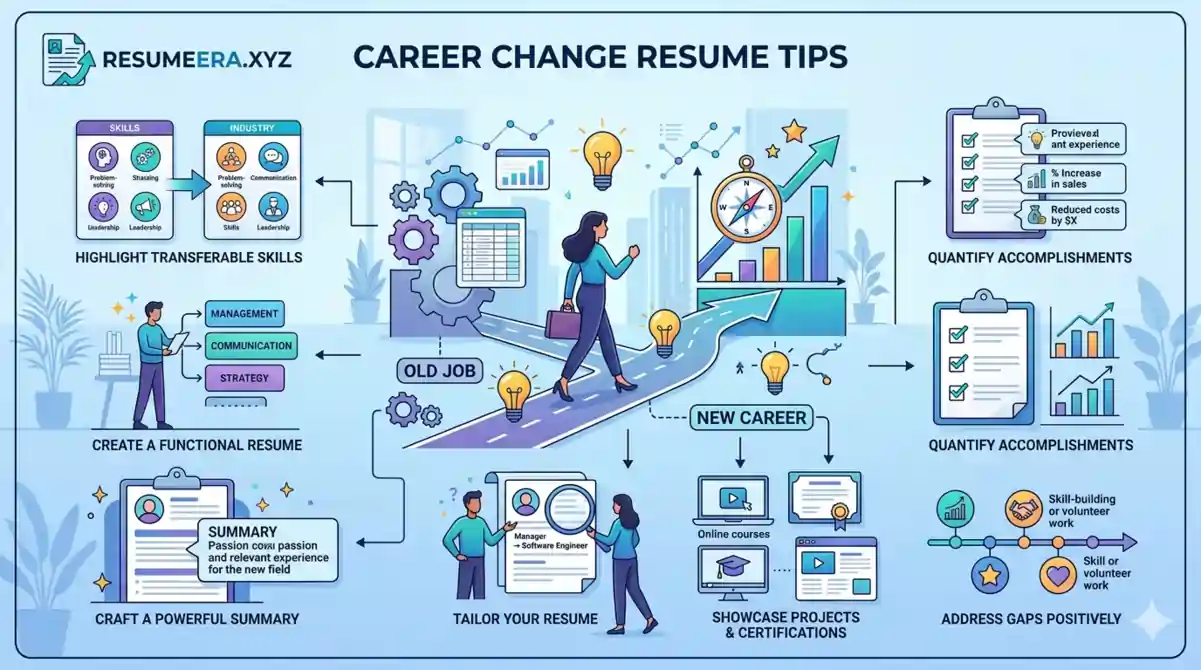
Changing careers is one of the boldest and most rewarding moves a professional can make — but it also comes with one significant challenge: your resume. Most career changers send out dozens of applications and hear nothing back, not because they lack ability, but because their resume wasn't built for the career change . This comprehensive guide gives you every career change resume tip you need to write a powerful, ATS-optimized resume that makes hiring managers in your new industry take notice.
Table of Contents
Why Career Changes Are More Common Than Ever
According to data compiled by career researchers, 43% of workers want to change careers in 2026 — a figure that signals a profound shift in how people think about professional identity. Gone are the days when one career meant one lifetime path. Today, economic disruption, automation, AI advancement, and personal growth all push professionals toward new fields.
The modern workforce is more fluid than ever. People spend an average of 4.1 years in a single role before moving on, and many pivot to entirely different industries multiple times across their working lives. For Indian professionals especially, sectors like technology, digital marketing, data analytics, and healthcare continue to create massive demand — luring teachers, retail managers, accountants, and engineers toward exciting new opportunities. For a deeper Indian-market perspective, read our guide on how to change careers — a complete guide for Indian professionals.
Yet despite the opportunity, making that career change stick on paper remains the biggest bottleneck. A career changer without a strong resume for career transition is like a great product with terrible packaging — the value is real, but nobody sees it.
What Is a Career Change Resume?
A career change resume (also called a career transition resume or career switch resume) is a specially structured document that repositions your existing experience for a role in a new industry or function. Unlike a traditional resume that simply lists your history in reverse chronological order, a career change resume is built around transferable skills, reframed achievements, and targeted language that speaks to your new industry.
How It Differs from a Traditional Resume
| Feature | Traditional Resume | Career Change Resume |
|---|---|---|
| Focus | Job titles & career progression | Transferable skills & relevant achievements |
| Structure | Purely chronological | Hybrid / Skills-first |
| Summary | Career progression narrative | Transition narrative with value pitch |
| Keywords | Industry-specific (current) | Industry-specific (target) |
| Experience framing | Direct and literal | Reframed for new context |
When to Use a Career Change Resume
-
You are moving from one industry to a completely different one
-
Your job titles don't match the roles you're now targeting
-
You have little to no direct experience in the new field
-
You are a recent graduate pivoting away from your degree subject
-
You are a mid-career professional seeking more fulfillment or better pay
Why Most Career Change Resumes Fail
Understanding what goes wrong is the fastest way to get it right. Here are the five most common reasons career change resumes get rejected — often within seconds:
1. Focusing on old job titles
When your most prominent words are your previous job titles (e.g., "Secondary School Teacher" or "Retail Supervisor"), you signal irrelevance before the recruiter reads a single bullet point.
2. No transferable skills highlighted
Many career changers simply copy-paste their old resume. If no effort is made to reframe experience in the language of the new role, the recruiter cannot make the connection for you.
3. Generic professional summaries
A vague summary like "Results-driven professional with 8 years of experience seeking new opportunities" says nothing and wastes your most valuable real estate — the top quarter of your resume.
4. ATS optimization mistakes
Most companies use Applicant Tracking Systems (ATS) to filter resumes before a human ever reads them. Career changers often miss the specific keywords from the target industry, causing automatic rejection. Learn how to avoid this in our ATS-friendly resume format guide for beginners.
5. Poor formatting choices
Using overly designed templates, tables, or graphics that confuse ATS parsers. Or using a fully functional resume format that modern recruiters view with suspicion.
Top Career Change Resume Tips (Actionable Checklist)
These are the most effective, battle-tested career change resume tips used by professionals who successfully made the leap. Work through each one systematically.
✅ 1. Understand Your Target Role Inside and Out
Before writing a single word, read 10–15 job postings in your target field. Identify the skills, responsibilities, tools, and language that appear repeatedly. These recurring terms become your roadmap — they tell you exactly what your resume needs to communicate.
Expert Tip: Create a simple spreadsheet with two columns: "skills they want" and "experience I have." Every row where these overlap is resume gold.
✅ 2. Identify Your Transferable Skills
Go through every role you've held and describe — in plain language, without job titles or industry jargon — what you actually did. Then translate those activities into the vocabulary of your target industry. A teacher who managed a classroom of 30 diverse students has direct experience in "team coordination, performance assessment, and stakeholder communication."
✅ 3. Rewrite Your Professional Summary
Your summary is the first thing a recruiter reads. For a resume summary for career change, you need three things: what you're moving from, what you're moving toward, and why your background is relevant. Aim for 3–4 sentences. Make every word earn its place.
✅ 4. Highlight Relevant Achievements — Not Just Duties
Stop listing job responsibilities. Employers don't care what your job description said. They care what you actually accomplished. Reframe every bullet point as an achievement, even in your old career. Learn more about structuring resume achievements here.
✅ 5. Use Measurable Results Wherever Possible
Numbers add credibility that words alone cannot. "Managed a team" is weak. "Managed a team of 12 staff, reducing onboarding time by 30%" is compelling. Use percentages, timeframes, volumes, and monetary figures whenever you can.
✅ 6. Customize for Every Single Application
A generic resume is a rejected resume. For every job you apply to, adjust your summary, your skills section, and your key bullet points to mirror the specific language in that job posting. Use our guide on how to tailor your resume for every job application as your blueprint.
✅ 7. Lead with Skills Over Industry Experience
Place a "Core Skills" or "Key Competencies" section near the top of your resume, above your work history. This forces the recruiter's eye to land on your most relevant capabilities before they encounter a job title from a different field. Explore key skills for resume to discover which skills resonate most in 2026.
✅ 8. Remove or Minimize Irrelevant Information
If a previous role has zero transferable value for your target position, either remove it entirely or describe it in a single line. Your resume is a marketing document, not a biography.
✅ 9. Add Certifications, Courses, and Training
Certifications are one of the most powerful tools career changers have. A Google Digital Marketing certificate, a PMP credential, a data analytics course on Coursera — these signal genuine commitment to the new field and bridge the experience gap. List them prominently.
✅ 10. Optimize for ATS Systems
Use standard section headings (Work Experience, Education, Skills). Avoid tables, columns, text boxes, and graphics. Sprinkle target keywords naturally throughout your summary, skills section, and bullet points. Run your resume through a free ATS resume checker before submitting.
Career Change Resume Checklist
-
Professional summary tailored to target role
-
Core skills section near top of page
-
Transferable skills reframed in new industry language
-
Every bullet point is achievement-focused with measurable results
-
Resume customized for this specific job posting
-
ATS keywords from job description included naturally
-
Certifications and new training listed
-
Irrelevant roles minimized or removed
-
Standard formatting with no tables or graphics in body
-
Contact info is clean and professional
Best Resume Format for Career Changers
Choosing the right resume format is one of the most important career change resume tips and one of the most misunderstood. There are three primary formats to understand. You can explore all three in detail on the resume formats guide at Resumeera.
Chronological Resume
Lists experience in reverse chronological order (most recent first). This is the most widely used and most ATS-compatible format. It works for career changers who have recent experience that is partially relevant to the new field, or who have built significant new skills through freelance work, volunteering, or side projects.
Best for: Career changers with some overlapping experience or those transitioning within a related industry.
? Learn more: Chronological Resume Format 2026
Functional Resume (Skills-Based Resume)
Groups your experience under skill categories rather than job titles. This format hides employment dates and puts skills front and center. However, many recruiters are suspicious of functional resumes because they obscure the timeline, and many ATS systems struggle to parse them correctly.
Best for: Career changers with very long gaps or completely unrelated history. Use with caution.
? Learn more: Functional Resume Format Guide
Combination (Hybrid) Resume — Recommended
The hybrid resume format is widely considered the best choice for most career changers. It opens with a strong summary and prominent skills section (like a functional resume), then includes a standard reverse-chronological work history section (like a chronological resume). This gives you the best of both worlds: skills visibility upfront, and the credibility of a clear work history.
Best for: Most career changers, especially those switching to a different industry entirely.
? Learn more: Combination Resume Format
Format Comparison at a Glance
| Format | ATS-Friendly | Hides Gaps | Shows Skills | Best For |
|---|---|---|---|---|
| Chronological | ✅ Excellent | ❌ No | ⚠️ Moderate | Related field switchers |
| Functional | ⚠️ Poor | ✅ Yes | ✅ Strong | Big gaps + unrelated history |
| Hybrid/Combination | ✅ Good | ⚠️ Partial | ✅ Excellent | Most career changers |
For a dedicated deep-dive, visit our career change resume format guide.
How to Write a Powerful Resume Summary for a Career Change
Your professional summary is the most important section of your resume for career change . It's the first thing a recruiter reads and the one place where you get to directly control the narrative of your transition.
Step-by-Step Process
Step 1: Open with who you are — your professional identity in the new context, not the old one.
Step 2: Mention your most relevant transferable strength with a brief proof point.
Step 3: State clearly the type of role you're targeting and why you're a strong fit.
Step 4: Keep it to 3–4 sentences. No fluff.
Common Mistakes in Career Change Summaries
-
Starting with "I am looking for a new opportunity" (weak and self-focused)
-
Being too vague ("results-driven professional")
-
Apologizing for the career change ("Although I don't have direct experience...")
-
Writing a wall of text with no clear message
Sample Resume Summaries for Career Changers
Teacher → Corporate Trainer:
"Learning design professional with 7 years developing curriculum, facilitating workshops, and measuring instructional outcomes for groups of 30+ learners. Proven track record in performance assessment, needs analysis, and stakeholder communication. Seeking a Corporate Trainer role to bring structured, results-focused learning design to a business environment."
Retail Manager → HR Professional:
"Operations leader with 6 years managing 40+ staff across recruitment, onboarding, scheduling, and conflict resolution in a high-turnover retail environment. Experienced in employee engagement, policy compliance, and performance management. Transitioning into HR to apply people-first leadership in a dedicated HR function."
Customer Service → Marketing:
"Customer insight specialist with 5 years studying buyer behavior, managing escalations, and crafting communication strategies that improved satisfaction scores by 22%. Data-driven communicator with strong analytical and storytelling skills, now pursuing a marketing role to channel customer empathy into campaign strategy."
For more summary examples and frameworks, visit profile summary for resume on Resumeera.
Transferable Skills That Employers Value Most
Research consistently shows that transferable skills are the primary currency of a career transition. Here are the most in-demand transferable skills along with how to frame them:
| Transferable Skill | What It Means in Practice | Example Across Industries |
|---|---|---|
| Leadership | Guiding teams toward a goal | Teacher managing classroom = Team lead managing project |
| Communication | Verbal, written, cross-functional | Sales rep = Marketing copywriter; Nurse = Patient educator |
| Problem-Solving | Diagnosing and resolving challenges | IT support = Process improvement analyst |
| Project Management | Planning, executing, tracking deliverables | Event coordinator = Operations manager |
| Team Collaboration | Working across functions and personalities | Retail team = Cross-departmental work groups |
| Customer Service | Empathy, resolution, relationship management | Call center = Account manager; receptionist = CX specialist |
| Data Analysis | Making decisions using information | Inventory tracker = Business analyst |
| Time Management | Prioritization and deadline adherence | Any deadline-driven role = Any high-output corporate role |
Expert Tip: Don't just list these skills — prove them. For each skill on your resume, include one bullet point that shows you used it, with a measurable outcome.
For a comprehensive skill bank, explore personal skills for resume and our dedicated guide on transferable skills on a resume.
Career Change Resume Examples
Example 1: Teacher → Corporate Trainer
Before (generic):
"Taught English Literature to Year 9–12 students. Prepared lesson plans and graded assignments."
After (career change framing):
"Designed differentiated instructional programs for groups of 30+ learners at varying skill levels, improving average assessment performance by 18%. Conducted training needs analyses and adapted content delivery based on learner feedback and outcome data."
Example 2: Retail Manager → HR Professional
Before:
"Managed store operations and supervised staff at a retail outlet."
After:
"Led end-to-end recruitment, onboarding, and performance management for a team of 42 employees, reducing staff turnover by 25% in 12 months. Mediated employee conflicts and ensured policy compliance across all HR processes."
Example 3: Customer Service Representative → Marketing
Before:
"Handled customer queries and complaints over phone and email."
After:
"Managed 80+ customer interactions daily, identifying pain points and communication gaps that informed a messaging overhaul — contributing to a 22% increase in customer satisfaction scores. Developed templated response strategies later adopted company-wide."
Example 4: Administrative Assistant → Project Coordinator
Before:
"Managed schedules, filing, and office correspondence."
After:
"Coordinated logistics for 15+ simultaneous projects, managing timelines, vendor relationships, and documentation for a team of 20. Implemented a digital filing system that reduced document retrieval time by 40%."
These examples illustrate one of the most powerful career change resume tips : the experience you have is rarely irrelevant — it's just described in the wrong language. Learn how to add projects on the resume to supplement your experience narrative further.
ATS Optimization for Career Change Resume
More than 95% of Fortune 500 companies and a growing number of Indian employers use ATS software to screen resumes before a human reads them. For career changers, failing the ATS screen is the most common — and most preventable — reason for rejection.
Keyword Placement Strategy
-
Extract 8–12 keywords from the target job description (role-specific skills, tools, qualifications)
-
Include these keywords in your Summary, Core Skills section, and Work Experience bullet points
-
Use the exact phrasing from the job description — ATS systems often do exact-match searching
-
Avoid synonyms only; use both forms if relevant (e.g., "Project Management" and "Project Manager")
Skills Section Optimization
List your skills in a clean, single-column bullet list or a simple two-column layout. Do not embed your skills inside tables or text boxes — many ATS parsers cannot read these. Include both hard skills (tools, software, certifications) and soft skills (leadership, communication) relevant to the target role.
Formatting Rules for ATS Compatibility
-
Use standard section headers: Work Experience, Education, Skills, Certifications
-
Stick to standard fonts: Arial, Calibri, Garamond, Times New Roman
-
Avoid headers and footers for important information — ATS may skip them
-
Save and send as .docx or PDF (confirm PDF is accepted)
-
No columns, tables, text boxes, or graphics in the body
For a detailed breakdown, read our 11 ATS formatting mistakes to avoid and the 5 ways to get your resume past ATS in 2026.
Career Change Cover Letter Tips
A career transition cover letter is not optional — it is essential. Your resume shows what you've done; your cover letter explains why you're doing something different and why that makes you a stronger candidate, not a riskier one.
What Your Career Change Cover Letter Must Do
-
Name the transition clearly — Don't make the reader guess. State explicitly that you're moving from Industry A to Industry B.
-
Lead with your value, not your journey — Start with what you bring, not your personal story of why you're changing.
-
Bridge the experience gap — Identify the top 2–3 skills the role demands and show specifically how your background demonstrates those skills.
-
Address the concern preemptively — Acknowledge you're coming from a different field, then immediately pivot to why that's an advantage (fresh perspective, cross-functional skills, etc.).
-
Close with a clear call to action — Express enthusiasm and invite a conversation.
Sample Cover Letter Framework for Career Changers
Opening: "With seven years of experience in [previous field], I've spent my career developing [Skill A], [Skill B], and [Skill C] — the same capabilities that the [Job Title] role at [Company] demands."
Bridge Paragraph: "In my most recent role as [Previous Title], I [achievement 1] and [achievement 2]. Both experiences directly translate to [target role responsibility]."
Transition Statement: "Making this move is not a departure from my expertise — it's a focused application of it in a field I'm deeply committed to."
Close: "I'd welcome the opportunity to discuss how my background can contribute to [Company]'s goals. Thank you for your consideration."
For a complete guide on crafting compelling cover letters, visit how to write a cover letter that gets you hired in 2026.
Common Mistakes Career Changers Make
Avoiding these mistakes alone can dramatically improve your results.
1. Treating career gaps as liabilities
Gaps are only damaging if left unexplained. Frame them proactively — mention upskilling, freelancing, caregiving, or volunteering done during any break. See our guide on returning to the workforce resume for strategies.
2. Over-explaining the transition
Your resume and cover letter should briefly explain the transition — not justify, apologize for, or over-detail it. Trust the hiring manager to see the value once you've framed it properly.
3. Writing a weak or vague summary
As discussed above, your summary carries massive weight. A generic summary is the fastest way to lose a recruiter's interest.
4. Sending the same resume to every company
Generic applications signal low effort. Companies want candidates who understand their specific needs. Customize every application. This is the single most impactful career change resume tip.
5. Ignoring new skills acquisition
Not earning at least one new certification in your target field tells employers you're interested in theory but not committed in practice. Even a free online course carries weight. Explore 15 best AI tools for job seekers to find tools that can accelerate your upskilling.
6. Listing skills without proof
"Strong communication skills" means nothing without a bullet point that proves it. Every claim on your resume needs evidence.
Final Thoughts
A career change is not a setback — it's a strategic reinvention. The professionals who succeed in making a smooth transition are not the ones with the most impressive titles in their new field. They are the ones who took the time to understand their target market, translate their experience fluently, and present themselves with clarity and confidence.
The core principle behind every career change resume tip in this guide is the same: you don't change who you are, you change how you present yourself. Your transferable skills are real. Your achievements are real. Your value is real. The resume's job is simply to make that value visible and immediately recognizable to someone who doesn't yet know you.
Here are your key takeaways:
-
Use a hybrid/combination resume format for most career change situations
-
Lead with a targeted professional summary that frames the transition as a strength
-
Build a Core Skills section near the top using exact language from the target job description
-
Reframe every bullet point to speak to your new industry, with measurable outcomes
-
Earn at least one certification or credential in your target field
-
Customize every application — generic resumes are rejected resumes
-
Write a strong cover letter that bridges your experience to the new role
-
Optimize for ATS by using standard formatting and natural keyword placement
Start by getting your resume right — use Resumeera, India's best free resume builder, to create an ATS-optimized, professionally formatted career change resume at zero cost. Then pair it with a compelling cover letter, and you'll be far ahead of the competition.
Your next career chapter deserves a resume that matches your ambition. Build it with purpose, build it with Resumeera — the free resume builder trusted by thousands of Indian professionals navigating exactly the transition you're making.