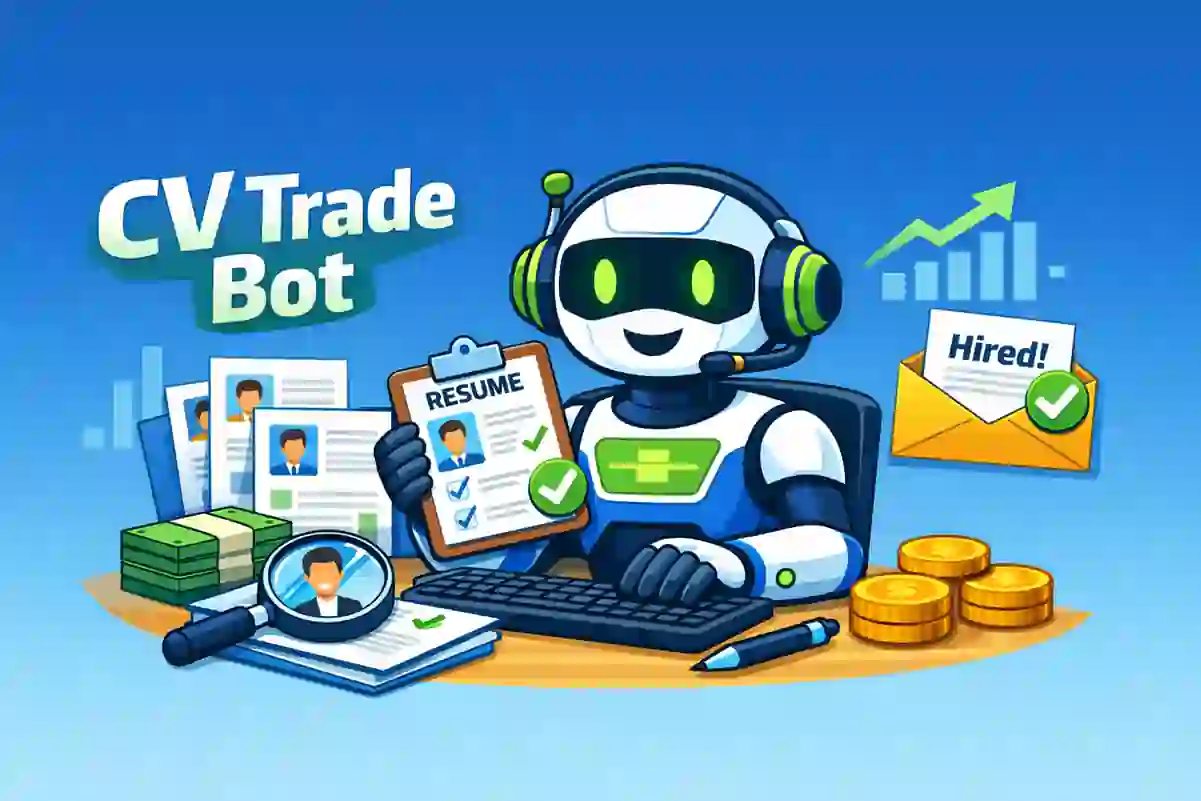
In the rapidly evolving landscape of job hunting, terms often circulate that promise magical shortcuts. One such term that has recently appeared in search queries is "Cv trade bot." Many job seekers, eager to automate their path to employment, search for a tool or bot that can automatically "trade" or generate a perfect CV in seconds. However, the reality is far more nuanced. There is no single software known as a "Cv trade bot" that can magically swap your experience for a job offer or fully automate the complex human process of career advancement without strategic input.
What searchers often mean when they type "Cv trade bot" is actually a desire for an ATS-friendly resume generator that uses Artificial Intelligence to optimize their profile for the job market. The confusion likely stems from the blending of concepts: "trading" one's skills for a salary, "bots" (AI) writing the content, and the urgent need to navigate Applicant Tracking Systems (ATS). In 2026, the most effective strategy is not a mythical bot, but a strategic understanding of how modern hiring algorithms work, combined with a professionally structured, human-verified document.
This comprehensive guide will dismantle the myth of the "Cv trade bot," explain the technology that actually powers modern resume screening, and provide you with the exact steps to build a high-converting CV. We will explore how AI tools like those at ResumeEra function as powerful assistants rather than autonomous bots, ensuring your application stands out in a crowded market.
Table of Contents
- What is a Cv Trade Bot? Separating Fact from Fiction
- How ATS and Hiring Bots Actually Work in 2026
- Why "Cv Trade Bots" Fail to Deliver Results
- Building an AI-Optimized CV: The Real Strategy
- The ResumeEra Approach: Human + AI Synergy
- Common Mistakes When Relying on Automated Tools
- People Also Ask
- Frequently Asked Questions
What is a Cv Trade Bot? Separating Fact from Fiction
The term "Cv trade bot" is not a recognized industry standard or a specific software product in the recruitment technology sector. Instead, it represents a conceptual misunderstanding of how modern hiring automation functions. In the context of the job market, "trading" usually refers to the exchange of labor and skills for compensation. A "bot" implies an automated program. When combined, the phrase suggests a tool that automatically negotiates or "trades" your CV against job descriptions to secure an interview.
However, no such autonomous bot exists that can legally or ethically apply for jobs, negotiate salaries, or guarantee a "trade" of your CV for a job offer on your behalf without your direct involvement. The confusion often arises from three distinct technologies that job seekers conflate:
First, there are ATS (Applicant Tracking Systems). These are the "bots" that companies use to filter resumes. They scan your CV for keywords, format, and relevance. They do not "trade" your CV; they reject or rank it based on strict criteria.
Second, there are AI Resume Builders. These are tools that help you write, format, and optimize your CV. They use Natural Language Processing (NLP) to suggest improvements, but they require human input. A tool like ResumeEra's free resume builder acts as a sophisticated assistant, helping you structure your experience, but it does not operate autonomously to "trade" your profile.
Third, there are Job Board Scrapers and Auto-Applicants. These are scripts that some job seekers use to automatically apply to hundreds of jobs. While these are technically "bots," they are generally discouraged by career experts because they often lead to low-quality applications that get rejected instantly by modern ATS systems. Relying on such bots often results in your CV being flagged as spam.
Therefore, when you search for a "Cv trade bot," you are likely looking for a way to maximize your chances of getting hired by optimizing your CV for the algorithms that companies use. The solution is not a magic bot, but a strategic approach to resume building that aligns with the logic of these systems.
It is crucial to understand that the "trade" in your career is a human decision made by a recruiter or hiring manager, not a bot. The bot's job is merely to decide if your CV makes it to the human's desk. If your CV is not optimized, no bot will help you "trade" your skills for a job. This is why understanding the difference between a myth and a tool is the first step in your 2026 job search strategy.
The AI Resume Misconception
Many job seekers believe that AI tools can write a resume from scratch and submit it without any human oversight. This is a dangerous misconception. While AI can generate text, it cannot replicate the nuance of your specific career journey, the context of your achievements, or the soft skills that differentiate you from other candidates.
According to recent industry trends, 47% of workers use AI to finish work early, but this does not mean they let AI make all their career decisions. The most successful candidates use AI to enhance their drafts, check for grammar, and optimize keywords, but they remain the final editors. Relying entirely on an automated "bot" to generate a CV often leads to generic, robotic-sounding content that fails to resonate with human recruiters.
Furthermore, the idea of a "trade" implies a transaction. A CV is not a commodity to be traded; it is a marketing document that must be tailored to a specific audience. A "Cv trade bot" that attempts to send the same generic CV to every job opening is doomed to fail. The modern job market requires personalization, a task that requires human judgment and strategic alignment with job descriptions.
How ATS and Hiring Bots Actually Work in 2026
To succeed in the 2026 job market, you must understand the "bots" that are actually in control: the Applicant Tracking Systems (ATS). These are sophisticated software applications used by over 90% of large companies and many mid-sized firms to manage the hiring process. They act as the gatekeepers, filtering out thousands of applications before a human ever sees them.
When a recruiter posts a job, the ATS creates a digital profile for that role. It scans the job description for keywords, required skills, years of experience, and specific qualifications. When you submit your CV, the ATS "bot" parses your document, extracting text and categorizing it into fields like "Work Experience," "Education," and "Skills." It then scores your CV against the job profile.
Scoring Mechanisms and Keyword Matching
The scoring mechanism is the core of the ATS "bot." It looks for exact matches and semantic variations of keywords. For example, if a job requires "Project Management," the bot will look for that exact phrase or closely related terms like "Project Coordination" or "Agile Leadership." If your CV uses the phrase "Managed projects" without the keyword "Project Management," you might score lower.
This is why understanding the importance of tailoring your resume to a job description is critical. You cannot simply upload a generic CV and hope the "bot" understands your value. You must speak the language of the job description. The ATS does not "think" in the way a human does; it follows a set of programmed rules. If your CV does not align with these rules, it is automatically rejected.
Modern ATS systems also analyze the format of your CV. They struggle with complex layouts, graphics, tables, and columns that are not standard. If your CV is visually appealing but unreadable by the bot, you will be filtered out. This is a common pitfall for candidates who use graphic design tools like Canva without understanding ATS compatibility. For a detailed guide on this, refer to our analysis on whether Canva resumes are ATS-friendly.
The Role of Semantic Search
While older ATS systems relied on exact keyword matching, the systems used in 2026 are powered by AI and semantic search. This means they can understand the context of words. For instance, they know that "Python" and "Python programming" are related, or that "Customer Service" is similar to "Client Relations." However, this does not mean you should ignore keywords. You still need to include the specific terminology used in the industry and the job description.
Semantic search also helps the bot identify "red flags" or gaps in employment, though it is less likely to reject a candidate solely for a gap if the overall profile is strong. The bot is designed to find the best fit, not to find the perfect candidate. It ranks candidates based on relevance. The top-ranked candidates are then presented to the human recruiter.
Therefore, the "Cv trade bot" you are looking for is essentially a tool that helps you optimize your CV for these semantic search algorithms. It helps you identify the right keywords, structure your content for readability, and format your document so the ATS can parse it correctly. This is where specialized resume builders like ATS-compatible resume formats come into play.
Why "Cv Trade Bots" Fail to Deliver Results
Despite the allure of automation, relying on a hypothetical "Cv trade bot" or using unverified auto-application scripts is a recipe for failure. There are several reasons why these approaches do not work in the modern hiring ecosystem.
Lack of Personalization
The primary failure of automated "trading" bots is the lack of personalization. Every job is unique, with specific requirements and cultural nuances. A bot that sends the same CV to 100 different jobs will inevitably fail because it cannot tailor the content to each specific role. Recruiters can easily spot generic applications. They look for evidence that you understand the company and the role. A bot cannot generate this level of insight.
Furthermore, the process of tailoring your resume for every job application is not just about keywords; it is about highlighting the most relevant achievements for that specific role. If you are applying for a marketing job, your sales achievements might be less relevant than your campaign management skills. A bot cannot make this strategic decision for you.
Risk of Blacklisting
Many job boards and company career portals have anti-spam measures in place. If a bot submits hundreds of applications in a short period, or if the applications look like they were generated by a script, your IP address or email may be flagged. This can lead to your CV being blacklisted, meaning you will never be considered for any future roles at that company, even if you are a perfect fit.
Recruiters are also becoming more adept at identifying AI-generated content. While AI is a powerful tool, content that is entirely generated by a bot often lacks the human voice and authenticity that recruiters look for. It can sound robotic, repetitive, or overly formal. This can hurt your chances of getting an interview, as it suggests a lack of genuine effort and creativity.
The Human Factor
Ultimately, the "trade" of a job offer is a human decision. No matter how well your CV passes the ATS, it still needs to impress a human recruiter. They are looking for personality, cultural fit, and passion. A "Cv trade bot" cannot convey these qualities. It can only present data. To succeed, you must use your CV to tell your story, highlight your unique value proposition, and demonstrate your enthusiasm for the role.
This is why the most effective strategy is to use AI tools as assistants, not replacements. You should use them to generate ideas, check for errors, and optimize keywords, but you must be the one to write the content, curate the achievements, and ensure the final document reflects your true self. This human-in-the-loop approach is the only way to build a CV that truly "trades" your skills for a job.
Building an AI-Optimized CV: The Real Strategy
Since the "Cv trade bot" is a myth, the real strategy involves building an AI-optimized CV. This means leveraging technology to enhance your resume while maintaining human oversight. Here is a step-by-step framework for creating a high-performance CV in 2026.
Step 1: Analyze the Job Description
Before you write a single word, you must analyze the job description. Look for recurring keywords, required skills, and specific qualifications. These are the signals the ATS "bot" is looking for. Create a list of these keywords and ensure they are naturally integrated into your CV. Do not just list them; explain how you have used them in your past roles.
For example, if the job description mentions "Agile methodology," do not just write "Agile" in your skills section. Instead, write: "Led a cross-functional team using Agile methodology to deliver projects 20% faster than the deadline." This provides context and proves your proficiency.
Step 2: Structure for ATS Readability
Your CV must be structured in a way that the ATS can easily parse. This means using standard headings like "Work Experience," "Education," and "Skills." Avoid using graphics, tables, or complex columns that might confuse the parser. Stick to a clean, single-column layout for the most critical sections. If you are unsure about the best format, refer to our guide on chronological resume formats, which are generally the safest bet for ATS compatibility.
Also, ensure your contact information is clear and easy to find. The ATS needs to be able to extract your name, email, phone number, and location without errors. A missing phone number or an unrecognizable email format can lead to an automatic rejection.
Step 3: Leverage AI for Content Optimization
This is where tools like ResumeEra shine. Use AI to help you rewrite your bullet points to be more impactful. Ask the AI to suggest action verbs, quantify your achievements, and ensure your tone is professional. However, always review the AI's suggestions. If it suggests something that doesn't sound like you, change it. The goal is to enhance your voice, not replace it.
AI can also help you identify gaps in your skills. If the job description requires a skill you don't have, the AI might suggest how to frame your existing skills as transferable. For instance, if you don't have "Python" experience but you have strong "Data Analysis" skills, the AI can help you phrase your experience to show your aptitude for learning new tools quickly.
Step 4: Proofread and Validate
Even the best AI can make mistakes. It might hallucinate facts, use the wrong tense, or miss a subtle nuance. Always proofread your CV manually. Check for spelling errors, grammar issues, and consistency in formatting. A single typo can ruin your credibility. Use tools like free ATS resume checkers to validate your document before submitting it.
Finally, ensure that your CV is visually appealing to a human reader. While the ATS reads the text, the recruiter reads the design. Use whitespace effectively, choose a professional font, and ensure your layout is clean and easy to scan. A well-designed CV can make a significant difference in getting the recruiter's attention.
Step 5: Customize for Every Application
Never use a generic CV for multiple applications. Tailor your CV for every single job. This means adjusting your summary, highlighting the most relevant experience, and tweaking your skills section to match the job description. It takes time, but it is the only way to maximize your chances of success. As highlighted in our guide on how to tailor your resume to any job description, this personalization is the key to standing out in a competitive market.
The ResumeEra Approach: Human + AI Synergy
At ResumeEra, we believe in the power of synergy between human insight and AI efficiency. We do not offer a "Cv trade bot" because we know that your career is too important to be left to an algorithm. Instead, we provide a platform that empowers you to build the best possible version of yourself.
Our tools are designed to help you understand the ATS landscape, optimize your content, and create a visually stunning CV that passes both the bot and the human eye. We offer features like real-time keyword analysis, AI-powered writing suggestions, and a wide range of ATS-friendly templates. Whether you are a fresher looking for your first job or an experienced professional seeking a career change, our platform adapts to your needs.
For example, if you are a fresher, you might struggle with how to present your lack of work experience. Our student internship CV guides help you highlight your projects, coursework, and transferable skills. If you are a career changer, we provide templates and advice on how to reframe your experience for a new industry, as discussed in our career change resume tips guide.
Moreover, we prioritize privacy and transparency. Unlike many other platforms that hide their costs or require payment to download your resume, we offer a free resume builder with no hidden fees. We believe that every job seeker deserves access to high-quality tools without the pressure of a paywall. This commitment to accessibility and quality is what sets us apart from the "bots" and generic tools that flood the market.
Why Human Oversight Matters
The "Cv trade bot" myth persists because people want a shortcut. But in reality, the shortcut is the long way around. A CV that is not reviewed by a human can lead to missed opportunities, embarrassing errors, and a lack of connection with the recruiter. Human oversight ensures that your CV tells your unique story, reflects your true personality, and aligns with your career goals.
When you use a tool like ResumeEra, you are in control. You decide what to include, how to phrase it, and what story to tell. The AI is there to assist, not to dictate. This human-centric approach is the only way to build a CV that truly resonates with employers and leads to real job offers.
Common Mistakes When Relying on Automated Tools
Even with the best tools, mistakes can happen if you rely too heavily on automation. Here are some common pitfalls to avoid when building your CV in 2026.
Keyword Stuffing
One of the most common mistakes is "keyword stuffing." This happens when you cram as many keywords as possible into your CV, often in a way that makes the text unreadable. Modern ATS systems are smart enough to detect this and may penalize your score. Instead, focus on natural integration. Use keywords in the context of your achievements and responsibilities.
Ignoring Formatting
Another mistake is ignoring the importance of formatting. A CV that looks great on your screen might be a mess when parsed by an ATS. Avoid using headers and footers for critical information, as some ATS systems cannot read them. Also, avoid using images or graphics for your contact details. Stick to simple, clean formatting to ensure your CV is readable by both bots and humans.
Failing to Tailor
Failing to tailor your CV is the biggest mistake of all. A generic CV is a CV that will be rejected. Every job is different, and your CV should reflect that. Take the time to read the job description, identify the key requirements, and adjust your CV accordingly. This might mean reordering your bullet points, changing your summary, or adding new skills. It takes effort, but it is worth it.
Over-relying on AI
Finally, do not over-rely on AI. While AI can generate great content, it cannot replace your personal experience. Always review the AI's output and make sure it sounds like you. If the AI suggests a phrase that doesn't fit your voice, change it. Your CV should be a reflection of you, not a robot.
People Also Ask
What is a Cv trade bot?
There is no official software called a "Cv trade bot." The term is likely a misunderstanding of AI resume builders or automated job application tools. In reality, no bot can automatically "trade" your CV for a job offer. Success comes from using AI tools to optimize your CV for Applicant Tracking Systems (ATS) and human recruiters, while maintaining human oversight of the content.
Do ATS bots read my resume?
Yes, ATS bots read and parse your resume. They extract information, score your profile based on keywords and relevance, and filter out candidates who do not meet the criteria. This is why it is crucial to use an ATS-friendly format and include the right keywords from the job description.
Can AI write my entire resume for me?
AI can generate drafts and suggest improvements, but it should not write your entire resume for you without your input. AI lacks the context of your specific career journey and the nuance of your achievements. The best approach is to use AI as an assistant to enhance your writing, while you provide the core content and strategy.
Why do my resumes get rejected by bots?
Resumes are often rejected by bots due to formatting issues, lack of relevant keywords, or generic content. If your CV is not optimized for the specific job description or if it uses complex layouts that the ATS cannot parse, it will likely be filtered out. Ensuring your CV is simple, keyword-rich, and tailored to the role is essential.
Is ResumeEra a good alternative to paid resume builders?
Yes, ResumeEra offers a robust alternative to paid resume builders. It provides free access to ATS-friendly templates, AI-powered writing assistance, and tools to optimize your CV without hidden fees. It is designed to help job seekers in India and globally create professional resumes that pass both ATS and human scrutiny.
conclusion
the search for a "Cv trade bot" is a search for a shortcut that does not exist. The real path to success lies in understanding the technology that powers hiring, optimizing your CV for both bots and humans, and taking ownership of your career narrative. By using tools like ResumeEra and following the strategies outlined in this guide, you can build a powerful, effective CV that opens doors to your dream job in 2026.
Remember, your CV is your passport to your future. Make it count by combining the power of AI with the unique value of your human experience. Whether you are a student, a professional, or a career changer, the right strategy will help you navigate the job market with confidence.