Table of Contents
- 1. What ATS Systems Actually Scan
- How ATS Reads Your Document
- Why Qualified Candidates Still Fail
- 2. The Only ATS-Friendly Format That Works
- Single-Column Reverse-Chronological
- DOCX vs PDF vs Plain Text
- 3. Formatting Mistakes That Tank Your Score
- Elements That Break Parsers
- Quick Fixes Before Your Next Application
- 4. Keyword Placement That Satisfies Both ATS & Recruiter
- Standard Section Labels
- Keyword Placement Zones
- 5. How to Use an ATS Checker Without Over-Relying on It
- 6. Resumeera Free Resume Builder — Built-In ATS Optimization
- FAQ
- Conclusion
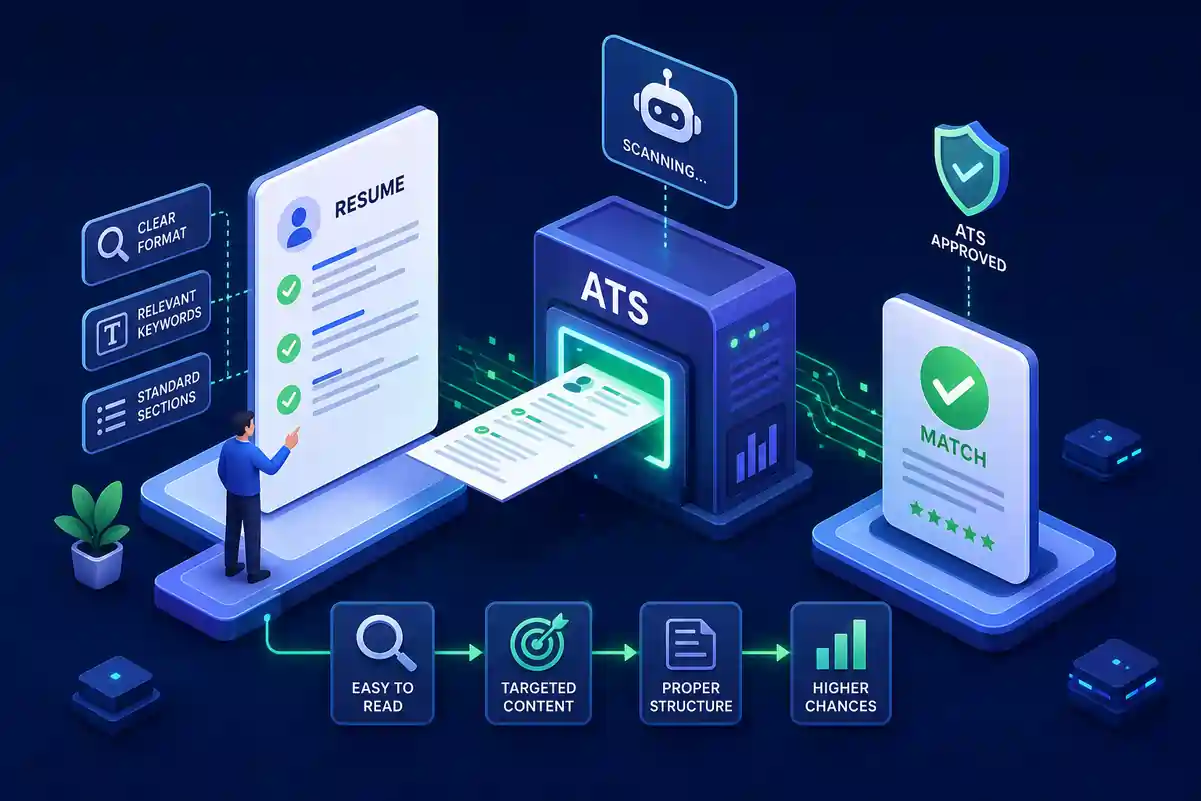
Most job applications are first screened by automated software before a human recruiter ever sees them. That's not a theory — it reflects how modern hiring actually works. About 98% of Fortune 500 companies run incoming applications through an applicant tracking system (ATS) as the first step in their review process. Those systems don't evaluate your potential or read between the lines. They parse your document into fields, compare extracted data against job requirements, generate a match score, and filter accordingly. If your resume doesn't parse cleanly, your qualifications don't matter.
Building an ATS-friendly resume is no longer optional — it's the baseline for getting your application in front of a person. This guide covers four things: what ATS software actually scans for, which format passes consistently across major platforms, the specific formatting mistakes that silently tank your score, and how to place keywords so both the system and the recruiter approve. Resumeera — a free resume builder — has ATS optimization built directly into its templates and export settings. But understanding the underlying logic will make you a sharper applicant regardless of which tool you use.
1. What ATS Systems Actually Scan For (and Why Most Resumes Disappear)
How Applicant Tracking Systems Read Your Document
ATS software doesn't read a resume the way a recruiter does. It parses the document into discrete fields: job title, employer name, employment dates, skills list, education level, and certifications. The system then compares those extracted fields against the requirements in the job description and generates a match score. If the parser can't extract a field cleanly, that information effectively doesn't exist in the system.
Major platforms — including Workday, Taleo, iCIMS, and SAP SuccessFactors — each use their own parsing logic, but all share the same fundamental requirement: clean, structured, machine-readable text.
⚠ The Core Problem
Most resume design advice prioritizes visual presentation over parse accuracy. A resume built with graphic icons, decorative columns, or stylized text boxes may look impressive in a PDF viewer. To an ATS parser, those elements are noise at best and unreadable characters at worst. The parser skips them or misclassifies them — and your match score drops before anyone reads a word.
Why Qualified Candidates Still Get Filtered Out
Automated scoring creates a specific kind of failure: a genuinely qualified candidate gets rejected because their resume's structure prevented the system from recognizing their qualifications. Think of it this way — a resume that can't be parsed is like handing a recruiter a document in a language they don't speak. The experience is real, but it's stored in a format the parser can't access.
This is why ATS optimization is a baseline requirement for most roles, not a competitive advantage. For the many employer portals that rely on ATS screening, getting the structure right is the entry fee for being considered. Learn more in our guide on 11 ATS formatting mistakes that cost you the job.
2. The Only ATS-Friendly Resume Format That Consistently Passes Major Platforms
Single-Column, Reverse-Chronological: Why This Wins Every Time
Testing across major platforms consistently shows that a single-column, reverse-chronological layout in .docx format produces the highest parse rates. One published benchmark recorded a 93% average parse rate across six ATS systems — including 97% on Workday and 92% on iCIMS — for exactly this format.
Reverse-chronological means your most recent role appears first, followed by earlier positions in descending order. Single-column means no sidebars, no two-column skills panels, and no split layouts — even though those designs are visually popular. Two-column formats can score up to 32 percentage points lower on parse rate tests. For a deeper breakdown, see our analysis of why single-column resumes outperform two-column layouts for ATS.
Section order also matters. The structure that ATS platforms parse most reliably is: Summary → Skills → Work Experience → Education → Certifications. Deviating from this sequence doesn't guarantee failure, but sticking to it removes one more variable that could cost you a score point.
| Format / Layout | Avg. Parse Rate | Workday | iCIMS | Verdict |
|---|---|---|---|---|
| Single-column .docx | 93% | 97% | 92% | ✓ Best Choice |
| Text-based PDF (Word export) | 89% | ~90% | ~87% | ✓ Acceptable |
| Two-column .docx | ~61% | Lower | Lower | ⚠ Risky |
| Designed PDF (Canva, etc.) | ~40% | Poor | Poor | ✗ Avoid |
| Scanned PDF / Image | 6% | <5% | <5% | ✗ Never Use |
| Plain text (.txt) | ~99% | ~99% | ~99% | ⚠ Parse-safe, visually poor |
ATS-Friendly Resume File Format: DOCX vs PDF vs Plain Text
File format affects parsing accuracy more than most job seekers realize. DOCX is the safest universal choice, recorded at a 94% parse rate in direct testing. A clean, text-based PDF exported from Word or Google Docs can also work — typically testing around 89% — but that number drops sharply with complex layouts, locked files, or scanned images. A scanned PDF can fall to a 6% parse rate. For full analysis, see our guide on PDF vs Word resume formats for ATS.
? The Practical Rule
Format safety comes first. A visually impressive PDF that fails to parse is worse than a clean .docx that looks straightforward. If the job posting doesn't specify a format, default to .docx. If you need to send a PDF, export it directly from a word processor — never save a visually designed file.
Skip the Manual Formatting Work
Resumeera — a free resume builder — generates ATS-safe .docx files automatically. No account needed, no paywall at download.
3. Formatting Mistakes That Silently Destroy Your ATS Score
The Elements That Trigger Parsing Failures
Certain design choices break ATS parsers in predictable ways. Knowing these in advance lets you avoid them entirely — or fix them before you apply.
| Formatting Element | How It Breaks ATS | Fix |
|---|---|---|
| Layout tables | Confuses field-extraction logic; text in adjacent cells merges or disappears | Replace with standard paragraphs or bullet lists |
| Multi-column design | Text stored in layout chunks that parsers misread or skip | Use single-column layout only |
| Decorative icons | Read as symbols or ignored; disrupts content flow | Use plain bullet characters (•) |
| Text in headers/footers | Exist on a separate document layer many parsers can't access | Move all contact info into the body |
| Text boxes | Layer parsing skips content inside boxes entirely | Delete all text boxes; use inline paragraphs |
| Non-standard section headings | "My Story," "What I Bring" — ATS won't recognize these labels | Use: Work Experience, Education, Skills, Certifications |
| Multiple font families | Inconsistent formatting disrupts parsing logic | Use Calibri 11pt or Arial 10.5–11pt throughout |
The safest font choices for major platforms including Workday and SAP SuccessFactors are Calibri at 11pt or Arial at 10.5–11pt, both recognized reliably across Windows-based ATS environments. For a complete breakdown of common errors, see our article on ATS formatting errors and how to fix them.
Quick Fixes You Can Apply Before Your Next Application
- Replace layout tables with standard paragraphs or simple bullet-point lists
- Move your name, phone number, email address, and LinkedIn URL into the main body of the document — not a header or footer
- Swap decorative icons for plain bullet characters
- Rename creative section headings to labels ATS systems recognize: Work Experience, Education, Skills, Certifications
- Standardize your font to one consistent family throughout the entire document
- Export as .docx — not a designed PDF — for maximum ATS compatibility
4. Section Headings and Keyword Placement That Satisfy Both ATS and Recruiters
The Standard Section Labels ATS Platforms Recognize
ATS systems rely on predictable heading labels to categorize resume content. The safest set is listed below. Labels like "What I Know," "Key Abilities," "My Journey," or "Things I'm Proud Of" cause systems to either misclassify the section or skip it entirely — your experience under an unrecognized section label effectively disappears from your match score.
| Recommended Label | Acceptable Alternate | Labels to Avoid |
|---|---|---|
| Summary | Profile, Professional Summary | "About Me," "My Story" |
| Work Experience | Professional Experience, Employment | "Career Journey," "Where I've Been" |
| Skills | Technical Skills, Core Competencies | "What I Know," "Key Abilities" |
| Education | Academic Background | "My Learning," "Studies" |
| Certifications | Licenses & Certifications | "Things I've Earned" |
| Projects | Key Projects, Portfolio | "Cool Stuff," "Experiments" |
For tailored advice on section structure for specific situations — like entry-level applicants or teens with no experience — see our guide on how to write a resume with no work experience.
Where and How to Place Job-Specific Keywords in an ATS-Friendly Resume
Keyword placement follows a three-zone structure:
- Summary: Establish your professional identity. Include your target job title and 2–4 high-value terms pulled directly from the job posting.
- Skills section: List role-relevant keywords in plain form. Group only if the grouping stays readable for a human recruiter too.
- Experience bullets: This is where keywords earn their weight. Tie them to specific achievements, tools, and outcomes rather than listing them in isolation.
? Mirror Exact Phrasing
If the posting says "Search Engine Optimization (SEO)," use that exact term — including the acronym — rather than a synonym. ATS systems match against the language in the job description, and close variants don't always score the same as exact matches. That said, don't keyword-stuff. A human recruiter will read whatever passes the filter, and a resume packed with disconnected terms reads as suspicious, not qualified.
For how to connect keywords to your broader career story — especially for mid-career or leadership roles — see our guide on 7 skills and resume tips for a leadership role in 2026.
5. How to Use an ATS Checker Without Over-Relying on the Score
What ATS Checkers Actually Measure (and Where They Disagree)
Tools like Jobscan and similar checkers measure different things, which is why the same resume can score markedly higher on one platform than another. Jobscan is primarily a job-description keyword matcher: it compares your resume against a specific posting and weights hard skills most heavily, followed by education level, job title, and soft skills. Other tools weigh formatting quality, section completeness, and writing quality more broadly.
Neither approach is wrong — they're grading different criteria. There is no universal ATS score, and no checker simulates exactly what Workday or Taleo will do with your file.
Treating the Score as a Diagnostic, Not a Grade
Use these tools to surface specific problems, not to chase a number. A score of 75 with the right keywords and a clean parse is more valuable than a 95 achieved by stuffing terms the job description doesn't actually emphasize. When you review a checker result, ask three questions:
- Are there missing keywords I can honestly and accurately add?
- Does the tool flag any formatting warnings I should fix?
- Does the overall match with this job description reflect my genuine qualifications?
If the answer to the last question is no, the right move is to pursue a better-fit role rather than forcing a keyword match that won't hold up in an interview. For a broader view of ATS scoring variation across tools, see our analysis of common ATS mistakes that cost you a job.
6. Resumeera Free Resume Builder — Built-In ATS Optimization
How the Tool Handles Templates, Formatting, and ATS Readiness Automatically
Resumeera — a free resume builder — is built around the requirements this article covers. Its templates are single-column, use standard section headings, and export in ATS-safe formats by default, applying consistent fonts designed to parse reliably across major ATS platforms including Workday, Taleo, iCIMS, and SAP SuccessFactors. You don't have to audit your resume against a checklist or manually remove text boxes you didn't know were there. The structure already reflects what testing confirms works.
Where many design-first tools prioritize visual polish over parse accuracy, Resumeera treats ATS compatibility as the starting point, not an afterthought. That makes it a stronger choice for job seekers who need their resume to actually reach a recruiter. See our full analysis in the Resumeera 2026 complete free resume builder review.
Why No Sign-Up and Zero Data Logging Matter for Job Seekers
Many job seekers refine their resume while still employed, meaning they're searching discreetly. Creating an account on a resume platform leaves a data trail: your email address, work history, and target roles — sometimes including your current employer. Resumeera requires no account and lets you download a finished resume immediately, with no paywall at the download stage and no subscription prompt. For someone fine-tuning a resume under time pressure or with privacy concerns, removing that friction is a real practical advantage.
Want more resume tips for 2026? Read our complete guide: How to Write a Resume in 2026 and 10 Essential Resume Sections in 2026.
Ready to Build Your ATS-Optimized Resume?
Resumeera is 100% free — no account, no hidden fee, no paywall. Download your ATS-safe resume in seconds.
Frequently Asked Questions (FAQ)
These are the most common questions about ATS-friendly resumes — answered directly.
An ATS-friendly resume is structured so that applicant tracking system software can parse it accurately into discrete fields — job title, employer, dates, skills, education — and match it against a job description. In 2026, 98% of Fortune 500 companies and the vast majority of mid-to-large employers use ATS as the first filter. A resume that can't be parsed reliably will be filtered out before any human reads it, regardless of how qualified you are. Using a free resume builder like Resumeera that builds ATS compliance in from the start removes this risk entirely.
DOCX is the safest ATS-friendly format with a ~94% average parse rate across major platforms including Workday, Taleo, iCIMS, and SAP SuccessFactors. A text-based PDF exported directly from Word or Google Docs also works well (~89%), but designed PDFs from tools like Canva drop to ~40% parse accuracy. Scanned PDF images score as low as 6%. Plain text (.txt) is technically 99% parseable but looks unprofessional to human reviewers. Default to .docx unless the job posting specifically requires a different format. See our detailed resume formats comparison guide.
Use a three-zone structure. Place your target job title and 2–4 priority terms from the job posting in your Summary. List role-relevant skills in your Skills section using the employer's exact phrasing — not synonyms. Then use keywords in your Experience bullet points tied to specific achievements and outcomes. For example, instead of listing "SEO" in isolation, write: "Increased organic traffic by 42% through SEO optimization." Context makes keywords credible to both the ATS and the human recruiter who reads your resume after it passes the filter. Read more in our guide: ATS-Friendly Resume Format for Beginners.
Generally, no — not reliably. Two-column resume templates score up to 32 percentage points lower than single-column layouts in direct ATS parsing tests. The reason is that ATS parsers read documents linearly, left-to-right, top-to-bottom. A two-column layout stores text in separate layout blocks that the parser reads out of sequence, causing skills, contact info, or experience details to be misclassified or dropped entirely. Unless you know the exact ATS a specific company uses and have confirmed it handles multi-column layouts, stick to a single-column design. Resumeera's free resume builder uses single-column templates by default for this reason.
Yes — Resumeera is a 100% free resume builder with no account requirement, no subscription, and no paywall at the download stage. You build your resume, download it immediately in ATS-safe format, and that's it. There are no hidden fees, no premium "download unlock" prompts, and no data logging of your personal details. This is by design — many job seekers are searching discreetly while still employed, and Resumeera removes the friction and privacy concerns that come with account-based tools.
Conclusion: Passing ATS Is About Structure, Not Luck
Automated screening comes down to a set of known, controllable variables. Start with a single-column, reverse-chronological format and export as .docx. Use standard section labels and place keywords in your summary, skills section, and experience bullets using the employer's exact phrasing. Run a checker to identify gaps, then treat the result as a diagnostic rather than a verdict.
An ATS-friendly resume doesn't require guesswork. Once you understand what these systems actually measure, the path to a clean parse is straightforward. If you want to skip the manual audit and start from a structure that's already optimized, Resumeera — a free resume builder — gives you ATS-compliant resume templates at no cost, with no account required. Build your resume, download it immediately, and apply knowing the format won't disqualify you before anyone reads your name.
Related Guides
Resume Writing
How to Write a Resume in 2026
Complete step-by-step guide for writing a modern resume that passes ATS and impresses recruiters.
ATS Tips
11 ATS Formatting Mistakes That Cost You the Job
Avoid the most common errors that quietly filter your application out before a human ever sees it.
Resume Formats
Resume Formats: Chronological, Functional, Combination
Which resume format is right for your situation — and which one ATS prefers.
Resume Structure
10 Essential Resume Sections in 2026
The must-have sections every modern resume needs, in the right order for ATS and recruiters.
Cover Letter
How to Write a Cover Letter That Gets You Hired in 2026
Pair your ATS-friendly resume with a cover letter that actually gets read.
AI & Resumes
Should You Use AI to Write Your Resume? Complete Guide for 2026
When AI resume tools help — and when they hurt your chances.
© 2026 Resumeera.xyz — Free Resume Builder. No account required. No hidden fees. Build and download your ATS-friendly resume instantly.
How to Write a Resume · Resume Formats · ATS Mistakes · Cover Letter Guide