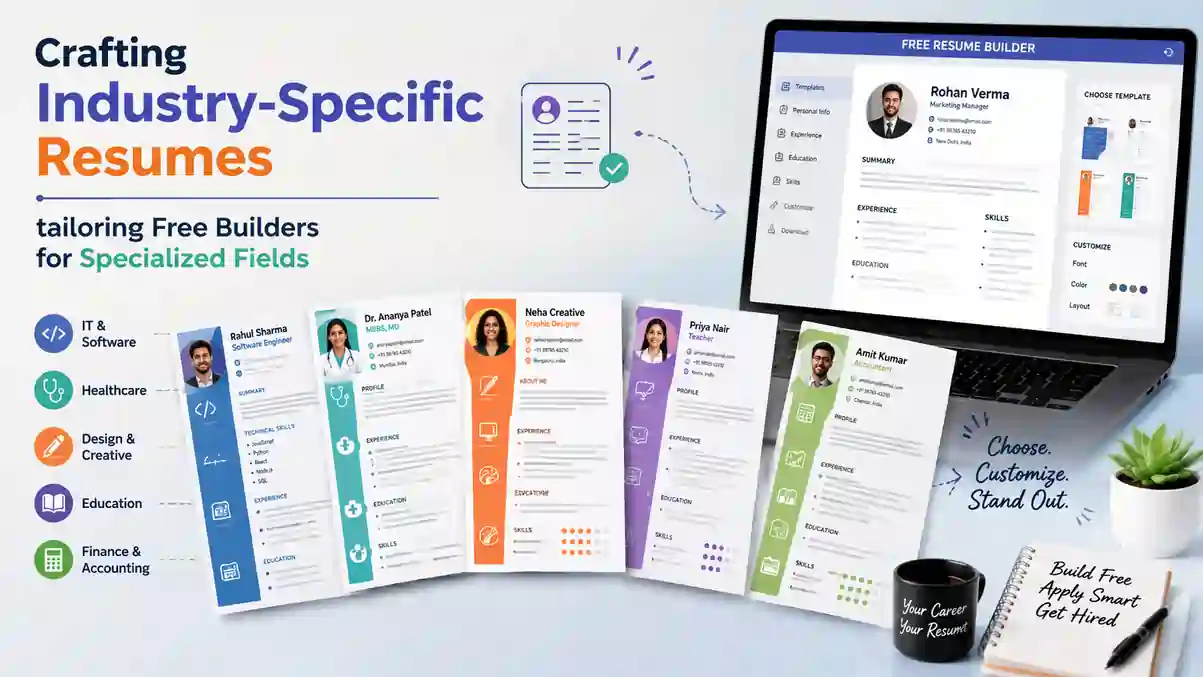
You don't land interviews by sending the same document to every posting. Use industry-specific resume customization tips to match the language, metrics, and proof hiring teams expect in your field.
In the next few minutes, you'll learn exactly what to change, how to pick the right builder, and the quick checks that keep your resume readable for both ATS and humans — with a repeatable workflow you can use before each application.
Table of Contents
- What Actually Changes by Industry
- Choosing the Right Tool Without Paying a Dime
- What to Test in 15 Minutes
- Beating the Bots and Showing Real Impact
- ATS-Minded Customization Tips
- Content That Signals You've Done the Job
- Metrics and Proof That Matter by Industry
- Templates, Sections, and Layout Decisions
- Formatting Rules That Travel Across Industries
- Quick Setup Checklist
- Frequently Asked Questions
- Conclusion
Industry-Specific Resume Customization Tips: What Actually Changes?
An industry-specific resume highlights the signals that matter in your niche — tools, standards, and outcomes — so a recruiter can see relevance in seconds. Scan industry-specific resume examples to spot patterns: common section order, go-to metrics, and keywords that show up across top candidates.
This same principle applies to structuring your document overall, as covered in our ATS-friendly resume format guide, where relevance and clarity consistently beat generic templates.
Choosing the Right Tool Without Paying a Dime
A free resume builder is fine if it exports cleanly, lets you edit section headings, and doesn't lock critical settings like font size or margins. Look for a resume builder for professionals that supports multiple versions so you can keep one master file and spin off tailored copies fast.
Our own breakdown of India's best free resume builders for 2026 covers exactly which tools meet this bar without hidden paywalls.
What to Test in 15 Minutes
- Export a PDF and DOCX; open both to verify spacing and bullet alignment.
- Swap a section order and confirm nothing breaks.
- Run a quick ATS scan to see if all text is selectable and parseable.
Beating the Bots and Showing Real Impact
An ATS resume builder should produce single-column layouts, standard headings, and selectable text — no text boxes or decorative icons. Prioritize resume templates by industry that make room for job-specific proof: portfolios for designers, publications for researchers, or licenses for clinicians.
For a deeper walkthrough, see our guide on how to build an ATS-friendly resume that passes the bots.
ATS-Minded Industry-Specific Resume Customization Tips
- Mirror exact phrasing from the job description for must-have skills and tools.
- Use simple bullets; keep special characters, graphics, and tables out of the main body.
- Name files like FirstLast-Role-Company.pdf and stick to common fonts (Calibri, Arial, Georgia).
These formatting habits pair well with the keyword strategy detailed in our guide to ATS keywords for IT jobs in India.
Content That Signals You've Done the Job
A solid professional resume builder won't write your bullets, but it should make it easy to quantify impact and keep tense, punctuation, and spacing consistent. For a tough resume for specialized jobs, lead each bullet with an action, include the context, and close with a result tied to an industry metric.
This action-context-result structure is the same approach we recommend in writing strong resume work experience sections.
Metrics and Proof That Matter by Industry
| Industry | Key Metrics to Highlight |
|---|---|
| Software | Release frequency, defect escape rate, unit test coverage, performance gains |
| Marketing | CTR, MQL-to-SQL conversion, CAC payback, organic growth rate |
| Operations | On-time delivery, throughput, scrap rate, cost per unit |
| Healthcare | Patient load per shift, time-to-triage, compliance pass rates |
| Finance | Cycle time for close, variance accuracy, audit findings resolved |
Templates, Sections, and Layout Decisions
Use custom resume templates to surface what matters: a "Selected Projects" block for engineers, "Grants & Publications" for academia, or "Licenses & Certifications" for regulated roles. The best resume builder for job applications lets you save multiple templates and swap sections quickly so you can adapt to each posting without rebuilding.
See our list of 10 essential resume sections in 2026 for a full breakdown of what to include and when.
Formatting Rules That Travel Across Industries
- Length: early career 1 page; senior ICs 1–2 pages; leadership 2 pages if the content earns the space.
- Bullets: 2–5 per role; each one proof-driven, not task-driven.
- Dates: month + year for recent roles; year-only for older roles is fine.
- Education: keep it compact unless the role is academic or licensure-heavy.
These universal rules echo the structural advice in our resume formats overview.
Industry-Specific Resume Customization: Quick Setup Checklist
- Language: mirror the job posting's exact skill and tool phrasing.
- Metrics: pick 2–3 industry-standard metrics per role.
- Structure: single column, standard headings, selectable text only.
- Sections: add field-specific blocks (portfolio, publications, licenses).
- Files: FirstLast-Role-Company.pdf, tested in both PDF and DOCX.
Frequently Asked Questions
1. How many versions of my resume should I keep for different industries?
Keep one master resume with all your experience, then spin off 2–3 tailored versions per industry or role type so you can apply quickly without losing quality.
2. Do I need different metrics for every industry?
Yes, each industry has its own standard metrics — for example, software roles focus on release frequency and defect rates, while marketing roles focus on CTR and conversion rates.
3. Is it okay to reuse the same bullets across industries?
Reusing bullets works only if you adjust the metric and phrasing to match the target industry's language and priorities; generic bullets reduce relevance.
4. What file format is safest for industry-specific resumes?
A text-based PDF is generally safest since it preserves formatting while remaining ATS-parseable, but keeping a DOCX version handy helps when a portal requests it.
5. Should regulated industries like healthcare include licenses on the resume?
Yes, licenses and certifications should be a dedicated section near the top for regulated roles like healthcare, since compliance is often a first-pass filter.
Conclusion
Focus on three things: match the posting's language, prove impact with metrics, and ship a clean, ATS-friendly file. If you repeat that workflow, you'll turn solid experience into interviews, fast — because industry-specific resume customization tips work by making relevance obvious.
Ready to build your next version? Try a template, test your export, and tailor one role at a time.
Start Free with ResumeEra