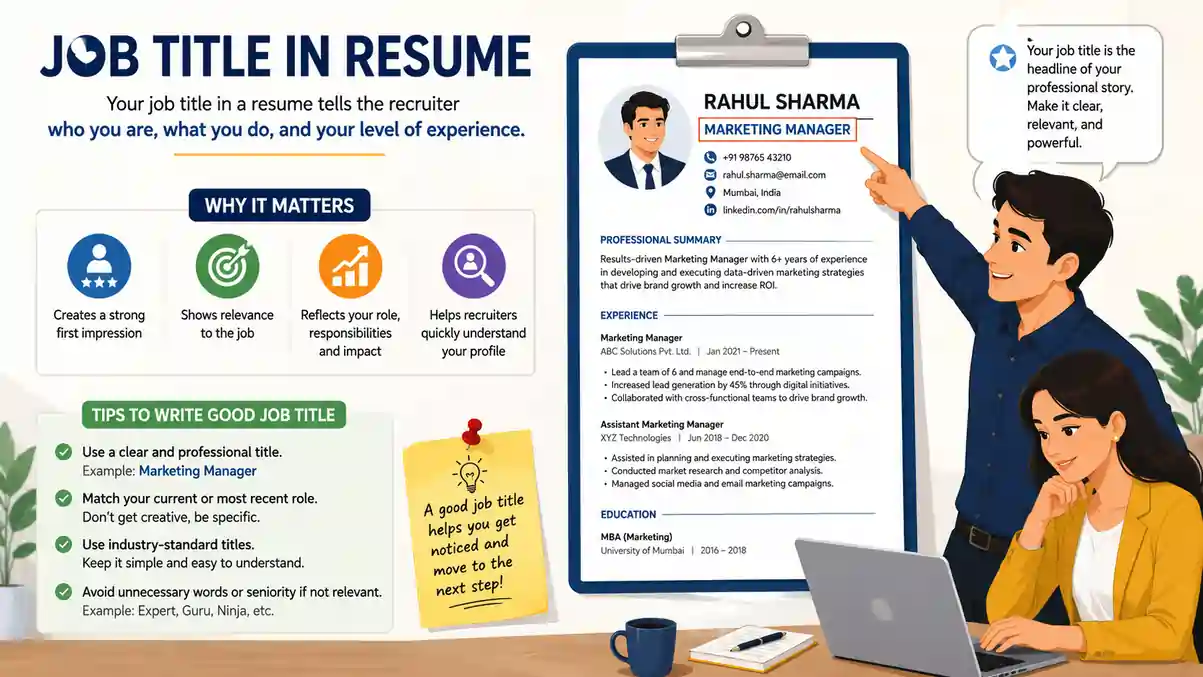
The job title in resume is arguably the most critical piece of metadata on your entire application document. It serves as the headline of your professional identity, the first filter for Applicant Tracking Systems (ATS), and the primary hook for hiring managers scanning your profile. A well-crafted title can bridge the gap between your experience and a new opportunity, while a poorly formatted one can cause your application to be discarded before a human ever sees it.
Many candidates make the mistake of treating their resume title as a literal copy-paste of their current employment designation. However, the strategic placement and wording of your job title go far beyond simple labeling. It requires an understanding of search intent, industry terminology, and how algorithms parse candidate data. Whether you are a senior executive, a mid-level specialist, or a career changer, mastering the job title in resume construction is the foundation of a successful job search strategy.
Understanding the Strategic Role of Your Job Title
Before diving into formatting rules, it is essential to understand the functional purpose of the job title in resume contexts. This element is not merely a label; it is a signal of relevance. In the modern recruitment landscape, hiring managers and recruiters often spend less than seven seconds on an initial resume scan. During this window, they look for two things: your current role and your immediate relevance to their open position.
Primary vs. Secondary Titles
In many industries, professionals hold multiple responsibilities that do not fit neatly into a single linear title. For example, a leader in a startup might be the "Head of Product" but also perform duties equivalent to a "Product Manager" and "Project Manager." The general rule is to prioritize the title that aligns most closely with the job you are applying for, while ensuring it remains truthful to your experience. Resume format 2026 often recommend using hybrid titles for clarity.
Optimizing for Applicant Tracking Systems (ATS)
Before a human ever reviews your application, your resume is likely processed by an ATS. These software systems scan documents for specific keywords, including job titles, to rank candidates. If your job title in resume does not contain the keywords the system is looking for, you may be filtered out immediately.
Keyword placement tip: Always mirror the exact title from the job description when possible. For deeper ATS strategies, check our guide on tailoring your resume for ATS.
Keyword Placement and Density
While the job title is a primary keyword, it should not be stuffed. It should appear prominently at the top of the resume, ideally near your name. Some candidates choose to include their target title as a subtitle. Learn more about writing a professional summary that complements your title perfectly.
How to Format the Job Title in Resume Headers
The visual presentation matters just as much as wording.
The Standard Header Approach
- John Smith → Senior Financial Analyst
The Target Title Approach
- Sarah Johnson → Aspiring Product Manager
The Hybrid Format
- Director of Engineering (Lead Software Architect)
Handling Title Mismatches and Career Transitions
When Your Official Title is Too Low
Use a parenthetical explanation: "Team Coordinator (Acting Manager)".
When Your Official Title is Too Vague
Translate "Growth Rockstar" → "Digital Marketing Manager". For career changers, see career change resume strategy and transferable skills guide.
Common Mistakes to Avoid with Job Titles
- Internal jargon: Never use "Level 4 Associate" – use standard titles.
- Over-exaggerating: Don't claim "Director" if you were "Analyst".
- Ignoring industry standards: Research job descriptions. Use ATS keywords for IT jobs tools.
Decision Framework: Choosing the Right Title
| Scenario | Recommended Strategy | Example |
|---|---|---|
| Official title matches target job | Use the exact title | Sales Manager → Sales Manager |
| Official title is internal jargon | Translate to industry standard | Ninja → Software Engineer |
| Too junior title | Descriptive subtitle | Analyst (Acting Team Lead) |
| Changing careers | Target title + context | Teacher → Learning & Development Specialist |
? More frameworks: ATS resume format and ATS-friendly resume templates can boost your success.
Industry-Specific Nuances
Technology and Engineering
Junior / Senior / Staff / Principal — levels matter. Read tech resume guide for engineers.
Sales and Marketing
Avoid "Ninja" / "Rockstar". Stick to "Sales Representative" or "Marketing Manager".
Healthcare and Finance
Precision is non-negotiable (RN vs NP). See finance resume standards and healthcare resume tips.
Advanced Strategies for Executive and Senior Roles
For C-Suite candidates, the job title in resume should align with the specific board or executive role they are targeting. Use "Chief Operating Officer" or "Chief Executive Officer | Strategic Operations Leader".
Related: executive resume writing strategies and board-level interview preparation.
Conclusion
The job title in resume is more than just a label; it is the cornerstone of your professional narrative. It determines how algorithms categorize you, how recruiters perceive your seniority, and whether you get the crucial first glance. By strategically selecting, formatting, and optimizing your title, you ensure that your experience is recognized and valued.
To further refine your approach, explore how to write a resume in 2026 and career progression strategies. With the right title and a solid strategy, you are well on your way to achieving your career goals.
? Need personalized help? Check our free ATS resume checker.
Job Title in Resume: The Ultimate Guide to Formatting and Optimization
The job title in resume is arguably the most critical piece of metadata on your entire application document. It serves as the headline of your professional identity, the first filter for Applicant Tracking Systems (ATS), and the primary hook for hiring managers scanning your profile. A well-crafted title can bridge the gap between your experience and a new opportunity, while a poorly formatted one can cause your application to be discarded before a human ever sees it.
Many candidates make the mistake of treating their resume title as a literal copy-paste of their current employment designation. However, the strategic placement and wording of your job title go far beyond simple labeling. It requires an understanding of search intent, industry terminology, and how algorithms parse candidate data. Whether you are a senior executive, a mid-level specialist, or a career changer, mastering the job title in resume construction is the foundation of a successful job search strategy.
Understanding the Strategic Role of Your Job Title
Before diving into formatting rules, it is essential to understand the functional purpose of the job title in resume contexts. This element is not merely a label; it is a signal of relevance. In the modern recruitment landscape, hiring managers and recruiters often spend less than seven seconds on an initial resume scan. During this window, they look for two things: your current role and your immediate relevance to their open position.
Primary vs. Secondary Titles
In many industries, professionals hold multiple responsibilities that do not fit neatly into a single linear title. For example, a leader in a startup might be the "Head of Product" but also perform duties equivalent to a "Product Manager" and "Project Manager." The general rule is to prioritize the title that aligns most closely with the job you are applying for, while ensuring it remains truthful to your experience. Resume format 2026 often recommend using hybrid titles for clarity.
Optimizing for Applicant Tracking Systems (ATS)
Before a human ever reviews your application, your resume is likely processed by an ATS. These software systems scan documents for specific keywords, including job titles, to rank candidates. If your job title in resume does not contain the keywords the system is looking for, you may be filtered out immediately.
Keyword placement tip: Always mirror the exact title from the job description when possible. For deeper ATS strategies, check our guide on tailoring your resume for ATS.
Keyword Placement and Density
While the job title is a primary keyword, it should not be stuffed. It should appear prominently at the top of the resume, ideally near your name. Some candidates choose to include their target title as a subtitle. Learn more about writing a professional summary that complements your title perfectly.
How to Format the Job Title in Resume Headers
The visual presentation matters just as much as wording.
The Standard Header Approach
- John Smith → Senior Financial Analyst
The Target Title Approach
- Sarah Johnson → Aspiring Product Manager
The Hybrid Format
- Director of Engineering (Lead Software Architect)
Handling Title Mismatches and Career Transitions
When Your Official Title is Too Low
Use a parenthetical explanation: "Team Coordinator (Acting Manager)".
When Your Official Title is Too Vague
Translate "Growth Rockstar" → "Digital Marketing Manager". For career changers, see career change resume strategy and transferable skills guide.
Common Mistakes to Avoid with Job Titles
- Internal jargon: Never use "Level 4 Associate" – use standard titles.
- Over-exaggerating: Don't claim "Director" if you were "Analyst".
- Ignoring industry standards: Research job descriptions. Use ATS keywords for IT jobs tools.
Decision Framework: Choosing the Right Title
| Scenario | Recommended Strategy | Example |
|---|---|---|
| Official title matches target job | Use the exact title | Sales Manager → Sales Manager |
| Official title is internal jargon | Translate to industry standard | Ninja → Software Engineer |
| Too junior title | Descriptive subtitle | Analyst (Acting Team Lead) |
| Changing careers | Target title + context | Teacher → Learning & Development Specialist |
? More frameworks: ATS resume format and ATS-friendly resume templates can boost your success.
Industry-Specific Nuances
Technology and Engineering
Junior / Senior / Staff / Principal — levels matter. Read tech resume guide for engineers.
Sales and Marketing
Avoid "Ninja" / "Rockstar". Stick to "Sales Representative" or "Marketing Manager".
Healthcare and Finance
Precision is non-negotiable (RN vs NP). See finance resume standards and healthcare resume tips.
Advanced Strategies for Executive and Senior Roles
For C-Suite candidates, the job title in resume should align with the specific board or executive role they are targeting. Use "Chief Operating Officer" or "Chief Executive Officer | Strategic Operations Leader".
Related: executive resume writing strategies and board-level interview preparation.
Conclusion
The job title in resume is more than just a label; it is the cornerstone of your professional narrative. It determines how algorithms categorize you, how recruiters perceive your seniority, and whether you get the crucial first glance. By strategically selecting, formatting, and optimizing your title, you ensure that your experience is recognized and valued.
To further refine your approach, explore how to write a resume in 2026 and career progression strategies. With the right title and a solid strategy, you are well on your way to achieving your career goals.
? Need personalized help? Check our free ATS resume checker.
Frequently Asked Questions
Should my resume job title match the job description exactly?
Should my resume job title match the job description exactly?
Yes, highly recommended for ATS. But don't lie — use subtitles if needed.
What if my official title is obscure?
Translate to standard industry title. Learn how to translate job titles correctly.
Can I change my job title for a promotion I haven't received?
No. Use "Acting" or "Lead responsibilities" in parentheses.
How long should my resume job title be?
2–5 words. For length guidelines see resume length optimization.
Does the job title affect salary negotiations?
Absolutely. Understating can lower offers. Use accurate levels.
Why Trust Resumeera for Job Title in Resume: The Ultimate Guide to Formatting and Optimization?

written by (Sharukh Khan + AI)
Co-Founder & Career Expert
The insights shared here are based on real ATS screening experience, resume shortlisting patterns, and hands-on work with job seekers.
- ✔ Certified expertise in resume & ATS optimization
- ✔ Practical hiring exposure through active consultancy work
- ✔ Resume strategies tested against real job shortlisting
- ✔ Updated with current hiring and ATS trends
![Resume Objective Examples: 100+ Real examples [how to write]](/JobPost/uploads/blog/articles/227/featured_resume-objective-examples_6a36129e674a9.webp)