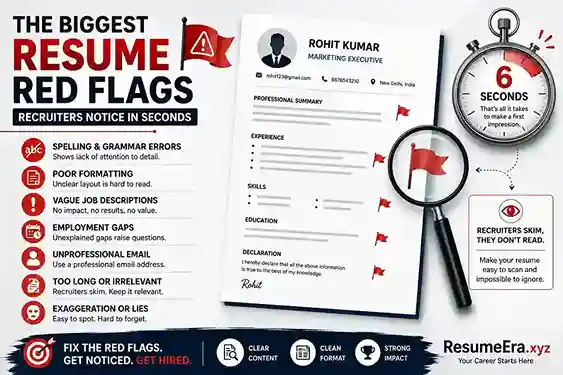
You don’t lose interviews because you’re unqualified—you lose them because of avoidable resume mistakes that make a busy recruiter stop reading in seconds. This guide breaks down the most common resume mistakes Indian recruiters and ATS tools notice instantly, and shows you how to fix them fast.
Table of Contents
- Introduction: Why Resume Mistakes Matter
- Resume Mistakes Recruiters Spot in Seconds
- Resume Mistakes That Break ATS Filters
- Formatting, Structure, and First Impressions
- Evidence Beats Claims: Show Impact Fast
- ATS Reality on Indian Portals
- India‑Specific Red Flags and Fixes
- Freshers vs Experienced: Length & Layout
- FAQ: Common Resume Mistakes
- Summary & Next Steps
Pro tip: fix formatting and vague bullets before changing templates. Clean structure plus quantified outcomes beats any “fancy” CV design.
Introduction: Why Resume Mistakes Matter
Recruiters in India skim hundreds of resumes a week. In the first six to eight seconds, they decide whether to keep reading or move on. Tiny resume mistakes—messy fonts, vague bullets, missing keywords—can block your profile before your actual skills get a chance.
The good news? Most resume writing mistakes are fixable in an afternoon. This article focuses on resume mistakes, resume red flags, and ATS resume mistakes that hurt Indian job seekers, and connects you to deeper guides on ResumeEra like biggest resume red flags recruiters spot India and ATS resume checklist before you apply .
Resume Mistakes Recruiters Spot in Seconds
The first scan is brutal but necessary. A professional resume has to clear three tests quickly: can I see your role, your impact, and your fit without zooming, scrolling, or guessing? If the answer is “no,” your resume is rejected before the recruiter ever checks your skills.
Common first‑pass resume mistakes include:
- Hard‑to‑read fonts or tiny body text (below 10.5–11pt).
- Walls of text with no white space or clear section headings.
- Job titles that don’t match the work (e.g., “Engineer” for a pure sales role).
- Buzzword dumps with no proof: “dynamic, motivated, results‑driven” without numbers.
- Irrelevant info up top: hobbies, full postal addresses, or personal details.
- Files named “Resume_final(3).doc” or sent as images instead of text‑based PDFs.
If you change only one thing, write like a human who solved real problems. Mirror the target job title, front‑load key skills, and put numbers before adjectives.
Resume Mistakes That Break ATS Filters
Most Indian employers use Naukri, LinkedIn, or in‑house ATS tools that parse your resume before a recruiter sees it. Here, formatting mistakes matter even more. Two‑column designs, text inside images, and graphic‑only skill bars are classic ATS resume mistakes that lead to auto‑rejection.
Avoid these ATS‑breaking resume mistakes:
- Using multi‑column layouts that jumble skills and experience during parsing.
- Putting content in tables, text boxes, or decorative frames.
- Embedding keywords, skills, or contact info inside images or logos.
- Submitting scanned or image‑only PDFs that contain no selectable text.
- Creative headings like “My Journey” instead of “Experience” or “Work Experience”.
A safer approach is a clean, single‑column resume with standard headings and month–year date ranges. For a full ATS formatting breakdown, pair this section with ResumeEra’s ATS‑friendly resume format for beginners and create a resume that passes AI resume screening tools (India) .
Formatting, Structure, and First Impressions
Bad fonts, uneven spacing, and creative layouts feel clever on your own screen until they distort on someone else’s device. Classic CV mistakes here include using tables for layout, centre‑aligning bullets, mixing three different fonts, and bolding everything.
Use these formatting rules to clean up first impressions:
- Stick to one professional font family (system UI, Calibri, or Arial).
- Left‑align body text and bullets; use bold only to guide the eye.
- Keep consistent spacing and date formats across every section.
- Place job titles, companies, cities, and dates in predictable locations.
- Limit colour to headings and links; avoid heavy backgrounds or gradients in the resume itself.
For more structure ideas, combine this advice with ResumeEra’s resume formatting best practices .
Evidence Beats Claims: Show Impact Fast
Claims don’t convince; evidence does. Recruiters see vague, duty‑only bullets all day: “Responsible for social media,” “Worked on sales,” “Handled accounting tasks.” These are classic resume mistakes because they say nothing about scale, complexity, or results.
Flip your bullets from duties to impact:
- Before: “Responsible for social media.”
After: “Grew Instagram leads from 25/month to 110/month in 90 days by testing Reels hooks and UTM tracking.” - Before: “Worked on sales.”
After: “Closed ₹1.2 Cr in FY24 across SMB SaaS by reviving stalled deals with 3‑call discovery and ROI decks.” - Before: “Handled accounting tasks.”
After: “Reduced reconciliation time by 40% by automating GST invoice matching in Tally.”
To sharpen your action verbs and metrics, use ResumeEra’s 25 resume action verbs and how to quantify resume achievements (India) .
ATS Reality on Indian Portals
On Naukri and LinkedIn, headline, job titles, and skills carry heavy weight in ATS scoring. Keep your headline close to the target: “Senior Data Analyst | SQL, Power BI, Python.” Put the most relevant project or recent role first, not necessarily the one you held longest.
Avoid skills stuffing; repeat the most important keywords naturally inside your bullets instead. Use a sensible file name like “Aditi‑Sharma‑Product‑Manager.pdf,” a professional email address, and text‑based PDF or DOCX uploads. If the portal offers both a form and an upload, paste clean text into the form and still upload the full ATS‑friendly resume.
For a deeper ATS view, pair this section with ATS‑friendly resume guide 2026 .
India‑Specific Red Flags and Fixes
Photos, marital status, religion, caste, or full postal address still show up on many Indian CVs. These are strong resume red flags because they invite bias, add no proof, and waste space that could be used for achievements.
Modern Indian resume contact details need only one line:
- City, state (e.g., Bengaluru, Karnataka).
- Mobile with country code (e.g., +91‑98765‑43210).
- Professional email.
- LinkedIn profile link; portfolio link only if maintained.
For a full list of recruiter‑level red flags, see ResumeEra’s biggest resume red flags recruiters spot in India .
Fresh Grad vs Experienced: Length and Layout
One of the most common resume mistakes is using the wrong length. Freshers try to stretch thin experience to two pages; senior professionals squeeze a decade of impact into one. In India, a simple rule works well: one page for early careers and tight pivots; two pages for multi‑year leadership, complex projects, and varied domains.
Fresh grads should keep it simple: one page, focused on internships, hackathons, college projects, and targeted coursework. Ten years or more? Two pages are fine—detail the last 5–7 years and compress older roles. Don’t hide career breaks; give a one‑line reason and move on.
For more detail, combine this section with resume length one page vs two pages explained (India) .
FAQ: Common Resume Mistakes
Summary & Next Steps
TL;DR: Recruiters reject fast because they must. Strip out noise, fix obvious resume mistakes, and show impact in the first third of the page. Use a clean, ATS‑friendly single‑column layout, focus on outcomes instead of duties, and cut any line that doesn’t sell the role you actually want.
Most Indian job seekers can dramatically improve interview rates by fixing a small set of resume red flags: messy formatting, vague bullets, outdated personal information, and ATS‑hostile templates. Let your results—not adjectives or graphics—carry the weight.