Resume Era - Professional Resume Builder

25 Resume Action Verbs That Make Your Experience Stand Out

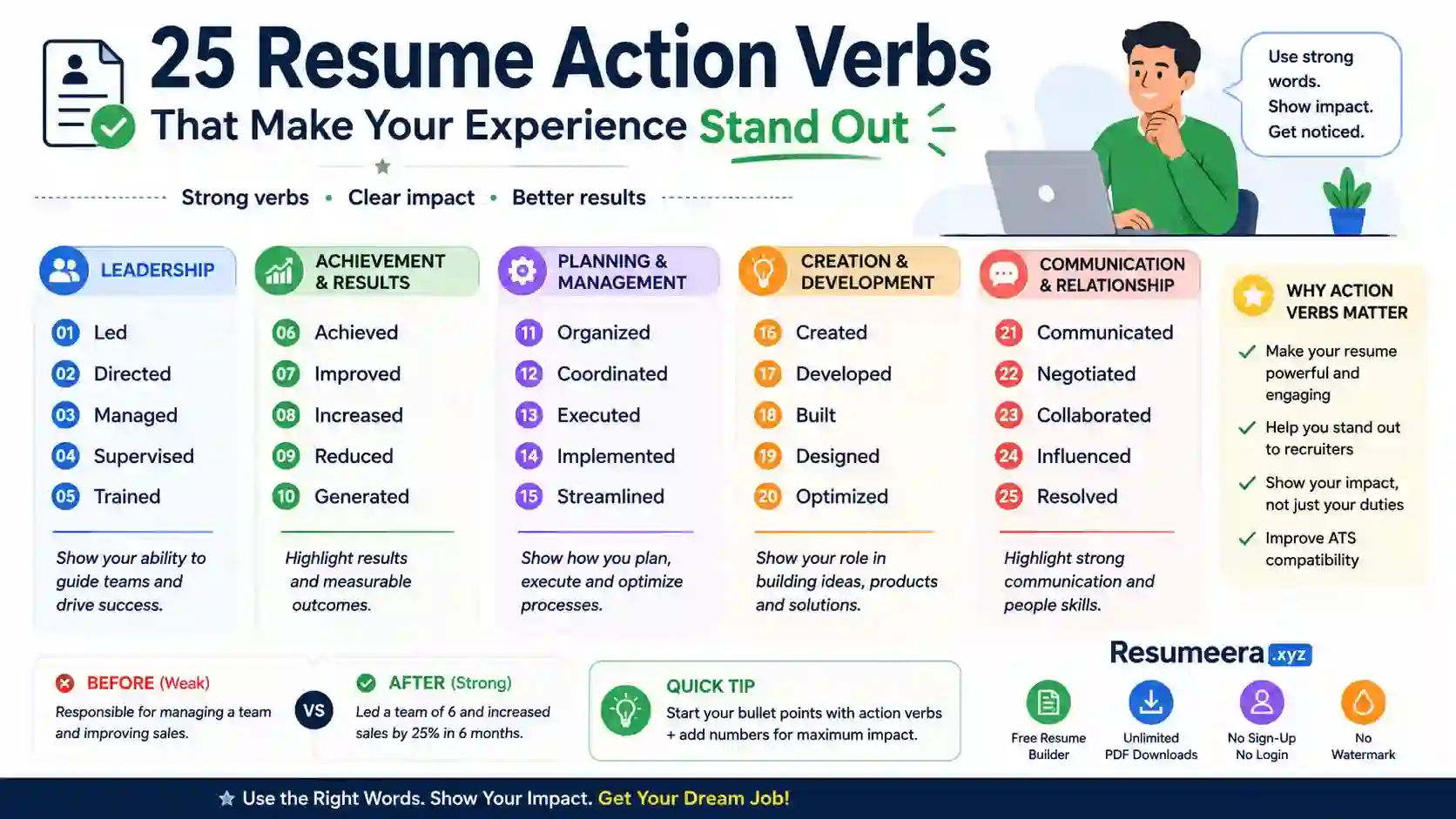
25 Resume Action Verbs That Make Your Experience Stand Out

Your resume gets 6–8 seconds of attention. In those precious seconds, every word matters. But most job seekers waste valuable real estate with weak verbs like "responsible for," "worked on," or "helped with." These generic phrases don't convey impact. Recruiters don't remember them. ATS systems don't prioritize them.

The difference between a resume that gets ignored and one that gets interviews often comes down to one thing: action verbs. Powerful resume action verbs immediately communicate that you're results-driven, capable, and worth an interview.

This guide gives you 25 powerful action verbs for resume organized by type, real before/after examples from different industries, and a framework for choosing the right verb for every bullet point. By the end, you'll know exactly which strong resume verbs will make your experience stand out.

Why Action Verbs Matter More Than You Think

Consider these two resume bullets for the same job:

Responsible for managing a team of 5 people and handling customer inquiries.
Spearheaded a high-performing team of 5, reducing response time by 35% and improving satisfaction scores by 22%.

Same role. Same accomplishment. One verb makes all the difference. "Spearheaded" tells a story: leadership, action, results. "Responsible for" is passive. It tells recruiters you showed up. "Spearheaded" tells them you owned the outcome.

Strong resume power words do three things: (1) They grab attention in the first 6 seconds, (2) They pass ATS keyword filters, and (3) They make you memorable. Weak verbs do none of these.

? Key Insight: Recruiters scan for achievements and impact. Action verbs signal impact. Generic verbs signal passivity. Choose accordingly.

Leadership Action Verbs That Command Attention

Leadership verbs convey confidence, vision, and accountability. Use these when you've taken charge, set direction, or guided others toward results.

1. Spearheaded

Led an initiative or project from inception to successful completion.
Spearheaded migration to cloud infrastructure, reducing operational costs by 40%.

2. Orchestrated

Coordinated multiple teams, resources, or strategies toward a unified goal.
Orchestrated company-wide digital transformation, aligning 3 departments and 40+ stakeholders.

3. Championed

Advocated for and drove adoption of new ideas, processes, or changes.
Championed diversity hiring initiatives, increasing hiring from underrepresented groups by 50%.

4. Pioneered

Introduced something new or innovative to an organization.
Pioneered India's first AI-powered customer support system within the organization.

5. Accelerated

Increased the speed or efficiency of processes, growth, or outcomes.
Accelerated product launch timeline by 3 months through agile restructuring.

Management Action Verbs That Show Capability

Management verbs demonstrate your ability to handle responsibility, organize resources, and deliver results. These work well when describing supervisory, operational, or project leadership experience.

6. Optimized

Improved efficiency, performance, or cost-effectiveness of a process or system.
Optimized inventory management system, reducing waste by 28% and saving ₹5 lakhs annually.

7. Scaled

Expanded operations, teams, or systems to handle increased demand.
Scaled customer support team from 5 to 25 people, maintaining 95%+ satisfaction.

8. Streamlined

Simplified or improved a process by removing unnecessary steps.
Streamlined onboarding process, reducing new hire ramp-up time from 6 weeks to 3 weeks.

9. Directed

Managed day-to-day operations or team activities with clear guidance.
Directed daily operations for 3 retail locations, maintaining profit margins of 18%+.

Technical & Analytical Action Verbs

Technical verbs demonstrate your ability to solve problems, build systems, and work with data or technology. Critical for IT, engineering, data science, and analytical roles.

10. Developed

Created, built, or designed new solutions, products, or systems.
Developed full-stack web application processing 10,000+ transactions daily.

11. Engineered

Designed or built complex technical solutions with precision.
Engineered microservices architecture supporting 1M+ concurrent users.

12. Analyzed

Examined data or information to draw insights and conclusions.
Analyzed customer behavior patterns, identifying high-value segments and increasing revenue by 32%.

13. Automated

Implemented technology to reduce manual work and increase efficiency.
Automated QA testing pipeline, reducing manual testing time by 60%.

14. Migrated

Moved systems, data, or processes from one platform to another.
Migrated legacy systems to cloud with zero downtime and 20% cost reduction.

15. Configured

Set up or customized systems, software, or hardware.
Configured ERP systems for 5 business units with 99.8% uptime.

Communication & Collaboration Verbs

Communication verbs highlight your ability to influence, persuade, and work effectively with others. Valued across all industries and roles.

16. Negotiated

Successfully worked toward agreements or favorable terms.
Negotiated vendor contracts, securing 25% cost savings without service reduction.

17. Collaborated

Worked effectively with teams or departments toward common goals.
Collaborated with product, design, and engineering teams to launch 12 new features in 6 months.

18. Presented

Communicated ideas, data, or strategies to audiences.
Presented quarterly business reviews to C-suite and board members, securing ₹2 crore in additional funding.

19. Influenced

Persuaded stakeholders to support a direction or decision.
Influenced leadership to adopt new marketing strategy, resulting in 45% increase in lead generation.

20. Mentored

Guided and developed team members professionally.
Mentored 6 junior developers, resulting in 3 promotions to senior roles.

Creative & Initiative Action Verbs

Use these verbs when you've taken independent action, solved problems creatively, or launched new initiatives.

21. Launched

Initiated and brought new products, campaigns, or programs to market.
Launched India-specific marketing campaign, acquiring 50,000 users in first quarter.

22. Transformed

Made significant, fundamental changes to improve outcomes.
Transformed customer retention program, increasing lifetime value by 60%.

23. Designed

Created or planned something new with purpose and intention.
Designed comprehensive employee wellness program, improving engagement scores by 35%.

24. Initiated

Started something new or took first steps toward change.
Initiated cross-functional innovation lab resulting in 5 patent applications.

25. Resolved

Found solutions to problems or eliminated obstacles.
Resolved critical system vulnerabilities, ensuring 99.99% security compliance.

Real Before & After Examples by Industry

IT Professional (Software Developer)

Role: Full-Stack Developer with 3 years experience

Worked on various projects using Java, Python, and React. Helped fix bugs and improved system performance.
Engineered 8+ full-stack applications using Java, Python, and React. Optimized database queries, reducing API response time by 45% and improving user experience for 100K+ daily active users.

Sales Professional

Role: Senior Account Manager with 5 years experience

Responsible for managing accounts and increasing sales. Worked with clients to meet their needs.
Orchestrated relationships with 25 enterprise clients, generating ₹5 crore annual revenue. Negotiated contract renewals, achieving 95% retention rate and 18% average uplift per account.

Marketing Professional

Role: Digital Marketing Manager

Responsible for managing social media and email campaigns. Helped increase brand awareness and engagement.
Launched integrated digital campaign across 5 channels, acquiring 75K new customers and increasing brand awareness by 150%. Analyzed performance data, optimizing ad spend and reducing cost-per-acquisition by 38%.

HR Professional

Role: HR Manager

Managed recruitment and employee development. Worked with teams to improve hiring and training processes.
Spearheaded end-to-end recruitment for 50+ positions, reducing time-to-hire from 60 to 35 days. Pioneered competency-based training program, improving employee retention by 22% and promotion rates by 35%.

How to Choose the Right Action Verb for Your Role

Not every powerful verb works for every situation. Here's a framework for selecting the right one:

Step 1: Identify Your Achievement

Start with what you actually did. Be honest. Did you lead it? Support it? Build it? Improve it? Analyze it?

Step 2: Match the Verb to the Action

  • If you led something: Use leadership verbs (spearheaded, orchestrated, championed, pioneered)
  • If you improved efficiency: Use management verbs (optimized, streamlined, scaled, accelerated)
  • If you built or created: Use technical verbs (developed, engineered, designed, automated)
  • If you influenced or worked with others: Use communication verbs (negotiated, collaborated, mentored, influenced)
  • If you started something new: Use creative verbs (launched, pioneered, transformed, initiated)

Step 3: Add Metrics (Critical)

The verb matters. Metrics matter more. "Accelerated growth" is good. "Accelerated growth by 45%" is unforgettable. Every bullet should have a number.

Step 4: Mirror the Job Description

If the job posting emphasizes "leadership," use leadership verbs. If it emphasizes "technical expertise," use technical verbs. This helps with both recruiters and ATS systems.

Weak Resume Verbs to Replace Immediately

These verbs are passive, vague, and unmemorable. Replace them:

Responsible for
Too passive. Doesn't convey action or ownership.
Use instead: Spearheaded, Directed, Managed, Owned
Worked on
Vague. Doesn't say what you did.
Use instead: Developed, Engineered, Created, Built
Helped with
Subordinate. Minimizes your role.
Use instead: Collaborated on, Contributed to, Supported, Assisted in implementing
Participated in
Generic and forgettable.
Use instead: Drove, Led, Orchestrated, Championed

ATS-Friendly Tips for Resume Action Verbs

Your resume doesn't just need to impress recruiters—it needs to pass ATS (Applicant Tracking System) filters first. Here's how action verbs factor in:

✓ ATS Tip 1: Use industry-standard verbs. If the job posting says "Developed solutions," use "Developed." If it says "Engineered systems," use "Engineered." ATS matches keywords.
✓ ATS Tip 2: Don't overuse the same verb. Vary your action verbs across bullets. Using "Managed" 5 times looks repetitive and may hurt your score.
✓ ATS Tip 3: Include both verbs and metrics. "Increased revenue" is good. "Increased revenue by 35%" with metrics makes it ATS-relevant and searchable.
✓ ATS Tip 4: Keep formatting simple. Don't use bullet symbols or special characters that ATS might not recognize. Use standard hyphens or dashes.

For a complete guide on making your resume ATS-friendly, see our dedicated resource.

Frequently Asked Questions

Are action verbs really that important?

Yes. They're one of the easiest high-impact changes you can make. A weak verb makes strong achievement sound mediocre. A strong verb makes any achievement sound impressive.

What's wrong with "responsible for"?

It's passive and vague. It tells recruiters you occupied a position, not that you drove results. Replace it with something active: "Spearheaded," "Managed," "Directed," or "Orchestrated."

Should I use the same action verb twice on my resume?

Avoid it. Repetition looks lazy and hurts readability. A 1-page resume should have 5–6 bullets with 5–6 different verbs. A 2-page resume can handle 10 unique verbs.

How many action verbs should I use?

One per bullet point. Start each bullet with a strong action verb, then add context and metrics. Example: "Spearheaded product launch, acquiring 50K users in Q1."

Can I use uncommon action verbs?

Yes, but be strategic. Uncommon verbs like "orchestrated" or "pioneered" stand out positively. But avoid verbs so obscure that recruiters need a dictionary. Test readability with a peer.

Do ATS systems recognize action verbs?

Yes. ATS systems scan for industry keywords, including action verbs. Using verbs that appear in the job description improves your ATS score and increases visibility.

Best action verbs for freshers with no work experience?

Focus on academic, project, and volunteer achievements. Use: "Developed," "Designed," "Created," "Analyzed," "Collaborated," "Initiated." Examples: "Developed mobile app for class project" or "Designed UI for volunteer nonprofit website."

Should action verbs match the job description?

Absolutely. If the posting says "Led cross-functional teams," use a leadership verb like "Spearheaded" or "Orchestrated." This signals relevance to both recruiters and ATS.

Can I use the same verb in different sections of my resume?

If sections are different (e.g., experience and projects), it's acceptable. But within your work experience section, vary your verbs. It improves readability and demonstrates versatility.

How do I choose between similar verbs?

Look at nuance. "Managed" suggests overseeing operations. "Spearheaded" suggests leading from the front. "Orchestrated" suggests coordinating multiple teams. Pick the one truest to what you did.

Your Action Verbs Are Your Resume's MVP

Strong action verbs are the difference between a resume that disappears into the pile and one that gets interviews. They're quick wins—low effort, high impact. You don't need to rewrite your entire resume. Just swap out weak verbs for powerful ones, add metrics, and watch the difference.

Here's what to do next:

  • Go through your current resume and find every instance of "responsible for," "worked on," "helped with," or other weak verbs
  • Replace them with verbs from this list that match your actual role and accomplishments
  • Add metrics to back up every verb
  • Mirror the job description's language for each application
  • Use a free resume builder to format everything professionally with zero watermarks

You've worked hard. Your achievements deserve strong resume verbs that reflect your actual impact. Don't let weak language hold you back.

Build Your Resume with Strong Action Verbs → Resumeera.xyz

Start using these 25 powerful verbs today and land more interviews tomorrow. ?

{ "@context": "https://schema.org", "@type": "BlogPosting", "headline": "25 Resume Action Verbs That Make Your Experience Stand Out", "description": "Discover 25 powerful resume action verbs organized by category with real before/after examples. Learn how to replace weak verbs and improve your resume impact.", "author": { "@type": "Organization", "name": "Resumeera.xyz" }, "datePublished": "2026-08-15", "dateModified": "2026-08-15", "keywords": "resume action verbs, action verbs for resume, strong resume verbs, resume power words, leadership action verbs" } { "@context": "https://schema.org", "@type": "FAQPage", "mainEntity": [ { "@type": "Question", "name": "Are action verbs really that important?", "acceptedAnswer": { "@type": "Answer", "text": "Yes. Strong action verbs are one of the easiest high-impact changes you can make to your resume. They transform weak achievements into impressive accomplishments." } }, { "@type": "Question", "name": "Should I use the same action verb twice on my resume?", "acceptedAnswer": { "@type": "Answer", "text": "Avoid it. Repetition looks lazy and hurts readability. Use different verbs for each bullet point to maintain variety and interest." } }, { "@type": "Question", "name": "Do ATS systems recognize action verbs?", "acceptedAnswer": { "@type": "Answer", "text": "Yes. ATS systems scan for industry keywords including action verbs. Using verbs that appear in the job description improves your ATS score significantly." } } ] }

Why Trust Resumeera for 25 Resume Action Verbs That Make Your Experience Stand Out?

Resumeera Team – Certified Resume Expert

Written by Resumeera Team Co-Founder & Certified Career Expert

The insights shared here are based on real ATS screening experience, 500+ resume shortlisting patterns, and hands-on work with job seekers.

Last reviewed & updated: | Published on Resumeera.xyz

ResumeEra – Footer