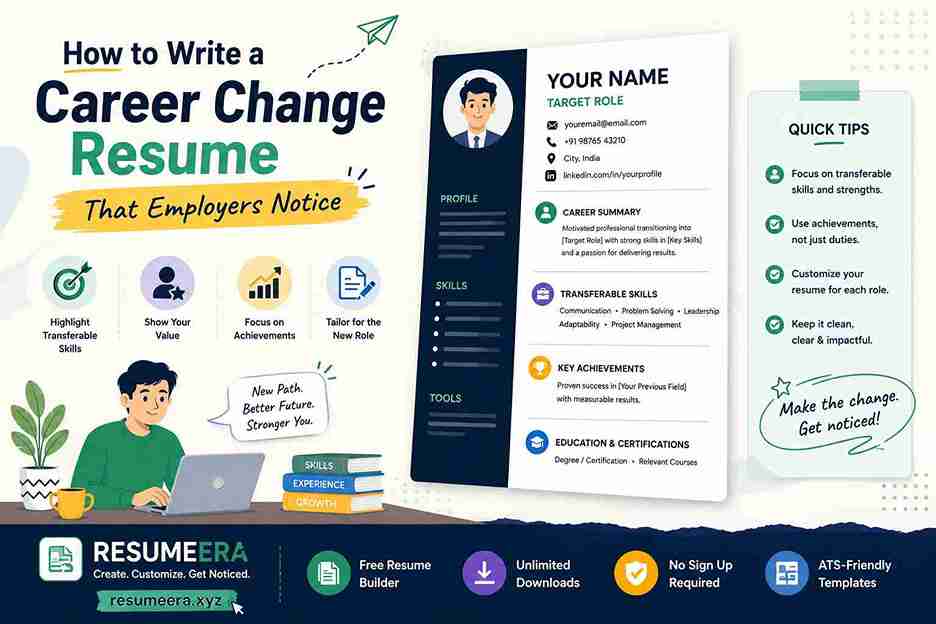
Switching careers in India is more common than ever. An IT support engineer wants to move into data analytics, a school teacher aims for a corporate L&D role, a sales executive targets digital marketing, and a bank operations officer wants to enter fintech product management. Recruiters on Naukri, LinkedIn and company career portals see hundreds of such applications every week, but most career change resumes get rejected in the first 6 seconds because they read like a history of the old job instead of a pitch for the new one. Indian hiring managers and ATS software look for direct relevance, not just years of experience. If your resume still highlights your previous job title, old KRAs and industry jargon that means nothing to the new field, you will be filtered out before a human ever reads it. This guide shows you exactly how to rewrite your resume so that your transferable skills, projects and results speak the language of the role you want next, whether you are a fresher exploring a different stream or an experienced professional with 5 to 15 years in another domain.
Why Career Change Resumes Fail in India’s Job Market
Indian recruiters spend very little time on an initial scan. On Naukri RMS, LinkedIn Recruiter and platforms like Taleo and SAP SuccessFactors used by large Indian IT, BFSI and manufacturing companies, your resume is first parsed by software and then glanced at by a recruiter who is matching keywords from the job description. A career change resume fails when it forces the reader to connect the dots. If you spent four years as a mechanical engineer and now apply for a business analyst role, listing only machine maintenance and AutoCAD without showing analysis, stakeholder communication or Excel and SQL work will get you rejected, even if you did those tasks.
- Old job title dominance: Your headline and summary repeat your previous designation, so the recruiter assumes you are not serious about the new field.
- Irrelevant KRAs: Copying your old appointment letter duties without translating them into outcomes relevant to the target role.
- Missing keywords: Not using the exact skills, tools and certifications mentioned in Indian job postings for the new role, which causes ATS rejection.
- Chronological trap: Using a strict reverse-chronological format that highlights a career gap or unrelated progression and buries your relevant projects.
- No proof of transition: No courses, freelance projects, internships or volunteer work that shows you have already started working in the new domain.
For example, a customer support executive moving to HR needs to reframe ticket resolution and CSAT scores as employee query handling, conflict resolution and process improvement. A teacher moving to instructional design should not just list syllabus completion but highlight curriculum design, learner engagement metrics and use of tools like Articulate, Canva or LMS platforms. The fix is not to hide your experience but to translate it. Every bullet should answer: how does this experience help me do the new job better than a fresher?
Choosing the Right Resume Format for a Career Switch
Format decides whether your relevant strengths appear on the first half of page one. For career changers in India, the combination or hybrid format works best because it balances skills and experience. It starts with a strong summary and skills matrix, followed by relevant projects and then work history. This is far more effective than a purely chronological resume that emphasizes timeline over capability, or a purely functional resume that many Indian ATS and recruiters distrust because it hides work history.
| Format Type | Best For | How Recruiters in India View It | ATS Compatibility |
|---|---|---|---|
| Chronological | Same field, steady growth | Familiar and trusted, but highlights unrelated roles | Excellent |
| Functional | Long gaps, very unrelated past | Often seen as hiding something, many MNCs reject it | Poor, skills without context confuse parsers |
| Combination / Hybrid | Career change, 1-15 years experience | Preferred for career switch, shows relevance quickly | Excellent when headings are standard |
Use standard headings like Summary, Skills, Experience, Projects, Education and Certifications. Avoid text boxes, tables for layout, images, icons and two-column designs that Naukri and LinkedIn parsers often scramble. Keep it single column, 10.5 to 11.5 pt professional font, and save as PDF and Word both, because some Indian consultancies still ask for .docx. Place your most relevant content above the fold. If you are a fresher with a B.Com moving to digital marketing, your Google Digital Garage certificate, freelance Instagram campaign and SEO project should appear before your college fest volunteer work.
How to Identify and Position Your Transferable Skills
Transferable skills are the bridge between your old role and new target. Indian employers hiring for growth roles care less about your previous industry and more about whether you can deliver outcomes with the tools and behaviours they need. Start by downloading 8 to 10 job descriptions for your target role from Naukri and LinkedIn India. Highlight repeated nouns and verbs. Those are your keyword targets. Then map your past work against them.
Technical and Tool-Based Transferable Skills
These are the easiest to prove. An operations executive who used Advanced Excel, VBA and Power BI for MIS reporting already has data analyst foundations. A sales person who ran WhatsApp campaigns and tracked leads in Zoho or Salesforce has CRM and funnel management experience for marketing. List tools exactly as written in JDs. If the JD says MS Excel, Tableau, SQL, write those terms verbatim, not just spreadsheets and dashboards. Add proficiency level only if honest, and support each tool with a result. For instance: Built automated MIS dashboard in Excel and Power BI, reducing monthly reporting time by 12 hours for a 40-member team.
People and Process Skills Recruiters Value
Soft skills become powerful when quantified. Indian recruiters look for communication, stakeholder management, training, problem-solving and process improvement because these reduce hiring risk. Do not just write good communication skills. Reframe: Trained 25 new joiners on product and compliance, improving first-month audit scores from 78% to 94% or Handled escalations for 120+ enterprise clients, retaining 96% accounts during service transition. For a teacher moving to corporate training, classroom management becomes batch facilitation and learner assessment. For a hospitality professional moving to HR, guest relations becomes employee engagement and grievance handling.
Domain Knowledge You Can Carry Forward
Even a complete industry switch has domain overlap. A pharma sales rep moving to health-tech product support understands doctor workflows, compliance and medical terminology. A bank cashier moving to fintech understands KYC, reconciliation and RBI reporting. Mention this context in your summary and project descriptions. It signals you will need less ramp-up time than a pure fresher. If you lack direct domain exposure, close the gap with a short, credible course from NPTEL, Coursera, upGrad or Google and a hands-on project. Indian hiring managers respect applied learning more than just a certificate name.
Step-by-Step Process to Write a Career Change Resume That Gets Shortlisted
Follow this sequence instead of editing your old resume line by line. It forces you to think like the hiring manager for the new role, not like an employee defending the old one.
- Define your target role precisely. Choose one role and one industry for each resume version, for example Junior Business Analyst in BFSI not Analyst / Operations / Marketing. Everything you write will be filtered through this target.
- Collect keywords from 10 live JDs. Copy JDs from Naukri, LinkedIn and company sites into one document. Extract top 15 hard skills, 5 tools and 5 soft skills that repeat. These become your ATS keywords.
- Audit your past for matches. List every task, tool and achievement from the last 3 to 5 years. Mark which ones map to the target keywords, even partially. Keep only the mappable ones for the main bullets.
- Write a tailored summary of 3 to 4 lines. Mention your years of experience, core transferable strengths, one relevant tool or certification, and the value you bring to the new role. Avoid objectives that only state what you want.
- Build a skills matrix. Create a 3-column table or bullet group under Skills with categories like Data & Tools, Business & Process, Communication & Leadership. Use exact JD terms.
- Rewrite experience with CAR bullets. For each relevant point, use Challenge-Action-Result and start with a strong verb. Quantify with numbers, percentages or time saved. Translate old jargon into new-role language.
- Add a Projects or Transition Evidence section. Include 2 to 3 freelance, academic, volunteer or self-initiated projects that prove you can do the new job. Link to portfolio, GitHub or Behance if applicable.
- Proof for ATS and humans. Check that headings are standard, there are no tables used for layout, no headers or footers with key info, and save as FirstName_LastName_TargetRole.pdf and .docx. Run it through a free ATS parser and ask a person in the target field for a 30-second review.
This process takes 3 to 4 hours but increases shortlist rate sharply. One resume for all applications no longer works in India where Naukri alone receives lakhs of applications daily. Create one master resume and then tailor the summary, skills and top 5 bullets for each application in 15 minutes.
How to Structure Each Section for Maximum Impact
Each section has a specific job in a career change resume. Recruiters should understand your new direction without reading the cover letter.
Resume Summary That Signals Change Clearly
Your summary is not a career history. It is a positioning statement. In 35 to 50 words, state who you are now, what you offer for the target role, and proof. Weak: Seeking a challenging role where I can use my experience. Strong: Operations Executive with 4 years in logistics and 6 months of hands-on training in data analytics (Excel, SQL, Power BI). Built 3 dashboards that cut reporting time by 40% and completed Google Data Analytics certificate. Seeking a Junior Data Analyst role in e-commerce to drive operational insights.
Example for teacher to corporate trainer: PGT English with 5 years of classroom and curriculum design experience, now transitioning to Corporate L&D. Certified in Instructional Design (ATD), created 12 e-learning modules on Articulate Rise with 92% learner completion. Adept at needs analysis, storyboarding and facilitation for batches of 30 to 60 learners.
Work Experience Rewritten for Relevance
Keep company name, location, title and dates, but rewrite bullets to highlight transferable outcomes. Use 3 to 5 bullets per role, with at least 60% focused on relevance. Start with an action verb and end with a metric. For a retail store manager moving to operations analyst: Analysed daily sales and footfall data for 18 months to forecast inventory, reducing stockouts by 22% and overstock by 15% is far better than Responsible for store operations. If you have unrelated roles, you can group very old or irrelevant jobs under Additional Experience with just one line each to save space.
Skills, Projects and Education Sections
Place Skills right after Summary so ATS and recruiters see keyword match instantly. Group them logically and avoid stuffing 30 skills in one line. Projects deserve a dedicated section for career changers. Title each project with the outcome, list tools used, and give 2 bullets of impact. Example: Customer Churn Analysis for Telecom — Python, SQL, Tableau — Analysed 5,000 records to identify top 3 churn drivers, proposed retention plan projected to save Rs 18 lakh annually. Education should include degree, university and year. Add certifications with issuing body and year, for example Digital Marketing Fundamentals — Google, 2024 or HR Analytics — IIM Rohtak (Executive), 2024. If you are pursuing a course, write Expected Dec 2026 to show momentum.
Optimising Your Resume for ATS Used by Indian Companies
Most large Indian employers and IT services companies use an ATS to parse and rank resumes before a recruiter sees them. Naukri RMS, Zoho Recruit, Darwinbox and SAP SuccessFactors all rely on clean parsing and keyword matching. A beautifully designed resume with columns and graphics may look good to you but can be unreadable to the ATS.
Keep formatting simple. Use standard section headings exactly as Summary, Skills, Experience, Education, Certifications, Projects. Use bullet points with simple dots or hyphens, not arrows or checkmarks. Avoid placing contact info in header or footer, and do not use text boxes. Mirror keywords from the JD naturally. If the JD says lead generation, CRM, funnel management, include those phrases in your skills and experience where true. Do not add them falsely. Save the file with a clear name and keep it under 1 MB. Finally, match location and notice period honestly, as many Indian ATS filter on these fields. A resume that passes ATS still needs to convince a human, so keep language concise, active and result-oriented.
Common Mistakes That Get Career Change Resumes Rejected
Even with good intent, small errors signal lack of seriousness about the new field. Indian recruiters are quick to reject when they sense a mass application.
- Explaining the career change in the resume at length. Your resume should show fit, not your life story. Keep the why for the cover letter or interview. One line in the summary is enough.
- Leaving old industry jargon untouched. Terms like TR, BTL, OTIF, NPA provisioning mean nothing to a new domain. Translate or remove them.
- Listing every job duty. A 2-page resume with 15 bullets per role dilutes relevance. Curate ruthlessly and keep total length to one page if under 8 years experience, two pages max otherwise.
- Using a generic objective. Objectives that say you want to learn and grow tell the recruiter nothing about what you can deliver from day one.
- Hiding the transition effort. Not mentioning courses, projects or freelance work makes you look like you are applying on impulse. Show evidence you have invested time and money in the new field.
- Typos and inconsistent dates. Errors in a career change resume raise doubts about attention to detail, especially when you claim transferable skills like communication and analysis.
- Applying with one resume to multiple unrelated roles. Sending the same resume for data analyst, HR and marketing roles guarantees rejection. Tailor for each track.
Before you apply on Naukri or LinkedIn, read your resume for 10 seconds and ask: would a stranger know within that time what new role I want and why I am a credible fit? If not, rewrite the top half. For design help, explore templates at https://resumeera.xyz that keep ATS-friendly structure while looking professional for Indian recruiters.
Frequently Asked Questions
Which resume format is best for a career change in India?
The combination or hybrid format is best. It starts with a tailored summary and skills matrix that highlights transferable strengths and keywords, then shows relevant projects and a concise work history. It satisfies both ATS parsers and Indian recruiters who want to see context behind skills, unlike a functional format which often gets rejected.
How do I show experience when my previous job is unrelated?
Translate duties into transferable outcomes. Focus on tools, processes and results that overlap with the target role, quantify achievements, and add a Projects section with 2 to 3 hands-on examples in the new field. Group very old unrelated roles under Additional Experience to keep focus on relevance.
Should I mention my career change reason on the resume?
Do not write a long explanation on the resume. Use the summary to position yourself for the new role in one line, for example Transitioning to Data Analytics after 4 years in operations with certification and project experience. Save the detailed story for your cover letter and interview where you can frame it positively.
How long should a career change resume be?
One page if you have less than 8 years of total experience, two pages maximum if you have more. Recruiters on Naukri and LinkedIn prefer concise resumes. Keep 3 to 5 bullets per role, prioritize relevance over chronology, and move older unrelated experience to a brief additional section.
Can I get shortlisted without formal experience in the new field?
Yes, if you show proof of capability. Complete a recognised certificate, build 2 to 3 practical projects, do freelance or internship work, and quantify impact. Indian startups and even large companies shortlist candidates who demonstrate applied skills, especially when the resume uses the exact keywords from the job description.
How do I beat ATS when switching careers?
Use standard headings, single-column layout, simple bullets and exact keywords from the target JD. Avoid graphics, text boxes and headers that confuse parsers used in India like Naukri RMS and SAP SuccessFactors. Save as both PDF and Word, keep file size small, and test parsing before applying.
Do I need a different resume for each application?
You need one master resume and a tailored version for each role family. Change the summary, skills order and top bullets to match the specific JD. This 15-minute tailoring significantly improves shortlist rate compared to sending the same resume to every opening.
A career change resume is not about hiding your past. It is about making your past useful for your future. When you choose a hybrid format, translate every bullet into the language of the target role, prove your transition with projects and certifications, and keep the layout clean for ATS and busy recruiters, you shift from being an outsider to being a low-risk, ready-to-contribute hire. Start with one target role, build evidence around it, and let your resume show not where you have been, but where you can deliver next.