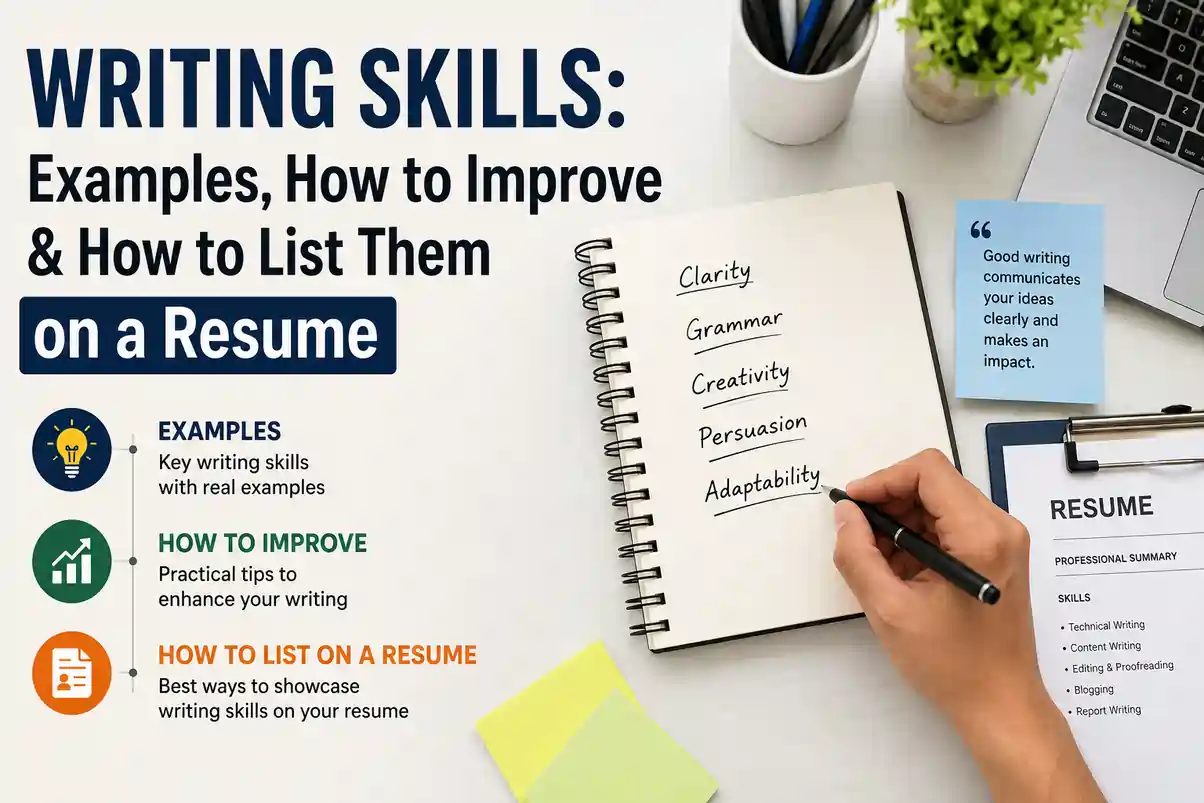
Strong writing skills are no longer just a "nice-to-have" — in 2026, they are one of the most sought-after professional competencies across every industry. Whether you're a software engineer documenting APIs, a nurse writing patient reports, or a marketer crafting ad copy, your ability to communicate clearly in writing directly impacts your career growth and salary potential.
According to the National Association of Colleges and Employers (NACE), written communication consistently ranks in the Top 3 skills employers look for in candidates. Yet, most resumes either skip listing writing skills entirely or bury them in a generic "soft skills" section without proof.
This guide covers everything: what writing skills actually are, real examples across 15+ industries, how to improve them, and exactly how to list writing skills on a resume for maximum ATS and recruiter impact.
What Are Writing Skills?
Writing skills refer to the ability to communicate ideas, information, instructions, and arguments clearly, concisely, and persuasively through written language. They encompass a broad spectrum — from grammar and spelling to research, storytelling, SEO writing, technical documentation, and persuasive communication.
Writing skills are broadly categorized into:
| Category | Examples |
|---|---|
| Technical Writing | Documentation, manuals, SOPs, API guides |
| Business Writing | Emails, reports, proposals, memos |
| Creative Writing | Copywriting, storytelling, brand voice |
| Academic Writing | Research papers, thesis, case studies |
| Digital Writing | SEO content, social media posts, blog writing |
| Persuasive Writing | Sales copy, cover letters, grant proposals |
Why Writing Skills Matter in 2026
The rise of remote work, AI tools, and digital-first communication has made writing skills more critical than ever. Consider these facts:
-
A 2025 LinkedIn Workplace Report found that "written communication" was listed in job postings 3x more frequently than "verbal communication."
-
Grammarly's State of Business Communication study found that poor writing costs U.S. businesses $400 billion per year in lost productivity.
-
Professionals with strong writing skills earn 17–25% more on average, according to PayScale data.
-
With AI-generated content flooding the web, authentic human writing skills are becoming a differentiator, not a commodity.
When you build your resume on resumeera.xyz, listing writing skills with concrete proof can dramatically increase callback rates — especially in roles where communication is central.
Core Writing Skills: Complete List
Here is a comprehensive list of writing skills you can use on your resume, in interviews, and in cover letters:
Foundational Writing Skills
-
Grammar and punctuation accuracy
-
Spelling and vocabulary
-
Sentence structure and clarity
-
Paragraph organization and flow
-
Tone and voice consistency
-
Proofreading and editing
Advanced Writing Skills
-
Research and fact-checking
-
Audience analysis
-
Storytelling and narrative structure
-
Persuasion and argumentation
-
Data interpretation and data-driven writing
-
Abstract and executive summary writing
Digital & SEO Writing Skills
-
SEO content writing (keyword research, on-page optimization)
-
Blog and article writing
-
Social media copywriting
-
Email marketing writing
-
UX writing (microcopy, CTAs, onboarding flows)
-
Technical SEO writing
Specialized Writing Skills
-
Grant writing
-
Legal writing and contract drafting
-
Medical/clinical documentation
-
Technical documentation and API writing
-
Scriptwriting and video content
-
Press release and PR writing
-
Proposal and RFP writing
Writing Skills Across 15+ Industries (With Examples & Proof)
Strong writing skills look different depending on your profession. Here are real-world examples across major industries:
1. Technology / Software Development
Key writing skills: Technical documentation, API writing, user stories, bug reports, README files, release notes.
Example resume bullet:
"Authored 40+ internal API documentation pages that reduced onboarding time for new developers by 35%."
Writing skills matter here because poorly documented code costs teams thousands of hours. If you're building a tech industry resume, always include technical writing as a core skill.
2.Healthcare / Nursing
Key writing skills: Patient documentation, clinical notes, discharge summaries, incident reports, grant proposals.
Example resume bullet:
"Maintained 100% accurate SOAP note documentation across 80+ daily patient interactions, praised by supervisors in two consecutive performance reviews."
For nurses preparing for interviews, showcasing documentation precision is critical.
3. Marketing & Advertising
Key writing skills: Copywriting, SEO writing, email campaigns, social media content, ad copy, content strategy.
Example resume bullet:
"Wrote SEO-optimized blog content that increased organic traffic by 127% in 6 months (from 8,000 to 18,160 monthly visits)."
Writing skills are the backbone of marketing. Every campaign begins with words — and strong writers drive measurable ROI.
4. Finance & Banking
Key writing skills: Financial reports, investment memos, compliance documentation, client communications, risk assessments.
Example resume bullet:
"Prepared monthly financial reports for 12 clients, reducing revision requests by 40% through structured executive summaries."
For accountant roles, precise writing skills directly affect client trust and regulatory compliance.
5. Legal Industry
Key writing skills: Contract drafting, legal briefs, case summaries, client correspondence, regulatory filings.
Example resume bullet:
"Drafted 30+ contract agreements annually with zero legal disputes filed, saving firm an estimated ₹15 lakh in litigation costs."
Legal writing is one of the most specialized writing skills — precision and formality are non-negotiable.
6. Education & Teaching
Key writing skills: Lesson planning, student feedback writing, curriculum development, research papers, progress reports.
Example resume bullet:
"Developed a written feedback system for 120 students that improved assignment scores by an average of 18% over one semester."
Strong writing skills help teachers communicate expectations and inspire students. Check out resume formats for fresher teachers to present these skills effectively.
7. Engineering (Civil, Mechanical)
Key writing skills: Project proposals, site reports, technical specifications, feasibility reports, safety documentation.
Example resume bullet:
"Wrote 15+ detailed project feasibility reports that helped the firm secure contracts worth ₹2.4 crore in FY2025."
For civil engineers and mechanical engineers, writing skills often determine whether proposals get approved or ignored.
8. E-Commerce & Retail
Key writing skills: Product descriptions, customer review responses, email newsletters, return policy writing, chatbot scripts.
Example resume bullet:
"Rewrote 500+ product descriptions using conversion-focused writing, resulting in a 22% increase in add-to-cart rate."
9. Hospitality & Hotel Management
Key writing skills: Guest communications, complaint resolution emails, menu descriptions, event proposals, team memos.
Example resume bullet:
"Drafted guest satisfaction communication templates that improved response resolution time from 48 hours to 6 hours."
Hotel management professionals who communicate well in writing consistently receive higher guest satisfaction scores.
10. Government & Public Sector
Key writing skills: Policy drafting, RTI responses, public notices, grant applications, inter-departmental memos.
Example resume bullet:
"Authored 60+ official public communications and government circulars with zero compliance violations over 3 years."
For government job seekers, writing skills are heavily evaluated in written exams and document verification rounds.
11. Journalism & Media
Key writing skills: News writing, feature writing, investigative reporting, scriptwriting, headline writing, fact-checking.
Example resume bullet:
"Published 200+ articles achieving an average read-time of 4.5 minutes and 3,000+ monthly organic visits per piece."
12. Human Resources
Key writing skills: Job descriptions, offer letters, HR policies, performance review writing, employee handbooks, training materials.
Example resume bullet:
"Rewrote 25 job descriptions using inclusive language, increasing qualified applications by 30% within 60 days."
13. Architecture & Design
Key writing skills: Project briefs, client proposals, design rationale documentation, tender documents.
Example resume bullet:
"Produced client-facing architecture proposals that contributed to winning 4 of 5 competitive tenders in 2025."
See architecture resume examples to learn how to position these skills.
14. Research & Science
Key writing skills: Research paper writing, grant proposals, lab reports, literature reviews, peer review writing, abstracts.
Example resume bullet:
"Co-authored 3 peer-reviewed research papers published in indexed journals, with a combined citation count of 145."
15. Digital Media & Content Creation
Key writing skills: YouTube scripts, podcast show notes, newsletter writing, thread writing (X/Twitter), LinkedIn articles, SEO blog writing.
Example resume bullet:
"Built a LinkedIn newsletter from 0 to 12,000 subscribers in 10 months through consistent, value-driven writing."
How to Improve Your Writing Skills (Proven Methods)
Improving your writing skills is a learnable, measurable process. Here are the most effective, research-backed approaches:
1. Read Widely and Deliberately
The strongest writers are voracious readers. Read across genres: news articles, technical documentation, long-form essays, and industry reports. Pay attention to sentence structure, how authors transition between ideas, and how they tailor their tone to the audience.
Goal: Read 20 minutes daily in your target writing domain.
2. Write Every Single Day
Writing is a muscle — it atrophies without use. Start a daily writing habit: journal, LinkedIn posts, personal blog, or even email drafts you never send. The goal is volume and consistency.
Goal: Write 300–500 words per day without editing while writing.
3. Learn the "Inverted Pyramid" Structure
Used in journalism, this method puts the most important information first, then supporting details, then background. It's universally applicable to business writing, emails, and reports.
4. Master the BLUF Method
BLUF = Bottom Line Up Front. Professional writing skill demands you state your conclusion or request first. Don't bury the main point. This dramatically improves email writing and report clarity.
5. Edit Ruthlessly — After You Write
Great writing is rewriting. After drafting, wait 30 minutes, then edit for:
-
Redundant words (delete "very," "really," "basically")
-
Passive voice (convert to active)
-
Clarity (would a 10th grader understand this?)
-
Length (cut 20% from every first draft)
6. Use AI Tools Strategically (Not as a Replacement)
Use tools like Grammarly, Hemingway Editor, and AI assistants to identify weakness patterns — not to write for you. The 2026 job market values authentic writing skills, and AI-generated generic content is increasingly easy for recruiters to spot.
7. Study Writing Frameworks
Learn foundational structures:
-
STAR (Situation, Task, Action, Result) — for resume and interview writing
-
AIDA (Attention, Interest, Desire, Action) — for marketing copy
-
PAS (Problem, Agitate, Solution) — for sales writing
-
5 Ws (Who, What, When, Where, Why) — for journalism and reports
8. Get Feedback Consistently
Share your writing with peers, mentors, or online communities. Feedback accelerates improvement faster than solo practice alone. Consider Toastmasters, writing workshops, or LinkedIn Learning courses.
9. Take a Certification Course
Validated writing certifications strengthen your resume:
-
Google Digital Garage (Content Writing)
-
HubSpot Content Marketing Certification
-
Coursera — "Writing in the Sciences" (Stanford)
-
Udemy — Business Writing & Technical Writing courses
10. Study Your Industry's Best Writers
Every industry has exemplary writers. In tech: read Stripe's documentation. In marketing: study David Ogilvy. In business: read Warren Buffett's shareholder letters. Reverse-engineer what makes their writing exceptional.
How to List Writing Skills on a Resume
This is where most job seekers underperform. Simply writing "Strong written communication skills" on a resume is weak — it's a claim with no proof. Here's how to do it right:
Step 1: Match Writing Skills to the Job Description
The most effective resumes mirror the exact language in the job posting. If the JD says "content writing," use "content writing" — not "blogging." This is critical for passing ATS filters.
Step 2: Use the Skills Section Strategically
In your key skills section, list specific writing skills:
Strong: SEO Content Writing | Technical Documentation | Email Copywriting | Grant Writing
Weak: Good communication | Writing skills | MS Word
Step 3: Prove Writing Skills in Your Work Experience
Every writing skill claim needs a bullet point with numbers:
| Weak Version | Strong Version |
|---|---|
| "Wrote blog posts" | "Published 3 SEO articles/week averaging 2,000+ words, driving 45K organic visits/month" |
| "Handled email communications" | "Managed executive email communications for CEO, maintaining <2hr response SLA across 200+ weekly emails" |
| "Created training materials" | "Developed 12-module onboarding documentation reducing new hire ramp time from 6 weeks to 3 weeks" |
Step 4: Mention Writing in Your Resume Summary
Your profile summary should reference writing skills if they're central to the role:
"Results-driven Marketing Executive with 5+ years of experience in SEO content writing and brand storytelling, with a proven track record of growing organic traffic by 150%+ across B2B SaaS clients."
Step 5: Add Writing Certifications and Portfolios
Under Education or a separate Certifications section, list relevant writing credentials. Always include a portfolio link (Google Drive, Notion, or personal website) — especially for content writing, journalism, and technical writing roles.
Step 6: Use Power Verbs for Writing on a Resume
Replace weak verbs with strong action words:
| Weak | Strong |
|---|---|
| Wrote | Authored, Crafted, Produced, Composed |
| Edited | Refined, Streamlined, Overhauled, Proofread |
| Made content | Developed, Created, Generated, Published |
| Did documentation | Documented, Catalogued, Standardized |
For a complete list of powerful resume verbs, see the guide on resume achievements.
Writing Skills for Freshers vs Experienced Professionals
Freshers without work experience can still showcase writing skills through:
-
College assignments and thesis writing
-
Personal blog or Medium articles
-
LinkedIn posts and thought leadership content
-
College newsletter or magazine contributions
-
Internship-related documentation
See how to write a resume with no work experience and still impress employers with transferable skills.
Experienced professionals should focus on:
-
Quantified writing output (articles published, documents created)
-
Business impact of their writing (revenue generated, traffic driven, time saved)
-
Leadership in writing (training junior writers, setting content standards)
For a strong foundation, also check 7 skills to upgrade your resume for a leadership role.
Writing Skills vs Communication Skills: Key Difference
| Writing Skills | Communication Skills |
|---|---|
| Specifically refers to written expression | Broader — includes verbal, non-verbal, listening |
| Measurable through output (documents, articles) | Harder to quantify directly |
| Can be demonstrated via portfolio | Demonstrated in interviews and references |
| ATS-scannable on resumes | Less likely to trigger ATS matches |
Both are important, but writing skills are more directly provable on a resume — which is why smart candidates always prioritize them with evidence.
For more on personal skills for resume and how they complement writing skills, see the full guide.
Common Writing Mistakes to Avoid on a Resume and in Professional Life
-
Using jargon without context — not every reader knows your industry terms
-
Writing in passive voice excessively — "Errors were found by me" → "I identified 12 errors"
-
No proofreading — even one typo can eliminate you from consideration; use these proofreading tips
-
Over-writing — saying in 100 words what could be said in 30
-
No structure — walls of text with no headings, bullets, or white space
-
Generic openings — avoid "I am writing to..." in cover letters; start with impact
Writing Skills in the Age of AI (2026 Perspective)
AI tools can generate text — but they cannot replace authentic writing skills that include:
-
Deep industry knowledge and nuance
-
Audience empathy and emotional intelligence
-
Ethical judgment in sensitive topics
-
Brand voice consistency
-
Strategic narrative building
In fact, the 47% of workers now using AI to finish work early still rely on human writing skills to edit, refine, and contextualize AI output. Knowing how to write well makes you a better AI user — and that's a competitive advantage in 2026.
Final Checklist: Writing Skills on Your Resume
Before submitting your resume, verify:
-
Writing skills listed in Skills section with specific types (not generic "writing")
-
At least 2–3 work experience bullets prove writing skills with numbers
-
Resume summary mentions writing if it's a core role requirement
-
Portfolio link included (for writing-heavy roles)
-
Power verbs used for all writing-related bullet points
-
Job description keywords for writing are mirrored in your resume
-
No spelling or grammar errors (use free ATS resume checker)
Use the 10 essential resume sections guide to ensure your entire resume is structured to pass ATS and impress human reviewers.
Build Your Resume with Strong Writing Skills Highlighted
Ready to put your writing skills to work? Start building your ATS-optimized, professional resume for free at resumeera.xyz — no signup required, no hidden fees, and no watermarks. The platform helps you structure your skills, achievements, and experience in a format that recruiters and ATS systems both love.
Whether you're a fresher applying for your first job, a mid-career professional seeking a career change, or an experienced manager going for a leadership role — strong writing skills are your most transferable, high-value asset.
Start writing your future today.