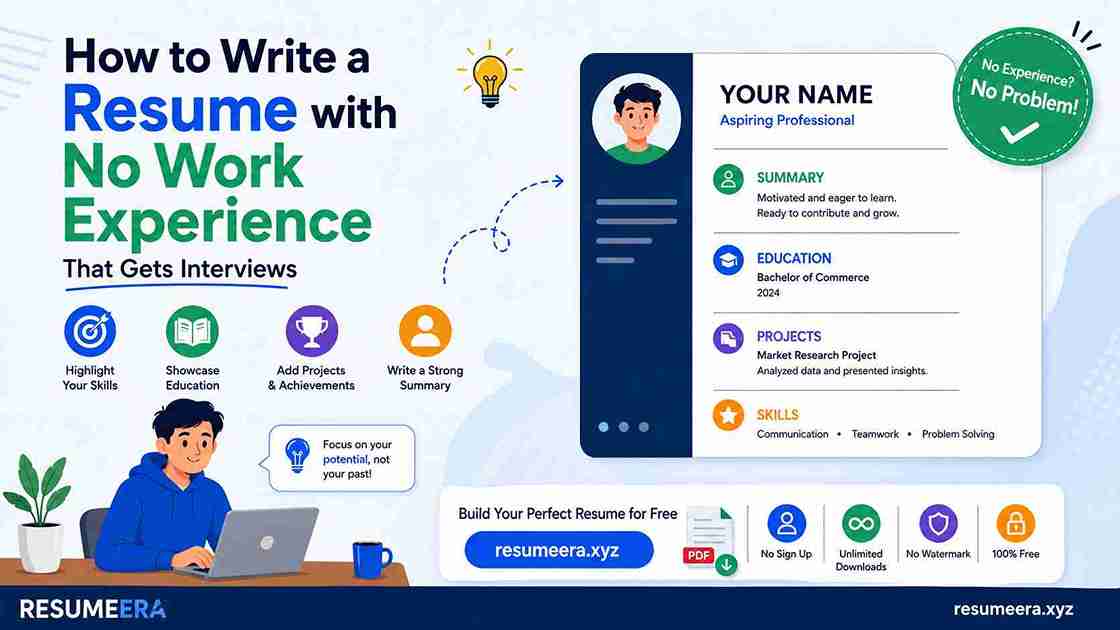
You can get interviews without a long job history. The trick is showing proof you can do the work, not padding. With a resume with no experience, you win by being specific, clear, and relevant to one role at a time.
I have helped plenty of new grads and career starters turn class projects and part-time gigs into sharp bullets that hiring managers actually read. Follow the steps below, keep it tight, and you will look ready on paper even if this is your first serious application.
In 2026, entry-level roles face intense competition. Studies show roughly 65–80% of “entry-level” postings still prefer some experience, and 75% of resumes never reach a human because Applicant Tracking Systems (ATS) filter them out first. Soft skills like communication and customer service appear in nearly 30% of listings, while quantified achievements and exact keyword matches dramatically improve interview rates. A strong no-experience resume focuses on education, projects, volunteering, skills, and results—not empty job titles.
This guide expands proven strategies into a complete, research-backed blueprint optimized for ATS and human readers. It includes format choices, section-by-section writing tips, real examples, a ready-to-adapt template, and interlinked resources from ResumeEra to help you build and refine your document faster.
Table of Contents
- Pick the Right Resume Format
- What to Put on a Resume with No Experience
- Turn School, Projects, and Volunteering into Results
- Make It ATS-Friendly and Easy to Scan
- Real Examples and a Quick Template You Can Copy
- Common Mistakes to Avoid
- FAQs
- Conclusion
Pick the Right Resume Format
Your layout should make your strengths obvious in seconds, so choose a resume format that brings skills and projects to the top without hiding your timeline. In 2026, recruiters and ATS systems still favor clean, single-column designs with standard headings. Fancy multi-column Canva templates often fail parsing.
Reverse-chronological vs Functional vs Hybrid
- Reverse-chronological: Classic. Education and experiences in time order. Great if you have internships or solid projects. Most ATS-friendly and preferred by recruiters for showing progression.
- Functional: Skills-only blocks with no dates. Often a red flag because it hides context and can score poorly with ATS (parse rates drop significantly compared with chronological or hybrid).
- Hybrid (Combination): Best for newcomers. Puts a skills snapshot and projects first, then brief experience with dates. It balances skills emphasis with timeline credibility and maintains strong ATS compatibility (often 89–94% parse accuracy in tests).
A hybrid layout works well for an entry-level resume because it spotlights course projects and skills while still showing dates and basic work history for credibility. For pure freshers in India or elsewhere, many experts also recommend leading with education in a chronological-leaning hybrid. Keep it to one page. Use 10–12 pt standard fonts (Arial, Calibri, Times New Roman), 0.5–1 inch margins, and consistent black text.
For detailed format comparisons and free templates tailored to Indian job markets, see the fresher resume format for India and combination resume format guides on ResumeEra. Also review the full resume formats overview.
What to Put on a Resume with No Experience
If you are building a no experience resume, lead with a tight summary (or objective), a focused skills section, and 2–3 projects that match the job posting. Coursework can earn space on a student resume when it is directly relevant to the role and links to a result you can quantify.
Recommended section order for 2026 (hybrid-friendly)
- Contact information (name, phone, professional email, city, LinkedIn/portfolio/GitHub)
- Professional summary or objective (2–4 lines)
- Skills (6–12 hard skills matching the job ad)
- Projects (or Relevant Experience)
- Education (with relevant coursework, GPA if 3.3+, honors)
- Experience (internships, part-time, volunteering, leadership—with dates)
- Certifications, languages, awards
What hiring managers scan first
- Top third: your summary, core skills, and most relevant project.
- Bullets that prove outcomes: numbers, scope, and tools used.
- Clean dates, role, and organization names with no typos.
- Evidence of teamwork, ownership, and follow-through.
Write a strong summary using this formula: [Adjective] + [your status/education] + with [2–3 relevant skills or proof points] + seeking [target role]. Example: “Motivated recent Computer Science graduate with hands-on experience building Python data-cleaning scripts and collaborative campus projects. Seeking an entry-level data analyst role to apply analytical and problem-solving skills.”
Avoid vague objectives like “looking for a job where I can learn.” Mirror the exact job title and key phrases from the posting. For more on summaries and objectives, check ResumeEra’s profile summary resume and career objective for resume resources.
Education should list degree, school, expected/actual graduation date, relevant coursework (3–5 courses), and GPA if strong. Projects and any non-traditional experience replace traditional “Work Experience.” Treat them with the same rigor. See the dedicated guide how to write a resume with no work experience in 2026 and new graduate resume format for deeper examples.
Turn School, Projects, and Volunteering into Results
Treat this like your first job resume by turning tasks into outcomes. Instead of listing duties, write bullets that start with a strong verb and end with a number or clear result. You can sound confident on a beginner resume by adding scope and context: size of team, budget, users, or time saved.
Bullet formula that works: Action verb + what you did + tools/skills used + quantified outcome or impact.
Real examples adapted from proven patterns:
- Designed a budget tracker in Google Sheets for a campus club; automated monthly reports and cut manual work by 3 hours per month.
- Built a Python script that cleaned 5,000 rows of survey data and produced charts for a class capstone; shared visual pack with 4 teammates.
- Led weekend food-drive logistics; coordinated 12 volunteers and filled 180 boxes; introduced a new check-in that cut lines by 40%.
- Developed a React web app for a marketing course project that analyzed 2,000+ customer reviews and identified sentiment trends; presented findings to 15 classmates.
- Managed university social media account with 5,000+ followers; increased engagement 25% through consistent content calendar and Canva graphics.
These bullets prove ownership, tools, and results even without paid jobs. Volunteer roles, club leadership, freelance help for family businesses, hackathons, and personal projects all count. Quantified achievements consistently outperform generic duty lists—resumes with metrics and numbers in summaries or bullets show higher interview rates.
For more project framing ideas, explore project on the resume and teen resume with no work experience 2026. Soft skills (communication, teamwork) should appear through examples rather than bare lists, since they rank among the most requested attributes in entry-level postings.
Make It ATS-Friendly and Easy to Scan
An ATS resume needs standard headings, simple fonts, and keywords phrased the way the posting writes them, so copy the employer’s language where it honestly applies to you. Up to 75% of resumes are rejected before human review; keyword mismatch and poor formatting are major causes.
Keywords to help your resume with no experience pass ATS
- Mirror the job title and core skills: for example, Marketing Assistant, Excel, Google Analytics, customer research.
- Use exact tool names and certifications: Figma, Canva, Python, CPR, CompTIA A+, Salesforce, Power BI.
- Name outcomes with numbers the system can parse: increased, reduced, delivered, percent, hours, dollars.
- Save as PDF unless the posting requests Word; keep file name professional: Firstname-Lastname-JobTitle.pdf.
ATS best practices checklist
- Single-column layout, no tables, text boxes, images, or icons.
- Standard headings: Professional Summary, Skills, Projects, Education, Experience.
- Exact keyword matches from the job description (no synonyms).
- Full skill names (JavaScript, not just JS).
- Clean dates and consistent formatting.
If you prefer guided formatting, a resume builder can speed things up, but double-check that it keeps section headers standard and exports a clean PDF. ResumeEra offers free ATS-friendly tools and templates specifically tested for beginners. Learn more in the ATS-friendly resume format for beginners complete SEO guide, how to build an ATS-friendly resume, and ATS resume tips. Also see 5 ways to get your resume past ATS in 2026.
Tailor every application. Candidates who maintain multiple tailored versions receive significantly more interview invitations than those using a single generic resume.
Real Examples and a Quick Template You Can Copy
Skim a few resume examples to see how strong verbs and numbers change the feel of the same experience. Here is a 7-line starter template you can adapt:
Summary: Target role + 2–3 strengths + 1 proof point.
Skills: 6–10 hard skills that appear in the job ad.
Project A: What you built, tools used, and a number that shows impact.
Project B: Another relevant result, kept to one or two lines.
Education: Degree or program, school, and key coursework.
Experience: Any work, volunteering, or leadership with 1–2 result bullets.
Extras: Certifications, awards, languages, or portfolio link.
Use this layout if you are writing a fresher resume and want a structure that recruiters recognize at a glance. Expand each section with the quantified style shown earlier. For India-specific fresher examples or teacher/accountant formats, visit ResumeEra’s specialized pages such as resume format for fresher teacher or accountant resume format 2026.
Additional free resources: 9 basic resume templates for 2026 and the main how to write a resume in 2026 guide.
Common Mistakes to Avoid
- Using functional format exclusively or creative designs that break ATS.
- Listing duties instead of results (“Responsible for…”).
- Including every class or hobby—stay relevant and tight.
- Apologizing for lack of experience in the summary.
- Submitting the same resume to every job.
- Typos, inconsistent dates, or unprofessional email.
- Overusing AI without editing for authenticity (many managers view fully AI-written resumes negatively).
Proofread carefully and have a peer review. For extra polish tips, see resume proofreading tips.
FAQs
1. What do I put on a resume if I have never had a job?
Lead with education (degree, coursework, GPA if strong), a skills section matching the job ad, 2–3 quantified projects, volunteering or leadership roles written as achievement bullets, and any certifications. Frame everything with action + tools + results.
2. Is a hybrid or chronological format better for no experience?
Hybrid (skills and projects first, then dated experience/education) works best for most beginners because it highlights strengths while remaining ATS- and recruiter-friendly. Pure chronological is fine if you have strong internships; avoid pure functional.
3. How long should a no-experience resume be?
One page. Recruiters spend seconds on the top third—make every line count.
4. Do I need a cover letter with a no-experience resume?
Often yes, especially if requested. Use it to expand on one or two projects and show genuine interest. Pair with the how to write a cover letter that gets you hired in 2026 guide.
5. How can I make my resume stand out without work history?
Quantify everything possible, mirror exact job keywords, lead with relevant projects and skills, keep formatting clean and ATS-safe, and tailor for each application. Strong evidence of ownership and results beats vague claims.
Conclusion
Keep the top third laser-focused on the job, quantify outcomes, and match the language of the posting. Do that, and your resume with no experience will still read like proof you can deliver. In the competitive 2026 market—where applications per role have surged and many entry-level postings favor candidates with some practical exposure—clarity, relevance, and measurable impact are your advantages.
Ready to build and send it out? Grab a clean template, tailor it to one role, and apply today. If you want a head start, explore free tools, ATS checkers, and samples from ResumeEra, including the free resume builder no hidden fee, best resume builder India 2026, and the complete how to write a resume with no work experience in 2026 resource.
Start with one targeted application this week. Consistency and continuous refinement turn a blank page into interview opportunities. Your first strong resume is the foundation for the career ahead.