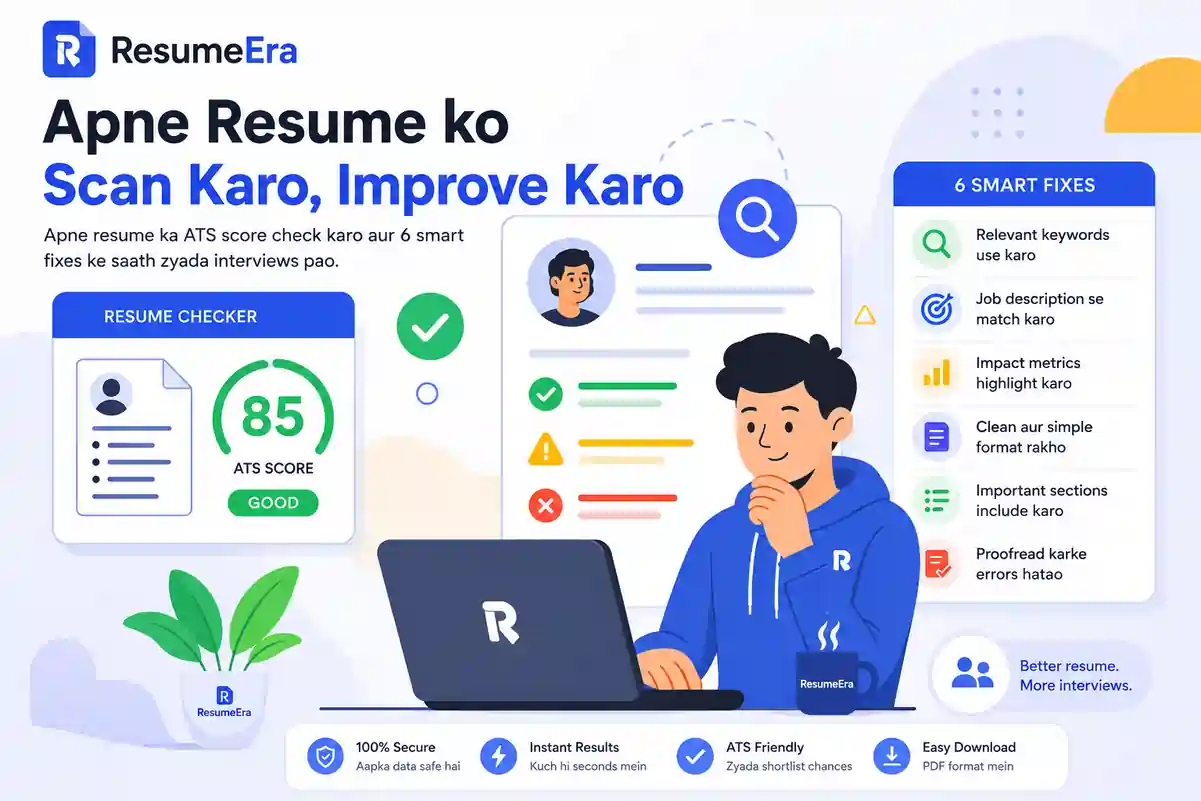
Many resumes are filtered by ATS before a recruiter ever sees them. Before your name reaches a human reviewer, an Applicant Tracking System has already scanned, parsed, and scored your file. Numerous mid-to-large employers in the United States use these systems to filter applicants automatically, and a resume that looks polished on screen can still fail that automated screen without any visible sign. That's the problem a free resume checker is built to solve.
These tools simulate how an ATS processes your resume, then surface the exact issues hurting your score. Some match against a specific job description; others apply a general scoring rubric. This guide breaks down what they're actually looking for, what each score range means, and the specific changes that move the needle. If you haven't built your resume yet, Resumeera — a free resume builder combines resume creation and ATS optimization in one place, no login, no account, no third-party upload required.
Table of Contents
-
What a free resume checker actually scans for
-
What your ATS score actually means
-
The most common issues free resume checkers flag
-
How to act on your free resume checker's feedback
-
Choosing the right free resume checker for your situation
-
The privacy risk most job seekers overlook
-
Before you hit submit: a final pass checklist
-
Conclusion
-
FAQ
Free Resume Builder
Don’t let a weak resume decide your future.
Thousands of people are getting rejected — not because they’re bad, but because their resume doesn’t speak for them. Make a resume that actually gets shortlisted.
Your next job is closer than you think.
Start in 2 minutes.
No complicated forms. Just pick a template, fill details, And Apply.
Apply Now Your Job →What a free resume checker actually scans for
A resume checker doesn't read your resume the way a person does. It extracts the text layer from your uploaded file, processes it in a linear sequence, and runs that output against a ruleset covering keywords, section labels, formatting structure, and file integrity. Understanding what happens under the hood helps you treat the feedback as actionable data rather than an arbitrary grade.
How ATS parsing works in practice
The tool pulls text from your file, identifies sections based on heading labels, and matches terms against a job description or a standard role taxonomy. The sequence matters: if your layout interrupts linear extraction, content gets scrambled or skipped entirely. Complex formatting elements, tables, multi-column layouts, and graphic sidebars are among the most common causes of parsing failure. File type matters too. Text-based PDFs and DOCX files parse cleanly, while image-based PDFs and design-tool exports often strip the text layer the parser depends on.
For layout-safe structures and beginner-friendly formatting, see ATS-friendly resume format for beginners and 11 ATS formatting mistakes.
What your ATS score actually means
Most checkers use a similar scoring range: below 50% signals high risk of being filtered before review, 50 to 69% is borderline, 70 to 79% is competitive, and 80% or above is strong. The same resume run through different tools can score anywhere from 38% to 70% depending on the platform's scoring model, a gap that reflects how differently each platform weights keyword density versus formatting compliance. The score is a directional signal, not a verdict. What matters is the specific list of flagged issues, not chasing the highest possible number across tools.
The best way to use a score is as a diagnostic. If the checker flags missing keywords, fix those in real experience bullets. If it flags formatting problems, simplify the structure before anything else.
The most common issues free resume checkers flag
Most job seekers assume their resume is ATS-safe because it looks clean and simple. Visual simplicity and parse-ability are two different things. Free resume graders surface the same categories of problems across virtually every resume they analyze, and the fixes are more straightforward than most people expect.
Formatting mistakes that break parsing
The formatting issues most ATS checkers flag fall into a predictable set: tables and multi-column layouts, text boxes used for contact info or sidebars, headers and footers that place critical data outside the main text layer, and embedded graphics or icons. Inconsistent date formats are another surprisingly common flag because they can distort how the system reads your work history.
One of the most overlooked failure points is a creative section heading. Labels like "My Career Journey" instead of "Work Experience" prevent the ATS from categorizing your content correctly, which can effectively make that section invisible to the scoring algorithm.
For resume structure that parses cleanly, pair this article with how to write a resume in 2026 and 10 essential resume sections in 2026.
Keyword gaps that lower your match rate
Job-description-matching tools compare the language in your resume to the language in the posting and flag the gaps. Exact-match keywords carry more weight than synonyms in many systems. "Project management" and "managing projects" are often not treated as equivalent by ATS parsers, so if the posting uses the first phrase and your resume uses the second, that's a flagged gap. The most common source of a low match rate is missing skills or tools that appear prominently in the job description, particularly technical terms, certifications, and software names that don't have obvious synonyms.
If your summary is weak, keywords won't save it alone. See profile summary for resume and key skills for resume.
How to act on your free resume checker's feedback
A score is only useful if you know which changes actually produce results. In practice, a small set of targeted fixes drives the biggest improvements. Most can be completed in a single focused session.
Adding missing keywords without making your resume unreadable
Pull the exact phrases the checker flags as missing. Identify which roles or projects from your actual experience are genuinely related to those terms. Then rewrite one or two bullets to include those phrases naturally, within real job descriptions rather than in a standalone list. Placing keywords in experience bullets carries more weight than a dumped skills section, for both the ATS score and the recruiter who reads the resume after it passes. A skills-only keyword list looks like optimization; experience-backed language reads as evidence.
Format changes that produce the fastest score improvements
Switch to a single-column layout if the checker flags parsing issues. Move contact information out of the header and into the main body of the document. Replace any creative section labels with standard names: Work Experience, Education, Skills, Summary. Export the file as a text-based PDF or DOCX rather than a design export or scanned image.
If you're rebuilding from scratch, use resume formats and chronological resume format as your starting point.
Choosing the right free resume checker for your situation
Not all free resume checkers work the same way. Some apply a generic scoring rubric based on resume best practices. Others, often called AI resume checkers or CV checkers, require you to paste in a specific job description to calculate an accurate match rate. The first approach tells you whether your resume follows general conventions; the second tells you whether it's competitive for a specific role.
Tools that match your resume to a job description
For job-description-specific matching, several tools are worth knowing. Jobscan is widely used for ATS-style keyword analysis against a specific posting. ResumeWorded offers recruiter-aligned feedback based on more than 20 checks and produces line-by-line suggestions on content quality, not just keyword presence. ResyMatch by Cultivated Culture provides free scanning against a pasted job listing. SkillSyncer focuses on keyword gap identification and explicitly states it doesn't share your resume with anyone. JD-specific tools are generally more accurate than generic graders for predicting whether a particular application will pass an automated screen.
When an all-in-one option makes more sense
If you're building your resume from scratch or need to rebuild it entirely, using a separate builder and then a separate checker adds friction and introduces inconsistency. Free Resume Builder handles resume creation and ATS optimization together in one free, no-login workflow. You build, optimize, and download without switching platforms or uploading your file to a third-party service. For job seekers who want a clean result with fewer steps, that matters.
See also free ATS resume checker and resume-worded alternatives.
The privacy risk most job seekers overlook
Uploading your resume to a third-party checker seems routine, but your resume contains your full name, contact information, employment history, and sometimes your home address. Most free resume checker platforms don't explain what happens to that data after the scan completes, and the checker landing pages are often where that information is least visible.
What most checker tools do with your uploaded resume
Among the major platforms, SkillSyncer is the clearest: it explicitly states it doesn't share your resume with anyone and allows you to request deletion from its servers at any time. Jobscan has documented user rights for data access and deletion under GDPR frameworks, and privacy-conscious users should consider using a scrubbed version with reduced contact details when scanning there. Based on publicly available landing pages reviewed for this article, some other tools don't prominently address storage or sharing policies, which leaves users making assumptions. For job seekers who are discreetly searching while employed, that ambiguity is worth factoring into your tool choice.
How to protect your data while still getting useful feedback
Check each tool's privacy policy before uploading, not just the landing page. Use a version of your resume that replaces your home address with just your city and state if you're concerned about exposure. Consider tools that don't require an account, since account creation produces a data record that persists independently of the scan. Free Resume Builder requires no registration and processes your resume without storing it on a third-party server, which sidesteps the data question entirely rather than answering it after the fact.
Before you hit submit: a final pass checklist
After running your resume through a checker and applying the key fixes, one more structured review before submitting separates "probably fine" from genuinely ready. The goal is to confirm the fixes landed correctly and catch anything the first pass missed.
What to verify after optimization
-
The file is saved as a text-based PDF or DOCX, not a design export or image file.
-
All section headings use standard labels: Work Experience, Education, Skills, Summary.
-
Keywords from the job posting appear in experience bullets, not only in a skills list.
-
Contact information sits in the main body of the document, not a header or footer.
-
A plain-text copy-paste test confirms the content reads in the correct order.
A quick re-run through a resume analyzer after making changes often confirms the score improved and catches anything that slipped through the first optimization pass. It usually takes just a few minutes and removes the guesswork from "I think this is fixed now."
Conclusion
A free resume checker isn't about earning a perfect score. It's about catching the specific issues that cause your resume to fail silently in an automated screen before a recruiter ever sees it. The fixes are consistent across tools and industries: clean up formatting that breaks parsing, close keyword gaps by placing missing terms in real experience bullets, and use standard section labels the ATS can actually read.
If you're starting from scratch or rebuilding an existing resume, Free Resume Builder handles the creation and ATS optimization together in one place, no account needed, no upload to a third-party service. Run your resume through the process and apply what comes back.
You’re not failing.
Your resume is.
Most people lose jobs before the interview — not because they lack skills, but because their resume looks average. Fix that in 5 minutes.
- ✅ ATS-optimized format
- ✅ Recruiter-friendly design
- ✅ Download instantly (PDF)
⚡ No signup required • 100% Free • Works on mobile
Get shortlisted faster
Pick a template → fill details → download resume.