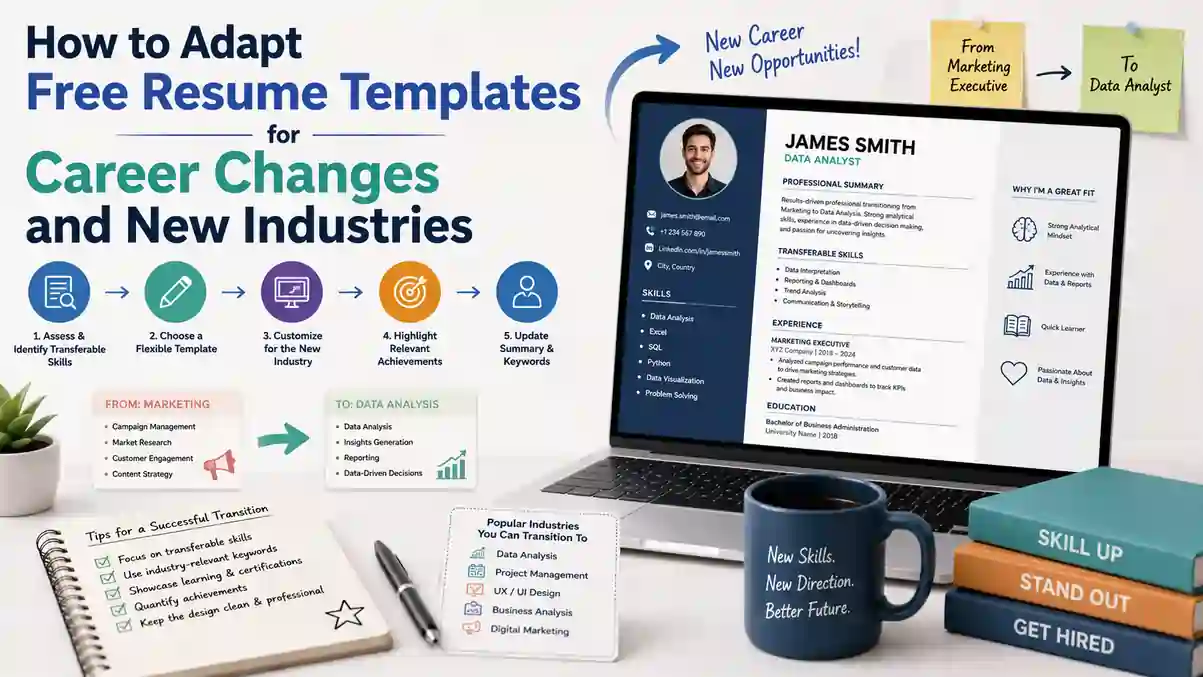
Switching careers in India is common, whether you are a fresher moving from engineering to digital marketing, a teacher aiming for corporate training, or an IT support executive targeting business analysis. A free resume template downloaded from the internet can save time, but using it without changes often hurts your chances. Recruiters on Naukri, LinkedIn and company career portals spend 6 to 8 seconds on an initial scan, and Applicant Tracking Systems used by TCS, Infosys, Wipro, HDFC Bank and many startups filter resumes before a human sees them. If your template still highlights your old job titles, old industry keywords and old achievements, it signals that you belong to your previous field, not the new one. Adapting a free template correctly means restructuring the layout, rewriting the content with transferable skills, and aligning every section with the expectations of your target industry in India.
Why Standard Free Templates Fail During a Career Change
Most free resume templates are built for linear career growth. They use a chronological format that lists your latest job at the top, followed by previous jobs in reverse order, with dates, company names and role-specific duties. For a career changer, this structure works against you. It forces the recruiter to focus on what you did in the past, rather than what you can do in the new role. For example, if you worked as a mechanical engineer for three years and now want to apply for a data analyst role, a chronological template will push your engineering projects and workshop experience to the top, while your SQL, Excel and Python skills get buried at the bottom.
Indian recruiters are highly role-specific when screening. A hiring manager for a digital marketing position in Gurgaon or Bangalore expects to see keywords like SEO, Google Ads, content strategy, and campaign ROI within the first half of the page. If your template still opens with "Maintenance of CNC machines and quality inspection" the relevance is lost immediately. Even if you have done relevant freelance work, certifications from Google or HubSpot, or personal projects, a standard template often lacks dedicated space to showcase them prominently.
Another problem is the objective statement that comes pre-written in many free downloads. Phrases like "Seeking a challenging position where I can utilize my skills" are vague and ignored by ATS. For a career transition, you need a targeted professional summary that connects your past experience to the new industry. Free templates also tend to have rigid sections. They may not include a "Relevant Skills" or "Transferable Achievements" or "Projects" block, which are critical when you lack direct experience in the new field.
- Overemphasis on chronology: Dates and old job titles dominate instead of skills relevant to the new role.
- Missing skill mapping: No space to translate old duties into new industry language, such as converting "handled classroom of 50 students" to "delivered training and managed stakeholder engagement".
- Generic summaries: Pre-filled objectives do not explain your career switch or value proposition.
- ATS mismatch: Headers like "What I am good at" or creative graphics confuse parsing software used by Naukri ATS and Zoho Recruit.
Recruiters do not hire you for where you have been, they hire you for where you can take them. Your resume template must be adapted to prove that bridge.
Choosing the Right Free Resume Format for Your Career Switch
Before editing content, you must pick the correct format. Not every free template suits a career change. The three main formats are chronological, functional and hybrid (combination). For Indian job seekers changing industries, the hybrid format performs best in most cases because it balances skills and experience while remaining ATS-friendly. Functional formats can hide employment gaps but many Indian recruiters and ATS flag them as suspicious if used poorly. Chronological formats are only advisable if your switch is within a related field, such as moving from software testing to software development.
When browsing free templates on https://resumeera.xyz, filter for clean, single-column layouts with standard headings. Avoid templates with heavy infographics, tables, text boxes or double columns, as these often fail ATS parsing. Look for templates that allow you to reorder sections easily in Word or PDF so you can place your strongest career-change assets at the top.
| Format Type | Best For | ATS Compatibility in India | Recruiter Perception |
|---|---|---|---|
| Chronological | Same industry, steady growth, no gaps | Very High | Preferred for experienced hires with linear growth |
| Functional (Skill-Based) | Large gaps, complete industry shift, freshers with projects | Moderate - Some ATS struggle to parse | Can raise questions if work history is hidden |
| Hybrid / Combination | Most career changers, 1-5 years experience, internal transfers | High | Ideal - Shows skills first, then supports with experience |
| Creative / Infographic | Design, portfolio roles only | Low | Often rejected for corporate and IT roles |
Which Template Layout Works Best for Specific Transitions in India
Your ideal template depends on the nature of your switch. For moves from engineering to IT, such as mechanical to software or EEE to data science, choose a hybrid template with a strong "Technical Skills" and "Projects" section at the top. Place programming languages, tools and certifications before work history. For moves from teaching, banking operations or customer support to HR, business development or corporate training, select a template that emphasizes "Core Competencies" and "Achievements" with bullet points, so you can translate classroom management into people management and sales targets into client handling.
For freshers who completed a B.Com or BA but want to enter digital marketing or UI/UX, a functional-leaning hybrid template is useful. You can lead with internships, freelance work, Google Digital Garage or Meta Blueprint certificates, and college projects. For experienced professionals with 5+ years in one domain moving to management, keep a chronological backbone but add a powerful summary and a "Key Transferable Skills" grid right below it. This respects your experience while redirecting focus.
What to Check Before Downloading a Free Template for Career Change Use
Do not download the first attractive template. Check five practical points. First, ensure headings are standard: Professional Summary, Skills, Work Experience, Education, Projects, Certifications. Avoid quirky headings like "My Journey" or "Why Hire Me". Second, confirm the file is available in both Word Docx and PDF, as Naukri and many Indian company portals specifically ask for Docx for ATS parsing while email applications often require PDF. Third, check font readability. Calibri, Arial, Garamond and Verdana at 10 to 11 pt are safe. Fourth, see if the template is single page for less than 5 years of experience and maximum two pages for senior transitions. Fifth, verify there is enough white space and bullet point structure so you can add 12 to 15 targeted keywords without clutter.
How to Rewrite Every Section of a Free Template for a New Industry
Adapting a template is not about changing colours or fonts. It is about rewriting every block to speak the language of the new industry. Indian recruiters use keyword searches on Naukri Resdex and LinkedIn Recruiter, so mirroring the exact terminology from the job description is essential. Keep the design simple and invest effort in the wording.
Transforming Your Professional Summary
Replace the generic objective with a 3 to 4 line professional summary tailored to the target role. Structure it as: Current identity + Years of transferable experience + Top 3 relevant skills + Value you bring to the new industry. Do not apologise for the career change or say you lack experience. Instead, frame it as a deliberate move.
Example for a teacher moving to HR: "Postgraduate in English with 4 years of experience in classroom training, curriculum planning and student counselling. Skilled in communication, performance assessment and stakeholder engagement. Seeking to apply people development and conflict resolution expertise as an HR Associate to support employee engagement and training programs."
Example for a support engineer moving to business analyst: "B.Tech graduate with 2.5 years in IT support and client coordination, with hands-on training in SQL, Excel and Power BI. Proven ability to analyse tickets, reduce resolution time by 22% and document process flows. Looking to transition into a Business Analyst role to drive data-backed process improvements."
Place this summary at the very top, directly under your name and contact details. Add 2 to 3 keywords from the target job description naturally within it.
Reframing Work Experience with Transferable Skills
This is the most important rewrite. Do not copy-paste old job duties. For each previous role, list 3 to 5 bullets that translate your work into the new industry's priorities. Use the formula: Action Verb + Task + Transferable Skill + Measurable Result.
If you were a sales executive targeting a digital marketing role, change "Achieved monthly sales target of Rs. 5 lakh" to "Drove client acquisition through consultative selling and follow-up campaigns, achieving 115% of monthly target and building a repeat customer base of 80+ clients — skills directly applicable to lead nurturing and conversion optimization."
If you were a bank operations officer moving to data analysis: "Processed 150+ daily transactions with 99.8% accuracy and reconciled discrepancies using advanced Excel (VLOOKUP, Pivot Tables), reducing reporting errors by 18%." This keeps the truth intact but highlights Excel, accuracy and reporting — all relevant for analysis.
For gaps or unrelated jobs, keep the company name, title and dates in a compact line, but devote bullet space only to transferable points. If you have done any freelance, volunteer or part-time work in the new field, list it as "Relevant Experience" or "Projects & Freelance Work" above your formal work history. This pushes relevant content higher.
Education, Certifications and Projects Section Tweaks
For career changers, education and skilling sections carry extra weight. Move "Certifications" and "Projects" above "Work Experience" if your formal experience is not directly relevant. List certifications with issuing authority and year, for example: "Google Data Analytics Professional Certificate — Coursera, 2024" or "Advanced Excel & Power BI — Udemy, 2025". For Indian recruiters, mention well-known platforms like NPTEL, Great Learning, UpGrad, Internshala or NISM where applicable.
In the projects section, add 2 to 3 projects that prove hands-on ability in the new field. Structure each as: Project Title | Tools Used | 1-line objective | 2 bullet outcomes. Example: "E-commerce Sales Dashboard | Power BI, Excel — Built interactive dashboard for sample superstore data to track sales by region and category; identified 3 underperforming product lines and suggested inventory adjustments." Even academic or self-initiated projects count if they show relevant tools and thinking.
If you are a fresher, expand education to include relevant coursework, such as "Relevant Coursework: Digital Marketing Fundamentals, Consumer Behaviour, Business Analytics". For experienced professionals, keep education concise and let skills and achievements dominate.
Step-by-Step Process to Adapt Any Free Resume Template in Under an Hour
You do not need to redesign from scratch. Follow this practical workflow to adapt any free Word or PDF template from https://resumeera.xyz for a new industry. Keep the target job description open side-by-side while you work.
- Analyse 3 to 5 target job descriptions: Copy job titles and descriptions from Naukri and LinkedIn for your desired role. Highlight repeating keywords, tools and qualifications. Create a master list of 15 to 20 must-have terms, such as "stakeholder management", "SQL", "content calendar", "recruitment lifecycle".
- Select and clean the template: Download a simple hybrid template in Docx. Remove decorative elements, photos, and graphic skill bars. Replace fancy headings with ATS-standard headings. Set margins to 0.6 to 0.7 inches and font to Calibri or Arial.
- Rewrite the header and summary: Update your location to City, State (e.g., Pune, Maharashtra), add LinkedIn URL and keep email and phone. Write a fresh 3-line summary that includes your career switch intent and top 3 keywords from your list.
- Create a Core Skills or Transferable Skills grid: Directly under the summary, add a 2-column or 3-column bullet grid with 9 to 12 skills matching the new industry. Group them logically, for example: Technical: SQL, Excel, Power BI | Business: Requirement Gathering, Process Mapping, Documentation.
- Reorder sections for impact: For most career changers, use this order: Header > Summary > Core Skills > Projects / Certifications > Work Experience > Education. If you have highly relevant freelance work, place it before formal experience.
- Translate work experience bullets: For each past job, rewrite 3 to 4 bullets using transferable language and metrics. Start each bullet with a strong verb like Analysed, Coordinated, Developed, Trained, Resolved. Quantify wherever possible with percentages, numbers or time saved.
- Optimise for ATS and proofread: Save as Docx for Naukri applications and as PDF for email. Run a final check: no tables for layout, no text boxes, no images, consistent date format (e.g., Jun 2021 – Mar 2023), and no spelling errors. Use a free ATS keyword checker or simply search your resume for the top 10 keywords from step 1 to ensure they appear naturally.
This process keeps you focused on relevance rather than design. Most Indian job seekers can complete it in 45 to 60 minutes per target industry. If you are applying to two different industries, such as HR and operations, create two separate adapted versions instead of one generic resume.
Optimizing Your Adapted Resume for ATS Used by Indian Recruiters
Over 75% of mid and large companies in India use an ATS to filter resumes before they reach a recruiter. Systems like Naukri ATS, Zoho Recruit, Darwinbox, SAP SuccessFactors and Taleo scan for keywords, section headings and formatting. A beautiful template that fails ATS will never be seen, no matter how strong your career story is.
First, keep formatting simple. Use single-column layout, standard headings and bullet points. Avoid headers and footers for critical information, as many ATS ignore them. Do not use text boxes, shapes or columns created with tables. Save your adapted resume as .docx when the portal allows, because Docx is parsed more accurately than PDF by many Indian ATS, though you should keep a PDF version for direct emails to hiring managers.
Second, mirror keywords exactly. If the job description says "Talent Acquisition" do not write only "Hiring". If it says "Power BI" do not write "PowerBI" without space. Include both long form and abbreviation where relevant, for example "Search Engine Optimization (SEO)". Sprinkle keywords naturally in summary, skills and experience sections, but avoid keyword stuffing in a hidden block, which recruiters can detect.
Third, use standard section titles. ATS is trained to recognise "Work Experience", "Experience", "Education", "Skills", "Certifications", "Projects". Creative titles like "Where I Have Made Impact" will be missed. Also, write dates and locations clearly: "ABC Pvt. Ltd., Mumbai — Customer Support Executive | Apr 2022 – Present".
Finally, test your resume. Upload it to Naukri and check the parsed preview. If skills appear under the wrong heading or content is missing, simplify further. Keep file name professional: "Amit_Sharma_Business_Analyst_Resume.docx" instead of "Resume_final_new.pdf". This also helps recruiters searching their database.
Common Mistakes to Avoid When Reusing Free Templates for Career Changes
Even with good intent, many Indian job seekers make errors that reduce interview calls after a career switch. Avoid these pitfalls when adapting any free template.
- Leaving old industry jargon: Keeping terms like "lesson planning" or "machine calibration" without translation confuses recruiters in the new field. Always convert duties into the target industry's language.
- Using a purely functional template to hide history: Completely removing employment dates or company names makes recruiters suspicious. Indian employers often verify background through references and background checks, so be transparent but strategic.
- Copying the template's sample content: Many free templates come with sample text for a marketing manager or software engineer. Leaving any of that text, even a single bullet, signals carelessness and can be flagged as plagiarism.
- Overloading with irrelevant details: Adding every past responsibility dilutes focus. For a career change, 3 strong transferable bullets per job are better than 7 generic ones. Remove duties that have zero relevance, such as "managed pantry supplies" when applying for data roles.
- Ignoring the cover letter and LinkedIn: Your resume alone cannot explain a career change fully. Not updating your LinkedIn headline and Naukri profile to reflect the new target role creates inconsistency when recruiters cross-check.
- Using one resume for all industries: Sending the same adapted resume to digital marketing, HR and business analyst roles fails to match any of them well. Create one tailored version per target industry, each with its own keywords and project emphasis.
- Adding photos, age, marital status or full address: Unless applying for acting or modelling, these details are unnecessary and can introduce bias. Keep only city, phone, email and LinkedIn. For Indian resumes, this modern standard is now widely accepted by MNCs and startups alike.
Aligning Your Resume, Cover Letter and LinkedIn for the New Industry
Your adapted resume works best when supported by a matching cover letter and LinkedIn profile. Recruiters in India routinely check LinkedIn after viewing a Naukri application. If your resume says you are aspiring to be a data analyst but your LinkedIn headline still says "Mechanical Engineer at XYZ Ltd.", credibility drops.
Update your LinkedIn headline to reflect your transition: "Aspiring Business Analyst | SQL, Power BI, Excel | Ex-Operations Executive | Open to Analyst Roles". Rewrite your About section to tell a concise career change story in 4 to 5 lines, focusing on why you are switching and what you bring. Add your new projects and certifications to the Featured and Licenses sections, and start engaging with content in the target industry to build visibility.
For the cover letter, use a simple template from https://resumeera.xyz and keep it to 250 to 300 words. Structure: Paragraph 1 — Role you are applying for and your transition hook; Paragraph 2 — 2 to 3 transferable achievements with metrics; Paragraph 3 — Why this company and your enthusiasm to contribute. Attach it as a PDF with a clear name like "Amit_Sharma_Cover_Letter_Business_Analyst.pdf". When you apply via Naukri Easy Apply or company portals, paste a short 3-line summary in the message box that mirrors your resume summary. This consistency across resume, cover letter and LinkedIn reassures recruiters that your career change is intentional and well-prepared.
Frequently Asked Questions
Can I use a free resume template for a complete career change with no direct experience?
Yes, you can. Choose a hybrid template and lead with transferable skills, certifications and projects rather than chronological work history. Add 2 to 3 self-initiated or freelance projects that demonstrate tools and outcomes relevant to the new role. Indian recruiters value demonstrated ability, so a well-documented project can compensate for lack of formal experience, especially for freshers and early-career switchers.
Which resume format is most accepted by Indian ATS for career changers?
The hybrid or combination format is most accepted. It places a skills summary at the top while retaining a clear work history with dates and company names. This satisfies both ATS parsing and recruiter expectations in India. Avoid heavily designed functional templates with text boxes or graphics, as Naukri ATS and other systems may fail to parse them correctly.
Should I include all my past jobs when switching industries?
Include all jobs from the last 8 to 10 years but be selective with details. List company, title, location and dates for transparency, but write bullets only for transferable achievements. For very old or completely unrelated short stints, you can group them under "Additional Experience" with a single line each. Never hide employment dates entirely, as background verification is standard in India.
How do I show transferable skills if my previous job was in a different field?
Identify the underlying skill behind each duty. Teaching involves communication, training and evaluation. Sales involves persuasion, negotiation and target achievement. Operations involves process optimization and coordination. Rewrite each bullet to highlight the underlying skill using the new industry's keywords and add a measurable result. For example, "Trained 200+ students annually and improved average scores by 15%" becomes relevant for corporate training or HR roles.
Is it necessary to create different resumes for different industries?
Yes, if you are targeting more than one industry, create a separate tailored resume for each. Each version should have a different summary, skills grid and keyword set matching that industry's job descriptions. A single generic resume rarely passes ATS filters for any role. Maintaining 2 versions is manageable and significantly improves response rates on Naukri and LinkedIn.
What file format should I use when applying on Naukri and LinkedIn in India?
Upload your resume as Word Docx on Naukri and most company ATS portals for best parsing accuracy. Keep a PDF version for email applications and LinkedIn Easy Apply where formatting preservation matters. Always name files professionally, such as "Priya_Singh_Digital_Marketing_Resume.docx", and ensure both versions have identical content.
How long should my career change resume be?
For less than 5 years of total experience, keep it to one page. For 5 to 10 years, one to two pages is acceptable, but ensure the first page contains your summary, key skills and most relevant projects or experience. Recruiters in India often print or view resumes on mobile, so concise, well-spaced content on the first page determines whether they read further.
Adapting a free resume template for a career change is about strategic rewriting, not just visual editing. Start with a clean, ATS-friendly hybrid template from https://resumeera.xyz, reposition your strongest transferable assets to the top, and rewrite every bullet to speak the language of the new industry. Support your resume with updated LinkedIn and Naukri profiles and a focused cover letter that explains your transition story with confidence. With careful keyword alignment and clear proof of relevant skills through projects and certifications, your resume can turn a career switch from a perceived gap into a compelling advantage and help you secure interviews in your chosen new field across India.