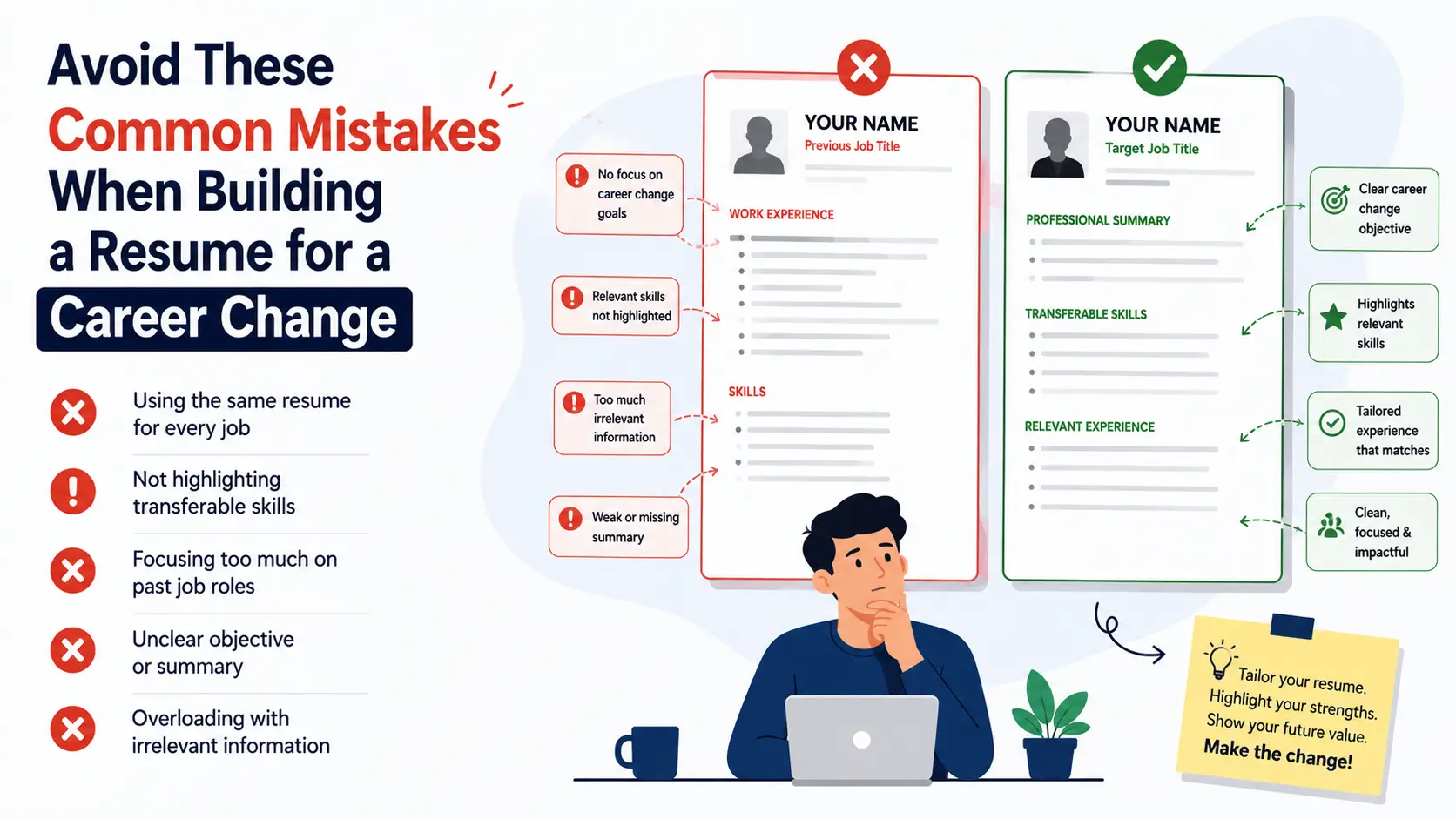
Changing your career path in India — whether you are moving from teaching to corporate training, from engineering to product management, from customer support to business analysis, or from sales to digital marketing — requires more than adding a new skill to your old resume. Most career change resumes get rejected not because the candidate lacks ability, but because the resume fails to connect past experience with the new role in a way Indian recruiters and applicant tracking systems can understand. A hiring manager at a Bangalore startup or an HR executive screening Naukri applications spends less than eight seconds on an initial scan. If your resume still reads like you belong to your previous industry, it will be filtered out before anyone reads your cover letter. This guide expands on the common mistakes career switchers make and shows you exactly how to fix them using formats, language and layouts that work for the Indian job market in 2026. You will learn which resume format actually helps career changers, how to rewrite your summary and experience bullets to highlight transferable skills, what to remove, how to handle employment gaps and short-term courses, and how to format your file correctly for Naukri, LinkedIn, and company ATS portals like Taleo, Workday and Darwinbox used widely in India. Each section includes practical examples relevant to Indian job titles, salary bands and recruiter expectations, so you can apply the changes directly on https://resumeera.xyz templates and improve your shortlisting rate.
Why Career Change Resumes Get Rejected by Indian Recruiters
Indian recruiters handling career change profiles look for one thing above all: relevance. They are not hiring your past job title, they are hiring your ability to perform the new job from day one. When your resume lists duties from your old field without translating them, the recruiter has to do the extra work of guessing your fit. Most will not. On Naukri, a recruiter often filters by keywords such as "SQL", "Google Ads", "client handling" or "curriculum design". If those keywords are missing or buried on page two, your profile never appears in their search results. LinkedIn Recruiter works similarly, ranking profiles based on headline, summary and skills match.
Another reason for rejection is lack of intent. An unexplained switch creates doubt. If you were a mechanical engineer for four years and now apply for a UX designer role without a clear summary or projects that explain the transition, the recruiter may assume you are applying randomly or will leave soon. In India, where many companies invest in 3 to 6 months of training, retention matters. Your resume must answer "why this change and why now" within the first third of page one. Without that, even strong candidates get marked as "not relevant".
ATS used by large Indian employers such as TCS, Infosys, Wipro, HDFC Bank and Reliance also contribute to rejections. These systems parse your resume text and match it against the job description. If your old designation is "Senior Teacher" and you apply for "Corporate Trainer", the ATS will not automatically know these share skills unless you explicitly use the new role's language. Using only internal jargon from your previous company, adding graphics, tables or columns that the ATS cannot read, or saving the file in a design-heavy format can cause parsing errors. The result is a low match score and automatic rejection before a human sees it.
What Indian Recruiters Look for in the First 7 Seconds
During the first scan, recruiters check four elements in order: job title alignment, summary relevance, recent experience and skills. Your headline or title line should reflect the target role, not the old one. For example, write "Aspiring Digital Marketing Associate | Ex-Sales Executive with Client Acquisition Expertise" instead of just "Sales Executive". Your summary must connect your past to your future in two to three lines. Your most recent experience should show at least 3 to 4 bullets rewritten with the new industry's verbs and metrics. Finally, your skills section should mirror the job advertisement's required skills, not a generic list. If these four elements align, the recruiter will read further. If not, they move on.
Choosing the Wrong Resume Format for a Career Pivot
Format is the structure that decides which information gets attention first. Career changers often make the mistake of using the same chronological format that worked when they stayed in one field. The chronological format lists work history in reverse time order and emphasizes job titles, companies and dates. For someone with 5 years in banking who now wants to enter data analytics, this format highlights the banking titles first and pushes relevant analytics projects to the bottom. The recruiter sees a banker, not an analyst.
At the other extreme, some candidates use a purely functional or skills-based format that hides employment history completely and only lists skill groups. While this seems attractive, Indian recruiters and ATS dislike it. Many Naukri and company ATS portals expect a clear timeline. A functional resume without dates or company names can look like you are hiding gaps and often gets flagged as incomplete. It also performs poorly in ATS parsing because the system cannot map experience to dates.
The combination or hybrid format solves both problems. It starts with a strong summary and a targeted skills section, followed by a concise work history where each role is described through transferable achievements. This lets you lead with relevance while still providing the timeline recruiters trust. For the Indian market, where most HR teams are familiar with chronological resumes, the combination format feels familiar yet strategic.
| Resume Format | Best For | How Recruiters in India React | ATS Compatibility |
|---|---|---|---|
| Chronological | Candidates staying in same field with steady growth | Easy to scan, but highlights old job titles for career changers | Excellent, parses dates and titles well |
| Functional / Skills-Based | Hiding gaps, but not recommended | Often viewed as suspicious, many recruiters reject it | Poor, struggles to map experience and dates |
| Combination / Hybrid | Career changers, freshers with projects, professionals with transferable skills | Preferred for pivots, shows relevance first while keeping timeline | Very good when formatted with simple headings |
| Creative / Infographic | Design roles only | Distracting for non-design roles, hard to scan | Very poor, graphics confuse ATS |
For most career changes in India, use the combination format built on a clean single-column layout. Keep it to one page if you have under 8 years of experience, and a maximum of two pages if you have more. Use standard headings like Summary, Key Skills, Professional Experience, Projects and Certifications, and Education. Avoid text boxes, header-footer content and multi-column designs from free templates that break ATS parsing on Naukri and Darwinbox.
Why Combination Format Works Best for Career Switchers in India
The combination format lets you control the narrative. You can place a "Relevant Skills for Target Role" section right after the summary, where you list 10 to 12 skills taken directly from job descriptions on Naukri and LinkedIn. Then, under each previous job, you rewrite bullets to prove those skills. For example, a teacher moving to instructional design can list "Curriculum Development, Learning Needs Analysis, Content Writing, LMS Tools" at the top, and then under teaching experience write "Designed 40+ lesson plans using needs analysis, improving student assessment scores by 18%" instead of "Taught Class 8 students". This translation is what convinces both ATS and human readers. It also helps you address gaps caused by reskilling. If you took a 6-month break for a full-time course, the skills section and projects section fill that period with evidence.
Step-by-Step Process to Rebuild Your Resume for a New Career
Rebuilding a resume for a career change is not about deleting everything and starting over. It is about reframing what you already have. Follow this structured process to avoid random edits and ensure every line supports your new goal. This method works whether you are a fresher switching streams after graduation or an experienced professional with 7 to 10 years in another domain.
- Define your target role with precision. Do not write "seeking opportunities in IT". Choose one specific role such as "Business Analyst - E-commerce" or "HR Executive - Talent Acquisition". Download 5 to 7 job descriptions for that role from Naukri and LinkedIn India. Highlight repeated keywords, tools and qualifications. These become your resume keywords.
- Write a new targeted summary of 3 to 4 lines. Mention your years of experience, your core transferable strengths, your reskilling efforts and your target role. Example: "Sales professional with 4 years of B2B client handling and target achievement, recently certified in Google Analytics and Meta Ads, seeking a Digital Marketing Associate role to apply data-driven campaign skills."
- Build a key skills matrix. Create a section with 2 columns: Core Skills and Tools. Under Core Skills, list 8 to 10 abilities that overlap between old and new roles. Under Tools, list software and certifications relevant to the new field. Match phrasing exactly to job ads, for example write "Advanced Excel" not just "Excel" if the ad says so.
- Rewrite every experience bullet using the STAR approach. For each bullet, identify Situation, Task, Action, Result, but phrase the Action and Result with the new industry's language. Quantify wherever possible with Indian context: revenue in lakhs, team size, percentage improvement, number of clients or students.
- Add a relevant projects or portfolio section. This is critical for career changers. Include 2 to 3 projects from online courses, freelance work, volunteering or personal initiatives. Mention project title, tools used, duration and outcome with a link to your portfolio or LinkedIn if available. For example, "E-commerce Sales Analysis Project - Analyzed 12 months of sales data using Excel and Power BI, identified top 3 underperforming categories, proposed pricing changes."
- Reorder education and certifications. Place the most relevant certification at the top, even if it is recent and short-term. If you completed a 6-month Data Science course from an institute like UpGrad, Simplilearn or NPTEL, list it above your older degree. Mention completion date and key modules.
- Remove or minimize irrelevant details. Delete old objectives, full postal address, declaration, and unrelated hobbies. Keep only one phone number, one professional email, LinkedIn URL and city. Remove outdated skills like "MS-CIT" if applying for a modern tech role unless specifically required.
- Format for ATS and human readability. Use a clean Word or PDF file with standard fonts like Calibri, Arial or Garamond at 10.5 to 11.5 pt. Use bold for headings, avoid graphics, keep margins 0.6 to 0.8 inches, and save as "FirstName_LastName_TargetRole.pdf" for easy identification by recruiters.
After completing these steps, run your resume through an ATS checker available on https://resumeera.xyz and compare it with the job description. Aim for a match score above 75% before applying. Apply this tailoring for each distinct role family, but keep a master resume with all details for quick customization.
How to Present Transferable Skills Without Confusing Recruiters
Transferable skills are the bridge between your old and new career. The mistake most candidates make is listing them as generic soft skills such as "hardworking, team player, good communication" without proof. Indian recruiters see these phrases on almost every resume and ignore them. Instead, you must show transferable skills through context and results that matter to the new employer.
Start by mapping skills correctly. Divide them into three types: technical, functional and adaptive. Technical skills are tools and methods like Excel, SQL, Tally, Figma, or SEO. Functional skills are processes like client handling, training, budgeting, or data analysis. Adaptive skills are behaviors like problem-solving or stakeholder management. For a career change, functional skills are the most valuable because they transfer across industries. A nurse moving to medical coding uses documentation and attention to detail. A journalist moving to content marketing uses research, storytelling and deadline management.
Do not just list these skills. Prove them in your experience bullets. Instead of writing "Good communication skills", write "Conducted weekly training sessions for 25 junior associates, improving process adherence by 22%". The second version proves communication through a measurable outcome. Use verbs that belong to the target industry. For HR roles, use "screened, onboarded, coordinated"; for analytics, use "analyzed, visualized, forecasted"; for design, use "wireframed, prototyped, iterated". This verb shift signals that you already think like someone in the new field.
Recruiters in India do not hire potential alone, they hire evidence. Every transferable skill on your resume must be backed by a number, a tool or a specific outcome that the new industry values.
Examples of Transferable Skills for Popular Career Changes in India
Here are concrete translations for common pivots seen in the Indian job market. Use these as models to rewrite your own bullets.
- Teacher to Corporate Trainer / Instructional Designer: Lesson planning becomes curriculum design, classroom management becomes batch facilitation, student assessment becomes training effectiveness measurement. Example bullet: "Designed and delivered 30+ hours of induction content for 120 new hires, reducing ramp-up time by 15%."
- Sales to Digital Marketing: Client acquisition becomes lead generation, target achievement becomes ROI-driven campaign management, negotiation becomes conversion optimization. Example bullet: "Achieved 112% of quarterly sales target by building a referral network, a skill now applied to organic social growth strategies."
- Engineering to Product Management: Technical problem-solving becomes requirement gathering, testing becomes user acceptance testing, documentation becomes product requirement documentation. Example bullet: "Coordinated with cross-functional team of 6 engineers to deliver a process improvement that cut production downtime by 11%."
- Customer Support to Business Analysis: Query resolution becomes stakeholder management, process knowledge becomes process mapping, feedback handling becomes requirement elicitation. Example bullet: "Analyzed 500+ customer complaints to identify top 3 service gaps, proposed workflow changes adopted by operations team."
- Banking Operations to Data Analytics: Reconciliation becomes data validation, reporting becomes dashboard creation, risk checks become anomaly detection. Example bullet: "Automated daily reconciliation report using Advanced Excel, saving 8 hours per week and reducing errors by 90%."
When you present skills this way, you help the recruiter instantly see fit without needing to interpret your background. Place the strongest 3 to 4 translated bullets at the top of your most recent role, even if they were not your main duties, as long as they are truthful.
Common Mistakes When Building a Resume for a Career Change
This section lists the most frequent errors that cause career change resumes to be rejected in India, and how to correct each one. Review your draft against this checklist before uploading to Naukri or sending to a hiring manager.
- Using a generic summary that could fit any job. Mistake: "Seeking a challenging role where I can utilize my skills and grow." Fix: Write a role-specific summary that names the target position, mentions years of relevant experience, highlights 2 to 3 transferable strengths and references your recent reskilling. Keep it under 40 words.
- Copying the old job description verbatim. Mistake: Pasting duties like "Responsible for daily attendance and discipline" when applying for an HR role. Fix: Translate duties into the new role's language. Attendance management becomes "Maintained HRMS records for 80+ staff with 99% accuracy".
- Hiding the career change reason. Mistake: Leaving the switch unexplained, which makes recruiters assume lack of focus. Fix: Address it briefly in the summary and cover letter. Example: "Transitioning from teaching to instructional design to apply curriculum expertise in a corporate learning environment after completing a certified course in Articulate 360."
- Listing every job and skill from the past 10 years. Mistake: Including irrelevant roles like part-time retail from college when applying for a data analyst role. Fix: Keep only the last 10 years or last 3 roles, and trim bullets to those that support the new career. Use a projects section to add recent relevant work.
- Ignoring keywords from the job advertisement. Mistake: Using "client handling" when the ad says "client relationship management" or writing "MS Office" when the ad requires "Advanced Excel and PowerPoint". Fix: Mirror the exact phrasing from the ad for skills and tools, provided you actually possess them.
- Adding an outdated or cluttered format. Mistake: Using two columns, text boxes, photos, or colorful infographics that ATS cannot parse. Fix: Use a single-column, text-based layout with clear headings. Save as PDF unless the employer specifically asks for Word (.docx). Test readability by copying your PDF text into Notepad; if it appears jumbled, the ATS will also struggle.
- Not quantifying achievements. Mistake: Writing "Improved sales" or "Handled team". Fix: Add numbers relevant to India: "Improved sales by 18% in 6 months across Mumbai region" or "Handled team of 5 associates and trained 12 new joiners". Numbers build credibility.
- Overloading with certifications without context. Mistake: Listing 8 short courses without showing application. Fix: List only 2 to 3 most relevant certifications and add a one-line project or outcome for each. For example, "Google Data Analytics Certificate - Completed case study analyzing 3 months of e-commerce data using SQL and Tableau."
- Forgetting to update LinkedIn and Naukri headlines. Mistake: Resume says "Aspiring Business Analyst" but Naukri headline still says "Mechanical Engineer". Fix: Align all profiles. Recruiters cross-check Naukri, LinkedIn and your resume. Inconsistency reduces trust.
- Using the same resume for every application. Mistake: Sending one generic resume to 50 companies. Fix: Keep a master resume, then create a tailored version for each role family by adjusting the summary, skills and top 4 bullets. This takes 15 minutes per application but doubles shortlist chances.
Avoiding these mistakes does not require years of experience in the new field. It requires clarity, translation and proof. Each correction makes it easier for the recruiter to say yes.
Formatting, PDF vs Word and ATS Errors That Hurt Indian Applications
Formatting errors are silent killers for career change resumes. You may have excellent transferable skills, but if the file cannot be read by the ATS or looks unprofessional to a recruiter, you will not get a call. In India, most large companies and many mid-size firms use ATS such as Taleo, Workday, SAP SuccessFactors and the homegrown Darwinbox. Naukri's own system, Resdex, also parses resumes for keyword search. All these systems prefer simple, text-based files.
Common formatting mistakes include using tables for layout, inserting icons for contact details, placing key information in headers or footers, and using non-standard fonts. ATS often ignores text inside headers, footers and text boxes, so your phone number or email could be lost. Icons for phone or email may not be parsed, leaving the recruiter without contact details. Multi-column layouts confuse reading order, so skills on the right column may be read out of context.
Another frequent error is inconsistent date formatting. Write dates as "May 2021 - Aug 2023" consistently, and align them to the right. Avoid writing only years like "2021 - 2023" if you had gaps, as it looks like hiding. For career changers who took a break for reskilling, show it transparently: "Career Break for Full-Time Certification - Jan 2024 - Jun 2024 - Completed Advanced Digital Marketing Program". Transparency builds trust with Indian employers who verify backgrounds.
PDF or Word: What to Upload on Naukri and LinkedIn
For most applications in India, PDF is the safest choice because it preserves layout across devices and looks professional. Naukri, LinkedIn Easy Apply and company career portals all accept PDF. However, some older ATS versions handle Word (.docx) better. If a job advertisement explicitly says "Upload resume in Word format" or "Send .docx", follow that instruction exactly. Otherwise, upload a text-based PDF exported from Word or Google Docs, not a scanned image PDF.
Keep file size under 500 KB, use a professional file name, and avoid password protection. Before final submission, test your file by opening it on a phone and by copying all text into a plain text editor. If the text appears in correct order and all keywords are visible, your formatting is ATS-safe. Templates on https://resumeera.xyz are already tested for ATS compatibility and use single-column layouts that work for both PDF and Word exports, which saves you from rebuilding the design manually.
- Use standard section headings: Summary, Key Skills, Professional Experience, Projects, Education, Certifications. Avoid creative headings like "My Journey" that ATS does not recognize.
- Use bullet points with simple hyphens or dots. Avoid arrows or custom symbols.
- Keep font size consistent: 14 to 16 pt for name, 11 to 12 pt for headings, 10.5 to 11 pt for body.
- Maintain 0.6 to 0.8 inch margins and adequate white space. Crowded resumes are skipped by recruiters.
- Do not include photo, date of birth, gender, marital status or full home address unless specifically required. These are outdated practices in India and can introduce bias.
Tailoring Your Resume for Every Application Without Rewriting Everything
Tailoring does not mean rewriting your entire resume for each job. It means adjusting the top third and keywords to match the specific advertisement while keeping the core experience intact. This is especially important for career changers who may be applying to slightly different titles within the same new field, such as "Digital Marketing Executive" and "Social Media Specialist".
Start with a master resume that contains all your experience, projects and skills. For each application, duplicate it and make three quick changes. First, edit the summary to include the exact job title and 2 to 3 must-have skills from the ad. Second, reorder your Key Skills section so the most relevant skills for that ad appear first. Third, adjust the top 3 to 4 bullets under your most recent role to emphasize the achievements that best match the ad's responsibilities. This targeted approach takes less than 20 minutes and significantly improves your match rate on Naukri's search and on company ATS.
Also tailor your cover letter or email body. In India, many recruiters still expect a short email with the resume attached, especially for mid-size companies. Use 120 to 150 words to explain your transition, mention one relevant project and express intent. Keep your LinkedIn headline and Naukri profile summary aligned with the tailored resume so that when recruiters cross-check, they see consistency. Over time, track which tailored version gets more responses and refine your master resume accordingly. Consistency and relevance together create a stronger impression than a single generic resume sent to many places.
Frequently Asked Questions About Career Change Resumes
Which resume format is best for a career change in India?
The combination or hybrid format is best for most career changes in India. It lets you highlight transferable skills and a targeted summary at the top while still providing a clear chronological work history that recruiters and ATS like Naukri Resdex and Darwinbox expect. Avoid purely functional formats that hide dates and companies, as they often get flagged as incomplete.
How do I show transferable skills if my previous job seems unrelated?
Map functional skills that overlap between fields and prove them with results. For example, a teacher moving to HR can show training, assessment and coordination skills with bullets like "Trained 15 new teachers and improved onboarding time by 20%". Use the new industry's verbs and quantify outcomes with numbers, tools or percentages to make the connection clear.
Should I include all my past work experience when switching careers?
No. Include only the last 8 to 10 years or the last 2 to 3 roles that are most relevant. Trim older or unrelated roles to one line or remove them if they add no value. Use the saved space for a projects or certifications section that shows recent, relevant work in your new field.
How do I handle a career gap due to reskilling or courses?
Show the gap transparently as a dedicated line. Write "Career Break for Full-Time Certification - Jan 2024 to Jun 2024 - Completed Business Analytics Program covering SQL, Excel and Power BI with 2 case studies". This explains the gap, shows intent and adds keywords. Indian recruiters prefer honesty over hidden gaps that appear during background verification.
Is PDF or Word better for uploading on Naukri and company portals?
PDF is preferred for most applications because it preserves formatting and is accepted by Naukri, LinkedIn and modern ATS. Use Word (.docx) only if the job ad specifically asks for it, as some older ATS parse Word slightly better. Always export as text-based PDF, not scanned image, and keep file size under 500 KB with a professional file name.
How long should a career change resume be?
One page is ideal if you have less than 8 years of experience, and up to two pages if you have more. Recruiters in India spend seconds on the first scan, so a concise, relevant resume performs better than a lengthy one. Keep margins clean, use bullet points and prioritize recent, relevant achievements over older duties.
Do I need to change my Naukri and LinkedIn profiles when changing careers?
Yes. Update your headline, summary and skills on both platforms to match your target role. Recruiters cross-check these profiles after screening your resume. If your Naukri headline still shows your old designation while your resume shows the new target, it creates confusion and reduces shortlisting chances. Align all profiles with the same keywords and summary.
A successful career change resume does not pretend you have years of experience in the new field. It respectfully translates what you already know into the language the new field values, proves it with projects and numbers, and presents it in a clean, ATS-friendly format that Indian recruiters trust. Start with a clear target role, choose the combination format, rewrite your summary and top bullets with keywords from real job ads on Naukri and LinkedIn, add 2 to 3 relevant projects, and keep your file simple and professional. Each application is a chance to refine this translation. With consistent tailoring and honest presentation of your reskilling journey, your resume will stop looking like a record of your past and start reading like a promise for your future role. Build and test your next version on https://resumeera.xyz to ensure it is ready for both human readers and ATS screening.