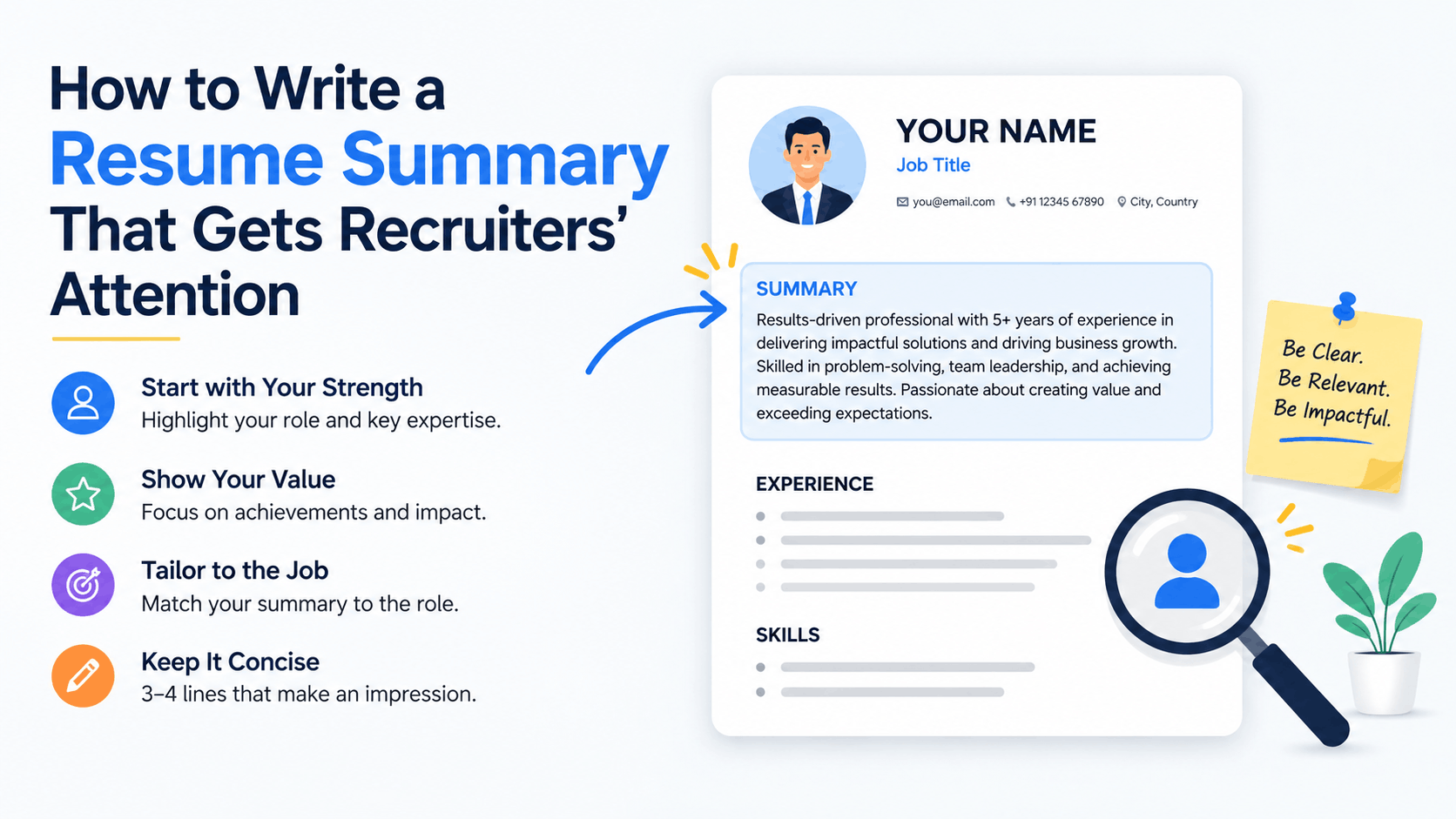
How to Write a Resume Summary That Gets Recruiters' Attention
? Table of Contents
- What is a Resume Summary?
- Why Recruiters Notice Your Resume Summary
- How to Write a Professional Resume Summary
- Resume Summary Examples for Freshers
- Resume Summary Examples for Experienced Candidates
- ATS-Friendly Resume Summary Tips
- Common Mistakes to Avoid
- Actionable Tips for Your Summary
- Frequently Asked Questions
- Conclusion
? Introduction: Why Your Resume Summary Matters
Your resume summary is often the first thing recruiters and hiring managers read on your resume. In fact, studies show that recruiters spend only 6-8 seconds scanning a resume. If your summary doesn't grab their attention in those precious seconds, your qualifications—no matter how impressive—might never get read.
In India's competitive job market, where thousands of applications flood hiring portals daily, a well-crafted resume summary can be the difference between getting an interview call and being passed over. Whether you're a fresher looking for your first job or an experienced professional seeking a career change, knowing how to write a resume summary is essential.
This comprehensive guide will show you exactly how to write a resume summary that stands out, includes resume summary examples for every situation, and teaches you the ATS-friendly resume summary strategies that help you bypass automated filtering systems.
1️⃣ What is a Resume Summary?
A resume summary is a brief, 2-4 sentence overview placed at the top of your resume that highlights your professional identity, core skills, and key achievements. It's your elevator pitch—a concise statement that answers the question: "Who are you professionally, and what value do you bring?"
Unlike a career objective (which focuses on what you want), a resume summary focuses on what you've accomplished and what you offer. It's tailored to each job application, not generic. Think of it as a professional profile summary that makes recruiters want to read the rest of your resume.
For Indian job seekers, especially freshers, a strong resume summary for freshers can substitute for limited work experience by showcasing enthusiasm, relevant skills, and potential. For experienced professionals, a professional resume summary positions you for leadership roles or career transitions.
2️⃣ Why Recruiters Notice Your Resume Summary
Here's the reality: recruiters are busy. They're reviewing dozens, sometimes hundreds of resumes daily. Your resume summary is the gateway—if it doesn't immediately communicate your value, your resume goes into the rejection pile.
Recruiters Notice Your Summary Because:
- It saves them time: They immediately understand your professional background without reading the entire resume.
- It shows self-awareness: A good summary proves you know your strengths and how to communicate them.
- It matches job requirements: When tailored properly, it shows you've actually read the job description (not just applied blindly).
- It highlights measurable value: Numbers and specific achievements in your summary catch attention faster than generic statements.
- It filters through ATS systems: An ATS-friendly resume summary with relevant keywords helps you pass automated screening.
For resume summary examples for job seekers, think about what would make YOU stand out in a sea of applications. What problem do you solve? What results have you delivered? That's what belongs in your summary.
3️⃣ How to Write a Professional Resume Summary (Step-by-Step)
Now let's get practical. Writing a strong how to write a resume summary requires a formula. Follow these steps:
Step 1: Start with Your Job Title/Role
Begin with your current or target job title. Example: "Experienced Digital Marketing Manager" or "MBA Graduate specializing in Finance." This immediately tells recruiters what role you're in or targeting.
Step 2: Highlight Your Core Strengths
List 2-3 key skills relevant to the job. Don't use generic terms like "hardworking" or "team player." Be specific: "SEO optimization," "Salesforce administration," "supply chain management."
Step 3: Include Quantifiable Achievements
This is crucial. Instead of saying "improved sales," say "increased sales by 35% in Q3 2025." Quantified achievements are 10x more powerful. Use metrics: percentages, revenue figures, time saved, customers acquired.
Step 4: Tailor to the Job Description
Your professional resume summary isn't one-size-fits-all. For each application, mirror the language and priorities from the job posting. If they need "project management expertise," mention it directly.
Step 5: Keep It Concise
Aim for 2-4 lines (50-80 words max). Recruiters won't read a paragraph. Your resume summary should be skimmable in under 10 seconds.
4️⃣ Resume Summary Examples for Freshers
If you're a fresher without much work experience, don't worry. Your resume summary for freshers should focus on education, internships, projects, and transferable skills. Here are resume summary examples for freshers from different fields:
Example 1: IT/Software Development Fresher
Example 2: Commerce/Finance Fresher
Example 3: HR/Business Development Fresher
5️⃣ Resume Summary Examples for Experienced Candidates
For experienced professionals, your career summary for resume should emphasize leadership, results, and industry expertise. Here are resume summary examples for professionals with 3-10+ years of experience:
Example 1: Senior Sales Manager
Example 2: Project Manager
Example 3: Marketing Professional
Notice how experienced professional resume summary examples always include specific numbers? That's what differentiates senior profiles. You're not just describing your job—you're quantifying your impact.
6️⃣ ATS-Friendly Resume Summary Tips
Before a human recruiter ever sees your resume, it needs to pass through an ATS (Applicant Tracking System). An ATS-friendly resume summary uses the right keywords and format. Here's how:
Keyword Strategy for ATS
- Mirror job description keywords: If the job posting says "project management" and "SAP," use those exact terms in your summary.
- Use industry-standard terminology: Instead of "good communicator," say "stakeholder management" or "cross-functional collaboration."
- Include soft and hard skills: Mix technical skills (Java, AWS) with professional skills (leadership, negotiation).
- Use relevant acronyms: ERP, CRM, SEO, MBA, PMP, etc.—but spell them out too.
Format Tips for ATS Scanning
- Keep your summary in 2-4 short lines
- Use clear, scannable language (not flowery prose)
- Place it at the top of your resume (after contact info)
- Avoid tables, columns, or text boxes in the summary section
- Learn more ATS best practices to ensure your whole resume passes screening.
An ATS-friendly resume summary doesn't sacrifice quality for keywords—it integrates relevant terms naturally while remaining compelling to human readers.
7️⃣ Common Mistakes to Avoid in Your Resume Summary
Let's look at what NOT to do in your resume summary:
Mistake 1: Being Too Generic
❌ Weak: "Hardworking professional seeking growth opportunities."
✅ Strong: "Data analyst with 3 years of experience using Python and SQL to reduce processing time by 40%."
Mistake 2: Focusing on What You Want, Not What You Offer
❌ Weak: "Seeking a challenging role with a fast-growing company offering learning opportunities."
✅ Strong: "Digital marketer with proven ability to increase brand engagement by 60% and drive qualified leads."
Mistake 3: Making Vague Claims Without Evidence
❌ Weak: "Excellent communication and leadership skills."
✅ Strong: "Led a team of 12 across India, improved onboarding efficiency by 30%, and mentored 5 junior staff members to promotion."
Mistake 4: Using Outdated Language
❌ Weak: "Passionate about synergizing solutions and leveraging core competencies."
✅ Strong: "Expertise in agile project management and cross-functional team collaboration."
Mistake 5: Ignoring the Job Description
Your resume summary should be customized for each role. Using the same summary for every application is a missed opportunity. Take 2 minutes to tweak it for each job.
Mistake 6: Overstuffing with Skills
❌ Don't list 15 skills in your summary. Pick the top 2-3 most relevant to the job, and expand on them in dedicated skills sections.
8️⃣ Actionable Tips for Crafting Your Resume Summary Right Now
Tip 1: The "Achievement Formula"
Example: "Senior software engineer with 5 years building scalable microservices | Led team that reduced API response time by 45% | Seeking architect role to drive technical innovation."
Tip 2: Use Power Action Verbs
Replace weak verbs with strong action verbs in your summary. Instead of "worked on," use "spearheaded," "championed," "optimized," "transformed," "accelerated," "scaled," "pioneered."
Tip 3: Test Your Summary with the "So What?" Question
After each statement in your summary, ask "So what?" If you can't answer with impact or proof, rewrite it.
Example: "I have leadership experience" → "So what?" → "I led a team of 15 people and improved retention by 25%."
Tip 4: Get Feedback
Have peers, mentors, or experienced professionals review your resume summary before submitting. Sometimes what feels clear to you sounds vague to others.
Tip 5: Use ResumeEra.xyz's Free Resume Builder
Don't have time to code or format your resume? Use ResumeEra.xyz's free resume builder—no signup required, no login needed, unlimited PDF downloads, and no watermark. It automatically formats your resume summary for ATS compatibility while keeping it visually appealing.
❓ Frequently Asked Questions
Q1: What's the difference between a resume summary and a resume objective?
Summary: Highlights your accomplishments and what you bring to the table. For job seekers of all levels—especially experienced candidates.
Objective: States what you want from the employer. Generally dated and less preferred, except for career changers or freshers. Learn when to use each.
Q2: How long should a resume summary be?
Keep it to 2-4 lines or 50-80 words maximum. Recruiters spend 6-8 seconds on your resume. Your summary needs to be skimmable. If it's longer, you're including fluff—cut it.
Q3: Should I use the same resume summary for every job application?
No. Tailor your summary for each role. Spend 2 minutes mirroring the job description's language and priorities. This dramatically improves your chances and helps you pass ATS screening.
Q4: Can freshers use a resume summary?
Absolutely. Freshers can use a resume summary for freshers to highlight education, internships, projects, and core competencies. It compensates for lack of work experience and shows professional maturity.
Q5: What if I'm changing careers? How do I write a resume summary?
Focus on transferable skills. Example: "IT professional transitioning to product management | 5 years of technical expertise, customer feedback analysis, and cross-team collaboration | Seeking PM role to leverage tech background and user-centric mindset." More on career transitions here.
Q6: Do I need numbers in my resume summary?
Strongly recommended. Numbers make your achievements concrete and memorable. "Increased revenue," vs. "Increased revenue by 35%" — the second one is 10x more powerful.
Q7: Should my resume summary include personal details?
Keep it professional. Your summary is NOT the place for personal interests or hobbies. Focus on your professional identity, skills, and achievements. (Personal interests can go in a separate section, if relevant.)
Q8: How do I write an ATS-friendly resume summary?
Use keywords from the job description, industry-standard terminology, and clear formatting. Avoid graphics, special characters, and fancy fonts. Keep it simple, scannable, and keyword-rich. Full ATS guide here.
✅ Conclusion: Your Resume Summary is Your First Impression
Your resume summary is your professional headline—the first chance to convince recruiters that you're worth reading about. Whether you're a fresher crafting your resume summary for freshers, an experienced professional writing a professional resume summary, or someone changing careers, the formula is the same: be concise, be specific, and be compelling.
Remember the key principles:
- ✔ Focus on what you've accomplished, not what you want
- ✔ Include quantifiable results whenever possible
- ✔ Tailor for each job application
- ✔ Keep it short and scannable (50-80 words)
- ✔ Use ATS-friendly formatting with relevant keywords
- ✔ Follow resume summary examples as templates, not scripts
Ready to create a winning resume? Use ResumeEra.xyz's free resume builder to craft your entire resume with a professional summary at the top. No signup, no login, unlimited downloads, zero watermarks. It's the fastest way to get job-ready.
Try ResumeEra.xyz Free Resume Builder →
Start building your professional resume summary today and land that interview tomorrow! ?
- How to Write a Resume in 2026 — Complete step-by-step guide
- Best Resume Format for Freshers 2026 — Tailored for Indian freshers
- 10 Essential Resume Sections in 2026 — What every resume needs
- How to Highlight Achievements on Your Resume — Make your impact visible
- ATS Resume Checklist Before You Apply — Ensure you pass screening