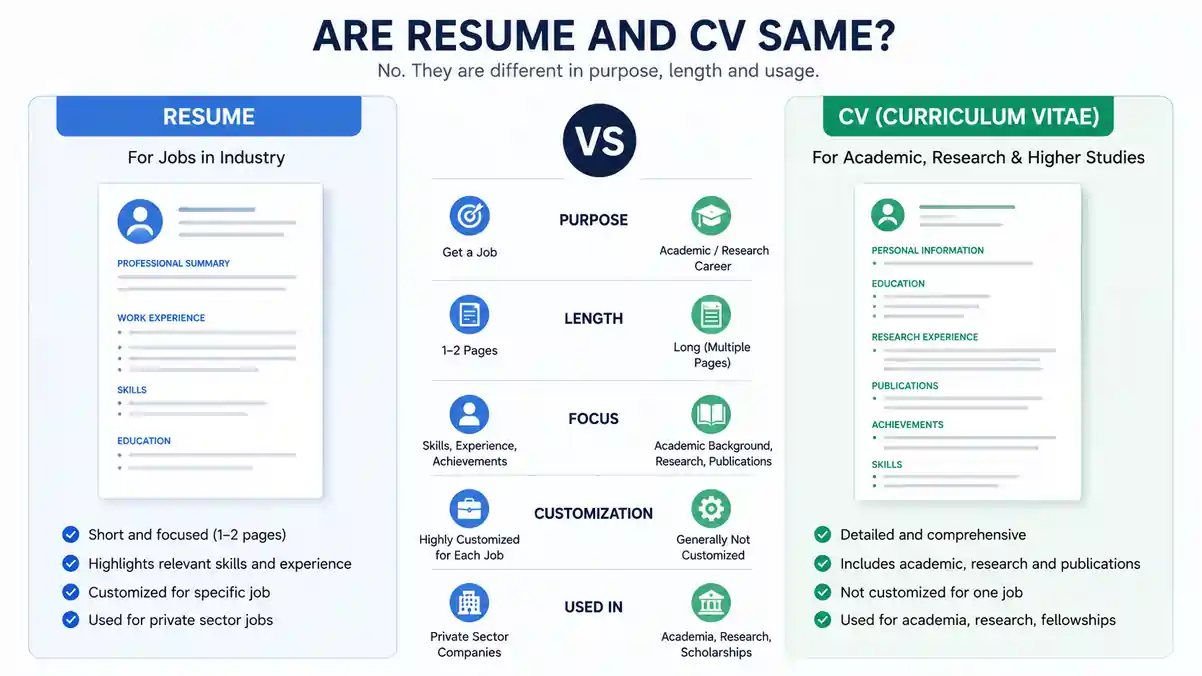
In the high-stakes world of job hunting, the difference between a resume and a Curriculum Vitae (CV) is not merely a semantic nuance; it is a fundamental strategic decision that can determine whether your application lands in the "interview" pile or the "reject" bin. Whether you are a fresh graduate in Delhi NCR, a tech professional in Bangalore, or an academic researcher applying for a global fellowship, understanding the distinct purposes, structures, and regional expectations of these two documents is critical.
Many job seekers mistakenly believe that a resume and a CV are interchangeable terms. This misconception leads to applications that are either too verbose for a corporate recruiter or too brief for an academic committee. As we navigate the hiring landscape of 2026, where Applicant Tracking Systems (ATS) and AI-driven screening tools play a dominant role, the precision of your document format has never been more important.
This article serves as the definitive resource for understanding the Are Resume And Cv Same concepts. We will break down the differences in length, content, structure, and regional usage, providing you with a mental model—and a visual guide—to ensure you submit the perfect document for every opportunity.
Free Resume Builder
Don’t let a weak resume decide your future.
Thousands of people are getting rejected — not because they’re bad, but because their resume doesn’t speak for them. Make a resume that actually gets shortlisted.
Your next job is closer than you think.
Start in 2 minutes.
No complicated forms. Just pick a template, fill details, And Apply.
Apply Now Your Job →Introduction to Resume and CV Differences
The terms "resume" and "CV" are often used interchangeably in casual conversation, but in the professional world, they represent two distinct types of career documents with specific functions. The primary difference lies in their intent: a resume is a concise marketing document tailored to a specific job, while a CV is a comprehensive historical record of your academic and professional achievements.
In the United States and Canada, the resume is the standard document for almost all private sector jobs. In contrast, in the United Kingdom, Europe, New Zealand, and parts of Asia (including India), the term "CV" is often used as a generic term for any job application document, even if it follows resume-style brevity. However, in the academic, scientific, and medical fields globally, a true CV is required to demonstrate a deep history of research, publications, and grants.
Understanding these nuances is the first step in optimizing your application. When you are creating a Are Resume And Cv Same for your own reference, the first category to consider is the "Purpose." A resume answers the question, "Why am I a good fit for this specific role?" A CV answers, "What is the complete story of my career and contributions to my field?"
Misunderstanding this distinction can lead to fatal errors. Submitting a 15-page academic CV to a tech startup in Mumbai will likely result in your application being ignored due to a lack of focus. Conversely, submitting a one-page resume to a university tenure committee in the UK will signal a lack of depth and experience.
To navigate this successfully, you must align your document with the expectations of the hiring ecosystem in your target region and industry. As you prepare your documents, ensure you are following the best practices for your specific goal. For a deeper dive into tailoring your documents effectively, you can refer to our guide on Resume with Job Description: The Complete 2026 Guide to Tailor Your Resume for Every Application.
Key Differences Breakdown: Length, Content, and Focus
When analyzing the Are Resume And Cv Same, the most immediate visual difference is the length and the depth of content. These are not arbitrary choices but are driven by the specific needs of the recruiter or hiring manager reading the document.
Length and Format
A resume is designed to be a snapshot. It is typically limited to one or two pages. The goal is to provide a high-level overview of your most relevant skills and experiences. Recruiters in the corporate world often spend less than 10 seconds scanning a resume. Therefore, brevity and impact are paramount. The format is usually chronological, functional, or a combination of both, but it always prioritizes the most recent and relevant experience.
In contrast, a CV has no page limit. It is a living document that grows with your career. A CV for a senior professor might span 10 to 20 pages, detailing every publication, conference presentation, grant received, and teaching assignment. The format is strictly chronological, focusing on the timeline of academic and professional achievements.
Content Focus
The content strategy differs significantly between the two. A resume focuses on achievements and skills relevant to the job description. It uses bullet points to highlight quantifiable results (e.g., "Increased sales by 20%," "Managed a team of 10"). It is highly customizable; you should create a different version of your resume for every single job application, tweaking the keywords to match the job posting.
A CV focuses on comprehensive history. It includes a detailed list of all research, publications, awards, honors, professional memberships, and even teaching experience. While you can tailor the order of sections to highlight relevant work, you do not omit older or less relevant academic work. The content is static in the sense that it represents your entire career, not just a filtered subset.
Visual Structure
The visual structure of a resume often employs design elements to improve readability, such as columns, bold headers, and skill bars. This helps in quickly scanning for keywords. However, when optimizing for ATS, simplicity is key. You can explore ATS Friendly Resume: The Complete 2026 Guide to Beat the Bots and Get Hired to understand how design impacts screening.
A CV, particularly in academic circles, is traditionally text-heavy and follows a formal, conservative layout. It prioritizes clarity and completeness over flashy design. The focus is on the substance of the work rather than the visual appeal of the document.
Regional Variations: When to Use Which?
One of the most confusing aspects of the Are Resume And Cv Same is the regional variation in terminology. What is called a "CV" in one country might be a "Resume" in another, and using the wrong term can confuse international recruiters.
North America (USA and Canada)
In the United States and Canada, the term "Resume" is the standard for all non-academic job applications. If you are applying for a job in finance, marketing, engineering, or retail, you must submit a resume. The term "CV" is reserved strictly for academic, medical, and scientific roles. If an American recruiter asks for a CV, they are almost certainly looking for an academic document.
Europe and the United Kingdom
In the UK, Ireland, and most of Europe, the term "CV" is used generically to refer to the document you submit for any job, including corporate roles. However, the content of a European "CV" for a corporate job usually mirrors the brevity of an American resume (1-2 pages). It is not the 10+ page academic CV unless you are in academia. Therefore, if you are applying to a company in London, you should prepare a 1-2 page document, but you should label it "CV" in your file name and header to match local expectations.
Asia and India
In India and many parts of Asia, the terminology is a mix. The term "CV" is widely used to describe the standard job application document for all sectors, including IT, BPO, and manufacturing. However, the content expected is often closer to a resume (1-2 pages) for entry-level and mid-level corporate roles. For senior roles or academic positions, the expectation shifts to a more detailed document.
It is crucial to understand the specific norms of the company you are applying to. For instance, when applying for international remote roles or global MNCs from India, it is often safer to follow the American resume standard (1-2 pages, focused on achievements) even if the job posting uses the word "CV." To learn more about crafting a document that works for Indian MNCs, check out our guide on Fresh Out of College in Delhi NCR: How to Build My First CV for an MNC Job Before My Morning Commute?.
Australia and New Zealand
Similar to the UK, the term "CV" is standard in Australia and New Zealand for all job applications. The length expectation is typically 2-4 pages, slightly longer than the US resume but shorter than an academic CV. It is important to include a professional summary and detailed work history, but avoid the exhaustive academic listing unless applying for research roles.
Deep Dive: Content and Structure Analysis
To truly master the Are Resume And Cv Same, one must look beyond the surface and analyze the specific sections required for each document type. The structural differences are designed to serve the distinct goals of the hiring process.
Resume Structure
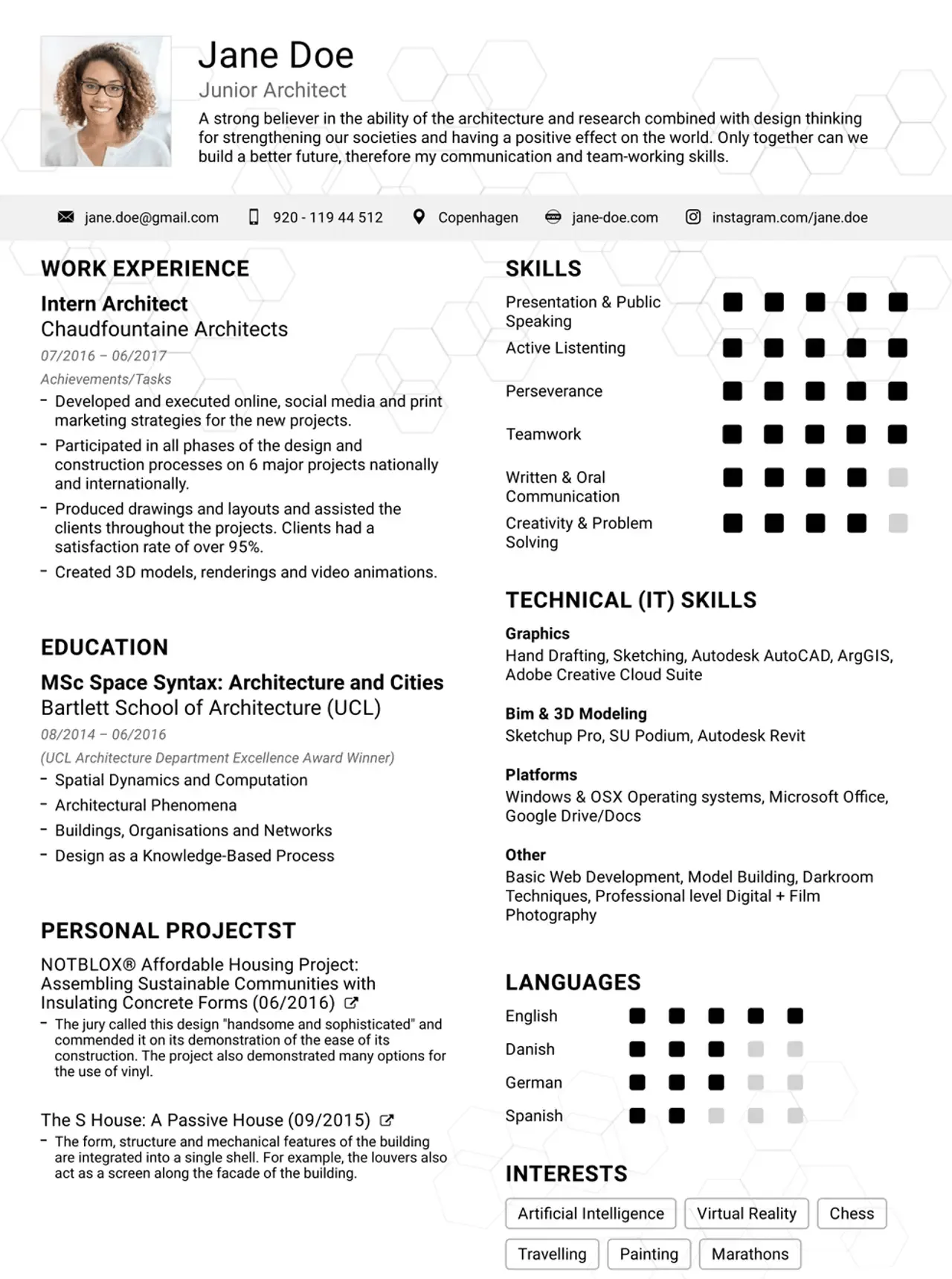
A standard resume follows a streamlined structure designed for quick scanning:
- Header: Name, contact information, LinkedIn URL, and portfolio link (if applicable).
- Professional Summary: A 3-4 line pitch highlighting your value proposition.
- Skills: A list of hard and soft skills relevant to the job.
- Work Experience: Reverse chronological order, focusing on achievements with metrics.
- Education: Degree, institution, and graduation year (recent grads may include GPA or relevant coursework).
- Optional Sections: Certifications, Projects, or Languages.
For those new to the process, ensuring these sections are correctly formatted is vital. You can find specific advice on sections in Key Resume Sections to Tailor for Every Job Application – Hinglish Guide.
CV Structure

A CV structure is expansive and includes:
- Header: Name, full contact details, and often a permanent address.
- Research Interests: A statement of your specific academic focus (for academic CVs).
- Education: Detailed list of degrees, including thesis titles and advisors.
- Publications: A categorized list of peer-reviewed articles, books, and chapters.
- Conference Presentations: Talks, posters, and panels.
- Grants and Awards: A comprehensive list of funding and honors.
- Teaching Experience: Courses taught, TA roles, and curriculum development.
- Professional Affiliations: Memberships in academic societies.
- References: Full contact details of academic or professional references (often 3-5).
Tailoring Strategies
The most significant operational difference is the tailoring strategy. A resume is a "chameleon"; it changes color to match the job description. You must analyze the job posting, identify keywords, and rearrange your bullet points to align with the employer's needs. This process is critical for passing ATS filters. For a detailed guide on this, refer to How to Tailor Your Resume to a Job Description & Boost Your ATS Score in 2026 – पूरी गाइड हिंदी+इंग्लिश में.
A CV, however, is a "monolith." While you can reorder sections to highlight relevant experience (e.g., putting "Grants" before "Publications" if applying for a funding-focused role), you generally do not remove content. The goal is to present the full scope of your capabilities.
Industry-Specific Scenarios: Who Needs What?
The decision to use a resume or a CV is often dictated by the industry you are targeting. Understanding these scenarios is a key component of any Are Resume And Cv Same.
Corporate and Technology
In the corporate world (Marketing, Sales, Finance, Operations) and the Technology sector (Software Development, Data Science, Product Management), the resume is the gold standard. Employers in these fields are looking for specific skills and immediate value. They want to know what you have achieved in your last 5-10 years.
For example, a software engineer applying to a startup in Bangalore needs a resume that highlights their tech stack, project contributions, and bug-fixing achievements. A 10-page document listing every coding class they took in college would be counterproductive. If you are a fresher, you might look at How to Write a Resume With No Work Experience in 2026 to structure your projects effectively.
Academia and Research
In academia, the CV is non-negotiable. Whether you are applying for a PhD program, a post-doctoral position, or a professorship, the hiring committee needs to evaluate the depth and breadth of your research. They need to see your publication history, citation counts, and grant acquisition skills.
Similarly, in the medical and scientific fields, a CV is required to list clinical rotations, research protocols, and specialized certifications. A resume would be insufficient to convey the necessary level of detail.
Non-Profits and International Organizations
International organizations (like the UN, WHO, or World Bank) and large non-profits often have unique requirements. While they may use the term "CV," they often expect a document that blends the two styles: a comprehensive list of experiences (like a CV) but formatted with a focus on impact and achievements (like a resume).
For example, if you are applying for a humanitarian role, you need to list all your volunteer work and field experience in detail, which might push the document beyond two pages. In this case, you should follow the "CV" format but ensure it remains readable and achievement-oriented.
Common Mistakes and Myths
Even experienced professionals fall prey to common misconceptions when navigating the Are Resume And Cv Same landscape. Avoiding these pitfalls can save you from immediate rejection.
Myth 1: Resume and CV are Interchangeable
This is the most pervasive myth. While they share similarities, they are not the same. Using a CV for a corporate job in the US will make you look out of touch with local norms. Conversely, using a resume for an academic role in the UK or India will make you look underqualified. Always verify the specific requirements of the job posting and the region.
Myth 2: Length Doesn't Matter
In the case of resumes, length is a critical factor. A 4-page resume for a mid-level position is often a red flag indicating an inability to prioritize information. Recruiters want brevity. For CVs, length is expected to grow, but it must remain organized. A disorganized 15-page CV is as bad as a 4-page resume.
Mistake 1: Omitting Relevant Info
Some job seekers, fearing their resume is too long, remove relevant experience or skills. This is a mistake. Instead of deleting content, refine the phrasing to be more concise. Every bullet point should add value. If you are struggling to fit your experience, review Resume Checklist 2026: The Ultimate Guide to Landing Your Dream Job for optimization tips.
Mistake 2: Generic CVs
While a CV is comprehensive, it should not be a "dump" of everything you've ever done. It must be curated. For academic CVs, irrelevant early career data might be summarized or omitted if it doesn't support your current research trajectory. For corporate CVs (in regions where the term is used), ensure the document is still tailored to the job, not just a generic history.
Mistake 3: Formatting Errors
Using a complex design for a CV or a text-heavy, unstructured format for a resume can both lead to ATS rejection. The design must match the document type. For a resume, clean lines and white space are essential. For a CV, clear headings and consistent formatting are key. Ensure your document is ATS compatible by following ATS Compatible Resume Format 2026 | Build a Resume That Passes ATS.
Creating Your Own Resume vs CV Comparison Infographic
Now that you understand the theoretical differences, how do you apply this knowledge to create a visual aid for your own career planning? Creating a personal Are Resume And Cv Same can be a powerful tool for organizing your job search strategy.
Step 1: Define Your Goals
Start by identifying the types of roles you are targeting. Are you applying to tech companies, academic institutions, or international organizations? This will dictate which document you need to prioritize.
Step 2: Map Your Content
Create two separate lists. One for "Resume Content" (skills, recent achievements, tailored summaries) and one for "CV Content" (publications, full education history, awards). This mapping helps you see where your current document falls short.
Step 3: Design the Visual
Use a simple tool to create a side-by-side comparison. Include columns for "Purpose," "Length," "Content Focus," and "Region." This visual will serve as a quick reference when you are preparing applications.
Step 4: Integrate Tools
Once you have your content mapped, use a resume builder to create the actual documents. If you are looking for a free tool that supports both formats and is ATS-friendly, consider using Free Resume Builder, No Sign-Up: Download in Minutes -Resumeera. This allows you to experiment with different layouts without paying for premium features.
Step 5: Review and Refine
Finally, review your documents against the job description. Ensure that the resume highlights the most relevant skills and that the CV provides the necessary depth for academic roles. Regular updates to your CV are essential as your career progresses.
People Also Ask
What is the main difference between a resume and a CV?
The main difference is length and purpose. A resume is a concise, 1-2 page summary of your skills and experience tailored to a specific job. A CV is a comprehensive, multi-page document detailing your entire academic and professional history, used primarily in academia and research.
Do I need a CV or a resume for a job in India?
In India, the term "CV" is commonly used for all job applications, including corporate roles. However, the content should typically follow resume standards (1-2 pages, focused on achievements) unless you are applying for an academic or research position.
Can I use a CV template for a corporate job?
Yes, but you must ensure the template allows for a concise, 1-2 page format. If the template forces a long, academic layout, it is not suitable for corporate jobs. Always choose a template that emphasizes readability and relevance. For template advice, see Which free resume templates are best suited for freshers applying to Indian companies? (Hinglish Guide).
How often should I update my CV?
You should update your CV every time you complete a significant project, publish a paper, or receive an award. Unlike a resume, which you update only when applying, a CV is a living document that should always reflect your current status.
Is a resume better than a CV for job hunting?
Neither is "better"; it depends on the context. For corporate jobs in the US and most industries in India, a resume is more effective. For academic and research roles globally, a CV is the only acceptable format.
What happens if I submit the wrong document type?
Submitting the wrong document can lead to your application being rejected. A resume for an academic role may look incomplete, while a CV for a corporate role may appear unfocused and difficult to read.
Can a resume be more than 2 pages?
Generally, no. For most professionals, a resume should be 1-2 pages. Exceptions exist for senior executives with 20+ years of experience, but even then, conciseness is valued. If you have extensive experience, focus on the most relevant 10-15 years.
Conclusion
Navigating the Are Resume And Cv Same landscape requires a clear understanding of your career goals, the industry norms, and the regional expectations of your target job market. Whether you are crafting a concise, high-impact resume for a tech startup in Bangalore or a detailed, comprehensive CV for a research position in London, the key is to align your document with the needs of the reader.
Remember, a resume is a marketing tool designed to get you an interview, while a CV is a historical record designed to establish your credibility. By mastering the differences in length, content, and structure, you can ensure that your application makes the right impression.
As you move forward with your job search, utilize the resources available to you. Tailor your resume for every application, keep your CV updated, and always prioritize clarity and relevance. With the right strategy and the correct document format, you will be well-positioned to secure your dream job in 2026. For further assistance with specific resume formats, explore The Complete Guide to Resume Formats in 2026: Choose the Right Format for Your Career Success to make an informed decision.
Your career is your most valuable asset. Treat your resume and CV with the care and precision they deserve, and you will open doors to new opportunities across the globe.
You’re not failing.
Your resume is.
Most people lose jobs before the interview — not because they lack skills, but because their resume looks average. Fix that in 5 minutes.
- ✅ ATS-optimized format
- ✅ Recruiter-friendly design
- ✅ Download instantly (PDF)
⚡ No signup required • 100% Free • Works on mobile
Get shortlisted faster
Pick a template → fill details → download resume.