Resume vs CV in India:
What Recruiters Actually Expect
Match the document to the decision-maker — not habit. Here's exactly how to choose between a resume and CV for every industry, role, and hiring process in India.
You're staring at a job post and second-guessing the document. Do they want a resume or a CV? In India, the answer depends on the role, the industry, and who's reading it — not just what you studied or how many years you've worked.
Private sector and corporate jobs: Send a resume. Academia, research, and government roles: Send a CV. Get this wrong and your application feels off before they've read line two.
This guide covers every angle of the resume vs CV debate for India — from what HR managers actually look for to ATS formatting, international applications, and real examples you can copy. Read it once, apply it every time.
Resume vs CV: The Core Difference in One Minute
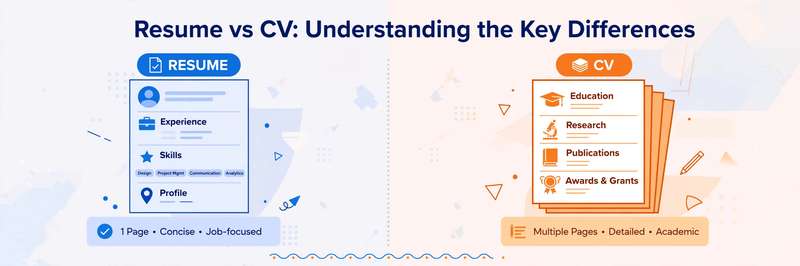
The confusion between resume and CV exists because Indian job portals, HR teams, and even companies use both terms interchangeably — but they are not the same document. Here is the fundamental difference:
| Factor | Resume | CV (Curriculum Vitae) |
|---|---|---|
| Purpose | RESUME Targeted snapshot of skills and results |
CV Comprehensive career and academic record |
| Length | 1–2 pages (max 3 for 15+ yrs exp) | 3–10+ pages (no upper limit) |
| Focus | Outcomes, metrics, KPIs, impact | Publications, research, grants, degrees |
| Customization | Tailored per job application | Updated continuously, rarely re-ordered |
| Used in India for | Startups, MNCs, IT, sales, product, design, finance | Academia, government, research, fellowships, PSUs |
| Photo Required? | No (avoid for private sector) | Sometimes (government forms may request it) |
| Screened by | ATS, HR recruiter, hiring manager | Selection committee, academic panel, UPSC board |
| Key sections | Summary, Experience, Skills, Education | Education, Research, Publications, Conferences, Grants |
Most Indian HR teams ask for a "CV" out of habit but actually want a resume. Read the job post for context clues — KPIs, revenue, product launches = resume. UGC-NET, PhD, JRF, annexures = CV.
When to Use a Resume vs CV in India
India's job market is diverse. The same qualification can require a resume in one sector and a CV in another. Here's a breakdown by hiring context:
? Send a Resume When…
- Applying to private companies, startups, MNCs
- Job post mentions targets, KPIs, growth, or revenue
- Application goes through ATS or a recruiter
- Campus placements and lateral hiring
- IT, product, sales, marketing, design, finance roles
- International applications to US companies
- Applying via Naukri, LinkedIn, or company career portals
? Send a CV When…
- Applying to universities, research institutes, labs
- Government jobs (UPSC, SSC, PSC, PSU applications)
- PhD programs, JRF, SRF, postdoc fellowships
- Faculty and assistant professor positions
- Funding applications (DST, DBT, CSIR grants)
- International applications to EU or UK academia
- Post mentions publications, annexures, or UGC-NET
Industry-Wise Quick Reference
| Industry / Sector | Document to Send | Key Signal |
|---|---|---|
| IT / Software / SaaS | Resume (1–2 pages) | ATS, recruiter screen |
| Startups | Resume (1 page preferred) | Founder reads directly |
| FMCG / Sales | Resume with metrics | Revenue, territory, quota |
| Banking / Finance | Resume (structured) | Certifications listed |
| Healthcare / Hospitals | Resume (clinical roles) / CV (research) | Depends on role type |
| Government / PSU | Detailed CV or prescribed form | Annexures, marks, caste cert. |
| Academia / University | Academic CV | Publications, teaching, grants |
| Research Institutes (CSIR, TIFR) | Academic CV | Scopus IDs, citations |
| NGO / Development Sector | Resume or CV (org-dependent) | Check job post carefully |
3-Step Decision Process: Which Document to Send
If you're still unsure after reading the job post, run through these three questions. They work for every role in India.
What does the post measure you on?
If it mentions targets, quotas, client acquisition, revenue growth, product launches, or user metrics — the decision-maker thinks in outcomes. That's a resume job. If it mentions research output, publications, grants, or teaching experience — that's a CV job.
Who screens your application first?
HR managers, startup founders, and ATS software need a skimmable resume — they spend 7–10 seconds on a first pass. Academic selection committees and UPSC panels review in depth and score on detailed evidence — they want a comprehensive CV.
What is the shortlisting mechanism?
If the company uses ATS or a recruiter portal (Naukri, LinkedIn, Workday, Greenhouse) — go concise with resume. If there's a prescribed application form, committee review, merit list, or annexures — go long with CV.
When in doubt and you can't ask HR: business and corporate roles → 2-page resume. Academia and public sector → full CV. This default won't get you auto-rejected.
Resume Format for India: What Hiring Managers Prefer
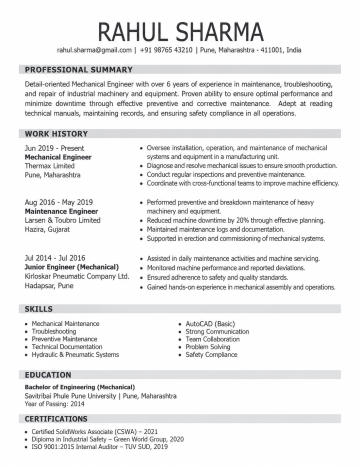
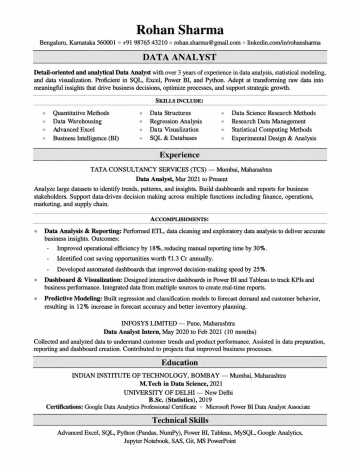
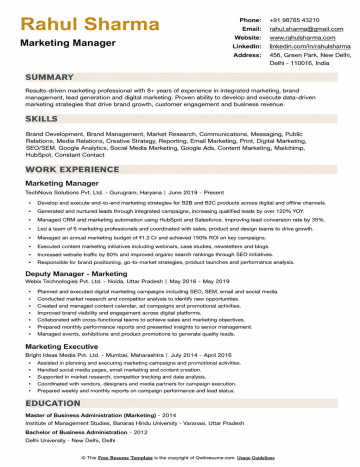
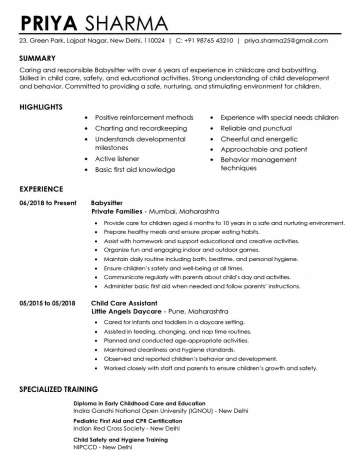
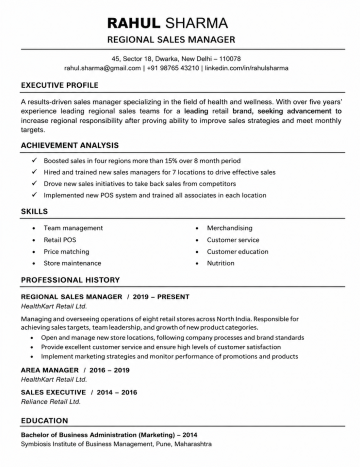
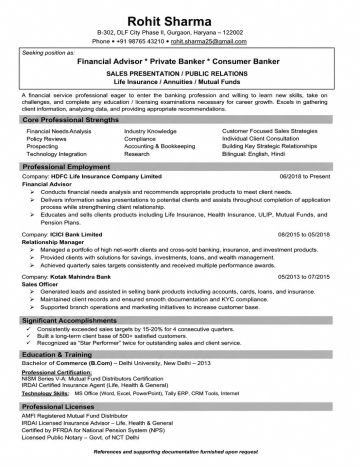
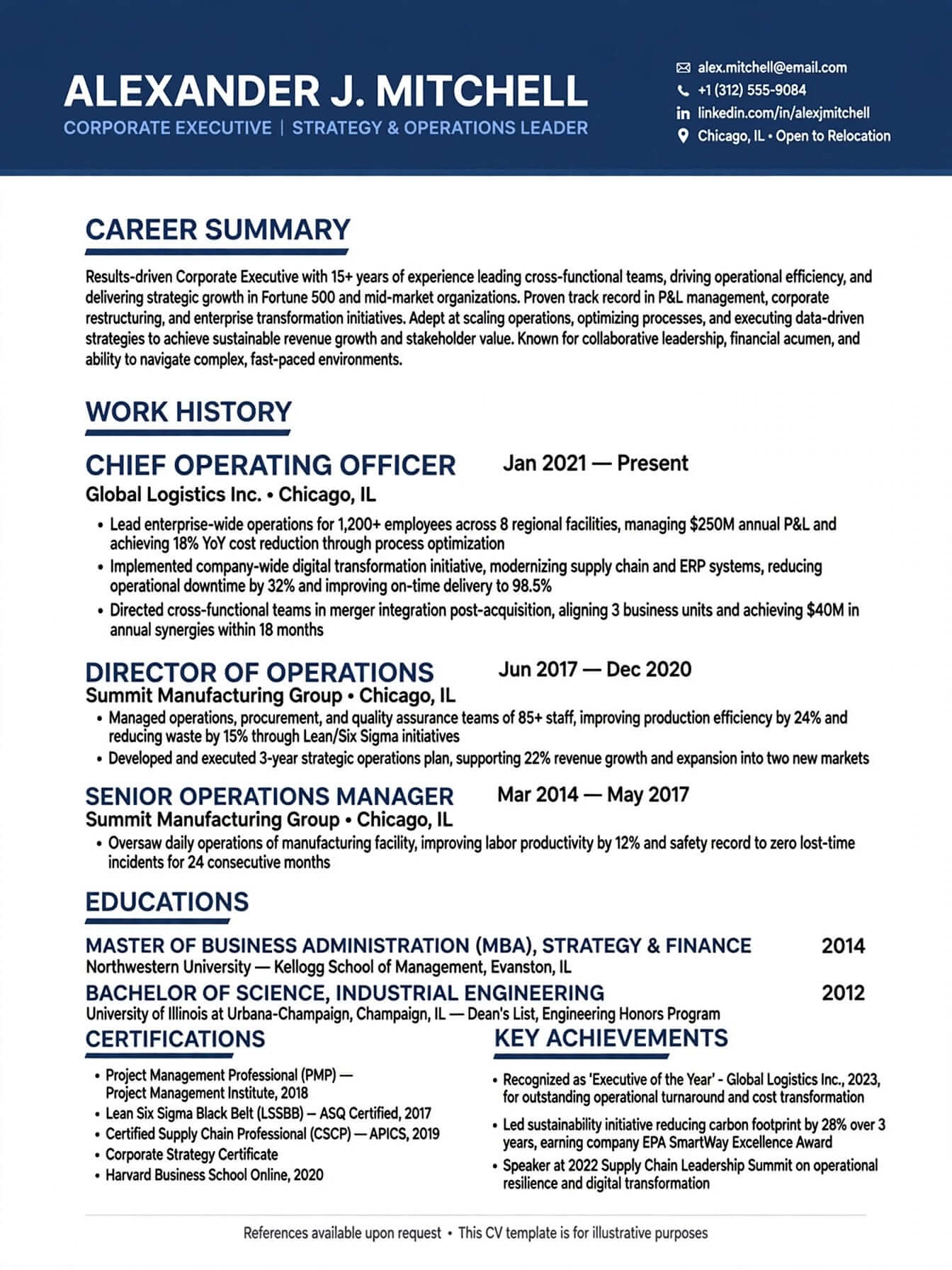
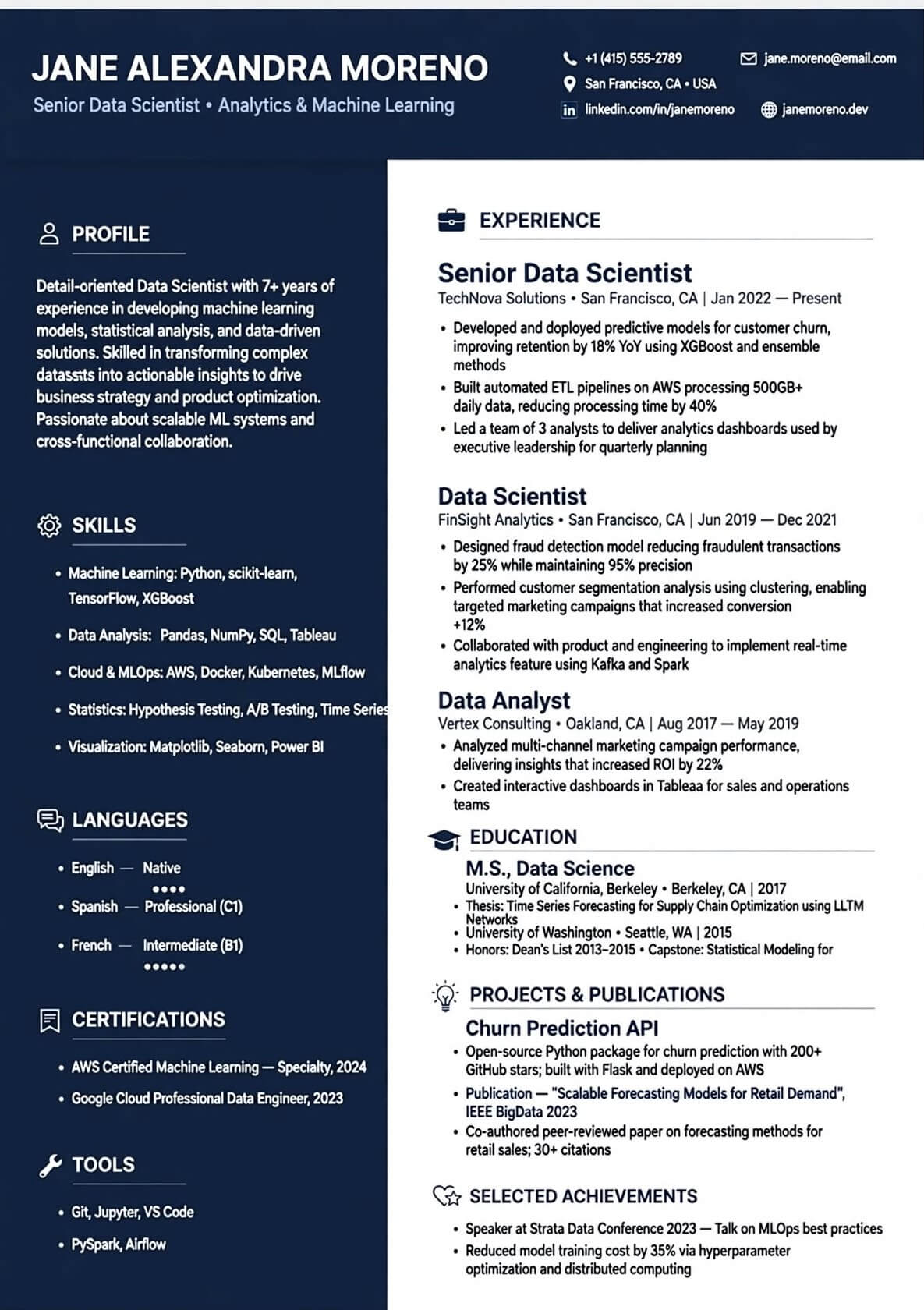
A strong Indian resume for private sector roles follows a consistent visual and structural logic. Here is the format that works in 2026:
Formatting Essentials
- Layout: Single-column structure — easiest for ATS and fastest for human skimming
- Font size: 10–11pt for body text; 14–16pt for your name
- Margins: 0.5–0.75 inch on all sides
- File format: Save as PDF unless the portal specifically asks for DOCX
- Length: 1 page for freshers; 2 pages for 6–10 years; up to 3 pages for senior roles
- Section headings: Standard names — Experience, Education, Skills, Projects, Certifications
- Bullets: 2–4 per role, each starting with an action verb, ending with a metric
Sections in Order (Private Sector Resume)
- Header: Name, phone, email, LinkedIn URL, city (no full address, no photo, no date of birth)
- Professional Summary: 2–3 lines — your niche, years of experience, and top outcome
- Work Experience: Reverse chronological; job title, company, dates, bullets with impact
- Education: Degree, institution, year, CGPA/percentage (if 7.5+ or 70%+)
- Skills: Technical tools, languages, frameworks — no vague soft skills
- Certifications: Only relevant, recent certifications with issuer and year
- Projects: (Optional but powerful for freshers and career switchers)
Summary: FMCG field sales professional with 4 years in South India distribution; drove 18% YoY revenue growth across 3 districts.
- Expanded territory from 120 to 200 retail outlets in 18 months (67% growth)
- Achieved ₹2.4 Cr quarterly target for 6 consecutive quarters — top 10% in region
- Reduced return rate by 22% through retailer training and stock-level audits
Skills: Salesforce CRM, Excel, Route Planning, Hindi, Kannada, Tamil
ATS Tips for Indian Resumes
- Mirror keywords exactly as they appear in the job post — ATS is literal
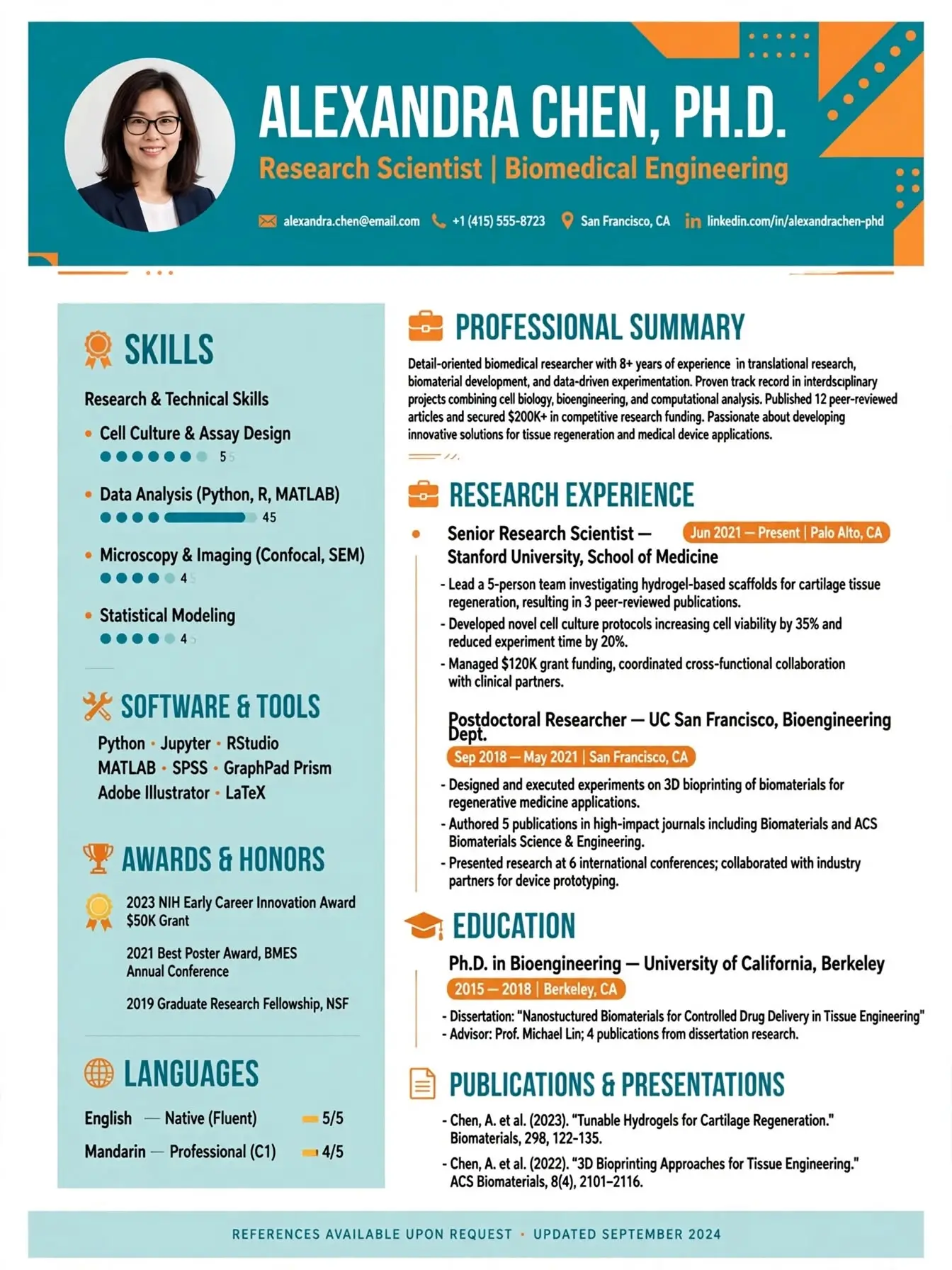
- Avoid tables, text boxes, graphics, or images — they confuse most Indian ATS platforms
- Use standard section headings — not creative titles like "My Journey" or "Impact Zone"
- Include both the spelled-out term and acronym where relevant: "Business Development (BD)"
- Save as PDF from Word or Google Docs — not a scanned image PDF
CV Format for India: Academic & Government Standards
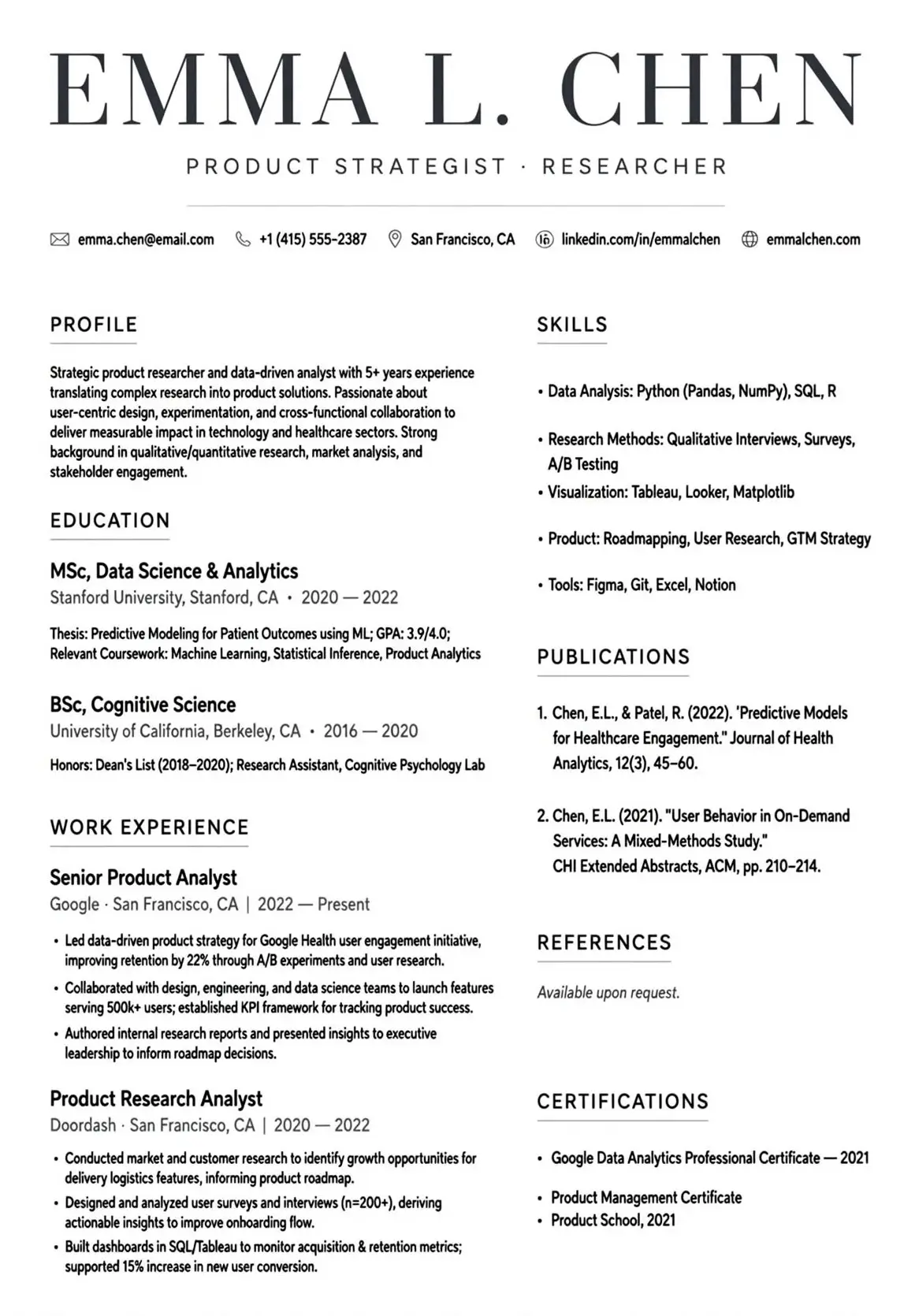
A CV for academic, government, or research applications in India follows different rules. Page count is not the goal — completeness and structured evidence are.
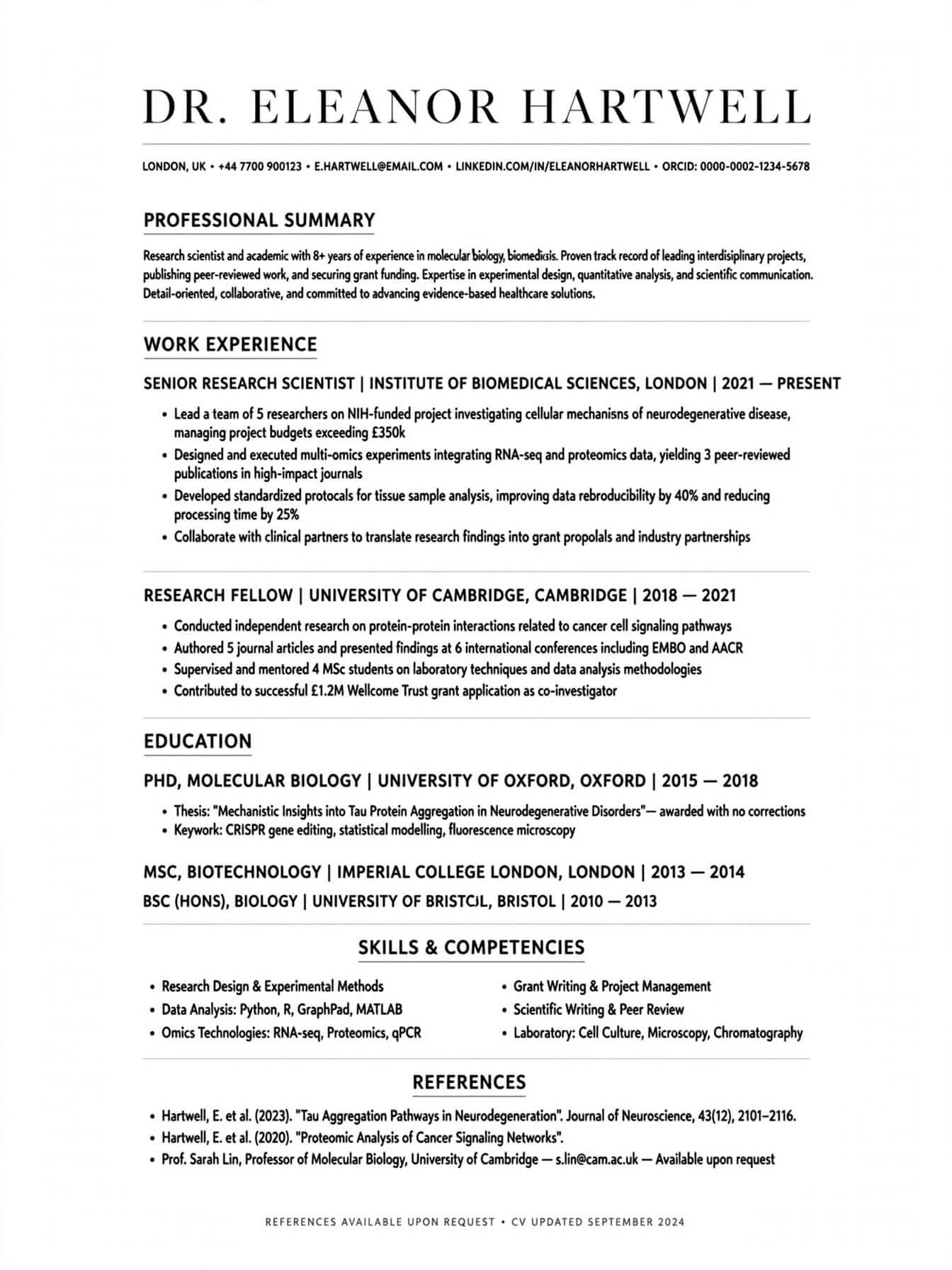
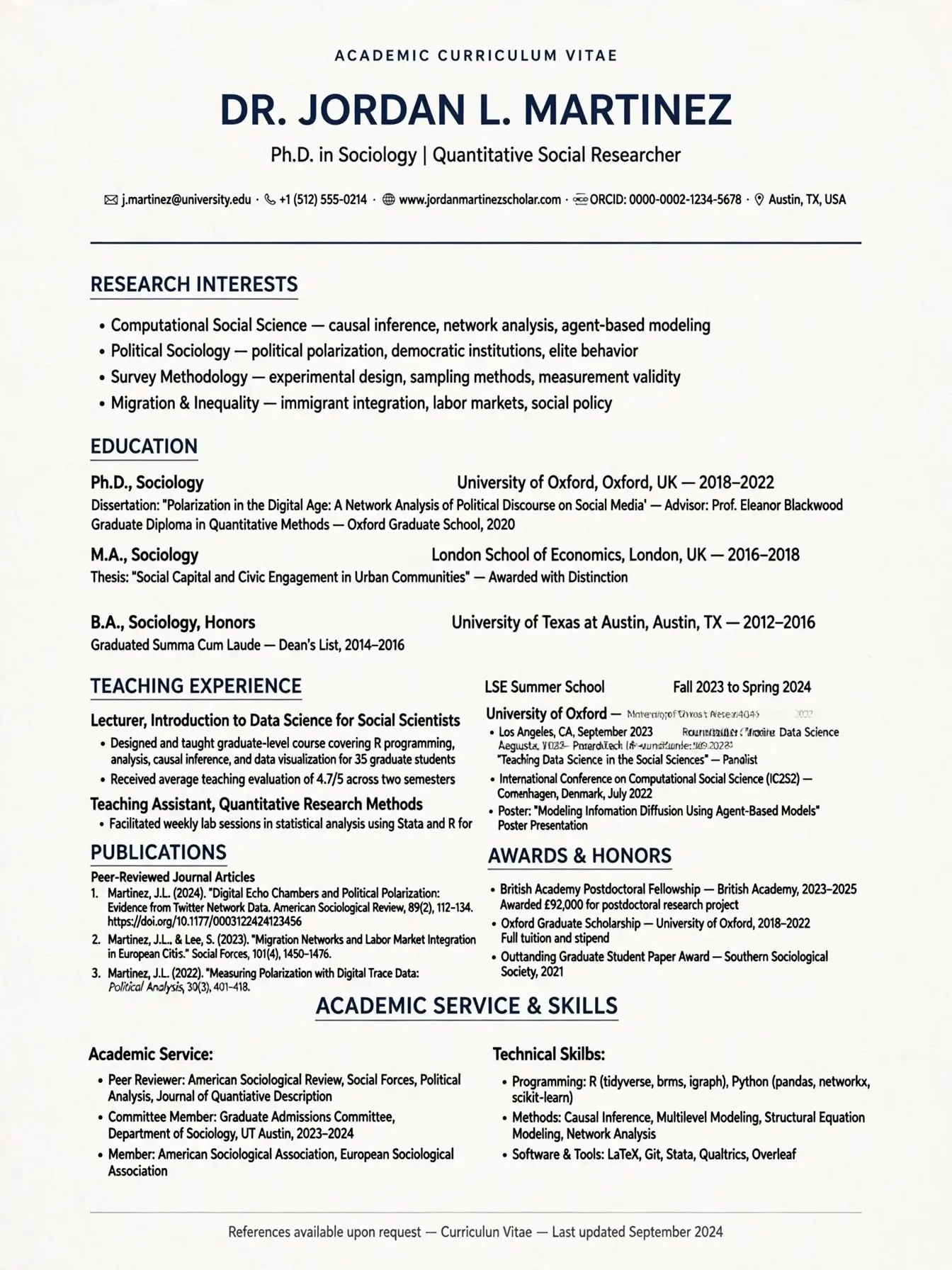
Sections in Order (Academic CV)
- Personal Information: Name, contact, institution affiliation
- Research Interests: 3–5 brief thematic areas
- Education: All degrees — institution, year, specialization, percentage/division
- Academic Positions: Every faculty/research role with dates
- Publications: Journals and conference papers in APA/IEEE format; separate by type
- Research Projects: Funded projects with grant agency, amount, role, dates
- Conferences & Talks: Presentations, keynotes, invited lectures
- Teaching Experience: Courses taught, institution, year, student count
- Doctoral Supervision: PhD students guided, thesis titles, status
- Awards & Recognition: Fellowships, UGC-NET/JRF, rank, scholarships
- Professional Memberships: Bodies like IEEE, ISCA, NAS India
- Scopus/ORCID IDs: Include citation metrics for science/engineering fields
Publications (Journals): 14 peer-reviewed papers | 8 in Scopus-indexed journals | h-index: 6 | Total citations: 210+
Recent: "Deep Learning Approaches in Medical Imaging" — IEEE Transactions on Medical Imaging, 2025 (IF: 8.9)
Projects: Principal Investigator — DST-SERB Early Career Award (₹22L), 2024–2026 | Co-I — DBT Bioinformatics Project (₹45L), 2023–2025
Resume vs CV for International Applications from India
If you're applying to roles outside India, the format norms shift significantly. Do not apply Indian conventions to international applications.
| Target Country/Region | Document Type | Key Norms |
|---|---|---|
| United States / Canada | Resume (1 page preferred) | No photo, no DOB, high-impact bullets, ATS-optimized |
| United Kingdom (Corporate) | CV (2 pages max) | Called CV but structured like a resume; no photo |
| European Union (Academia) | Academic CV (Europass format) | Teaching, research, language skills, publications |
| Australia / New Zealand | Resume or CV (2–3 pages) | References section expected; no photo |
| Middle East (Gulf) | CV (2–4 pages) | Photo sometimes expected; nationality and visa status included |
| Singapore / Southeast Asia | Resume (1–2 pages) | Photo common; expected, especially for SMEs |
Always confirm the expected format with someone who has recently hired for that specific market. Norms shift faster than guides can track, and getting this wrong in international applications has higher stakes.
Common Resume & CV Mistakes Indian Job Seekers Make
These are the most frequent errors that cause applications to be rejected before the recruiter has read past the first section:
- Vague bullets: "Handled operations" / "Responsible for sales" Replace with: action verb + task + measurable result. "Managed 3-state distribution for 200 SKUs; reduced stockouts by 35%."
- Sending a full CV to a startup or MNC Cut it to 1–2 pages. Pull out research details and publications unless directly relevant.
- Sending a 1-page resume for a government or academic application Expand to a full CV. Include every relevant detail, degree, and qualifying exam score.
- Wall-of-text professional summary (5–8 lines of dense prose) Cap at 3 lines: your niche, years, and top quantifiable outcome.
- Including date of birth, marital status, or father's name for corporate roles These details are not asked for in private sector hiring. Remove unless the application form explicitly requires them.
- Adding a photo to a private sector resume Indian MNCs and startups do not want photos. It introduces bias. Skip it unless explicitly required.
- Generic skills lists with buzzwords: "Team player, hard-working, dedicated" List tools, technologies, and contexts: "Python (scikit-learn, pandas), SQL, Tableau, A/B Testing."
- Sending the same resume for every role without tailoring Mirror the top 5 keywords from each job description naturally in your resume. Takes 10 minutes per application and significantly improves ATS scores.
Before You Apply: Resume & CV Checklist
Resume Checklist (Private Sector)
- Name, phone, email, LinkedIn, city at the top — no photo, no DOB
- Professional summary: 3 lines max with niche, years, and top outcome
- Each role has 2–4 bullets starting with strong action verbs
- At least one metric per recent role (%, ₹, units, users, time saved)
- Keywords from the specific job description included naturally
- Saved as PDF — not a scanned image, not DOCX (unless portal requires)
- No tables, text boxes, headers/footers, or graphics that confuse ATS
- Education section includes CGPA/percentage only if competitive (7.5+/70%+)
- Length: 1 page (fresher), 2 pages (3–10 years), max 3 pages (senior)
- Proofread: no spelling errors, consistent tense (past for old roles)
CV Checklist (Academic / Government)
- All degrees listed with institution, year, specialization, and score/division
- Publications listed with full citation in APA or IEEE format
- Journals and conference papers in separate sub-sections
- All research projects: funding agency, grant amount, your role, dates
- Teaching experience: courses taught, institution, student count, year
- Awards and qualifying exams: UGC-NET rank, JRF, GATE score, scholarships
- Scopus ID, ORCID, Google Scholar link (for science/engineering fields)
- Annexures attached as required by the application (government roles)
- No arbitrary page limit — completeness matters more than brevity
Frequently Asked Questions: Resume vs CV in India
What is the difference between a resume and a CV in India?
A resume is a concise 1–2 page document focused on results and relevant experience, used for private sector and corporate jobs. A CV (Curriculum Vitae) is a comprehensive career record covering publications, research, grants, and achievements — used for academic, government, and fellowship applications in India.
Should I send a resume or CV for an MNC job in India?
Always send a resume for MNC roles in India. Most MNC hiring managers and ATS systems expect a concise, results-focused 1–2 page document. Even if the job post says "send your CV," they typically mean a resume in the Indian private sector context. A lengthy CV will not help and may hurt your chances.
Do Indian government jobs require a CV or resume?
Most Indian government job applications — UPSC, SSC, PSU, PSC — require a detailed CV or a prescribed biodata/application form. They want full chronological history, marks, certificates, and annexures. A short resume is not appropriate for government job applications in India. Always follow the exact format specified in the official notification.
What should a fresher send — a resume or CV?
Freshers applying to private companies or startups should send a one-page resume highlighting education, projects, internships, and skills. A CV is only needed if applying to academic programs, research institutions, or government positions that specifically request it. Keep your fresher resume tight — one strong page beats a padded two-pager.
How long should a resume be in India?
In India, a resume should be 1 page for freshers and up to 2 pages for professionals with 6–10 years of experience. Beyond 10 years, 2–3 pages is acceptable for senior roles. A CV for academic or government roles has no strict page limit — include all relevant publications, grants, and achievements without worrying about length.
Is a CV better than a resume for PhD applications in India?
Yes, always. PhD applications, research fellowships (JRF, SRF), and postdoc positions in India require a full academic CV — not a resume. Your CV should include your complete academic history, all publications, conference presentations, research projects, lab experience, and any qualifying exam results such as UGC-NET, GATE, or CSIR scores.
Can I use the same document for all job applications in India?
No. Maintain two master versions — a tailored resume for private or corporate jobs and a comprehensive CV for academic and government roles. Even within private sector applications, tailor your resume to each job description to improve ATS matching scores and recruiter relevance. Sending the same generic document everywhere is the most common reason for silence after applying.
Should I include a photo on my Indian resume or CV?
For private sector resumes, skip the photo. Most MNCs and startups do not want one, and it can introduce unconscious hiring bias. For government job applications or academic CVs in India, include a passport-size photo only if explicitly requested in the application notification or form. When in doubt, leave it out.
Conclusion: Match the Document to the Reader
The resume vs CV decision in India is not about habit or tradition — it is about matching the document to the decision-maker on the other end. Private sector hiring managers want proof by metrics; research and government panels want proof by history.
Keep a short version and a long version ready. Tailor the short one for every corporate application. Update the long one every time you publish, present, or complete a project. Apply faster, apply smarter.
If you are still unsure which document fits your specific situation — or want a quick review of what you have — ResumeEra's free builder lets you create both formats and download them without signing up.
Build Your Resume or CV — Free, No Sign-Up
India's most ATS-friendly resume builder. Create, preview, and download your document in under 10 minutes.
Start Building for Free →