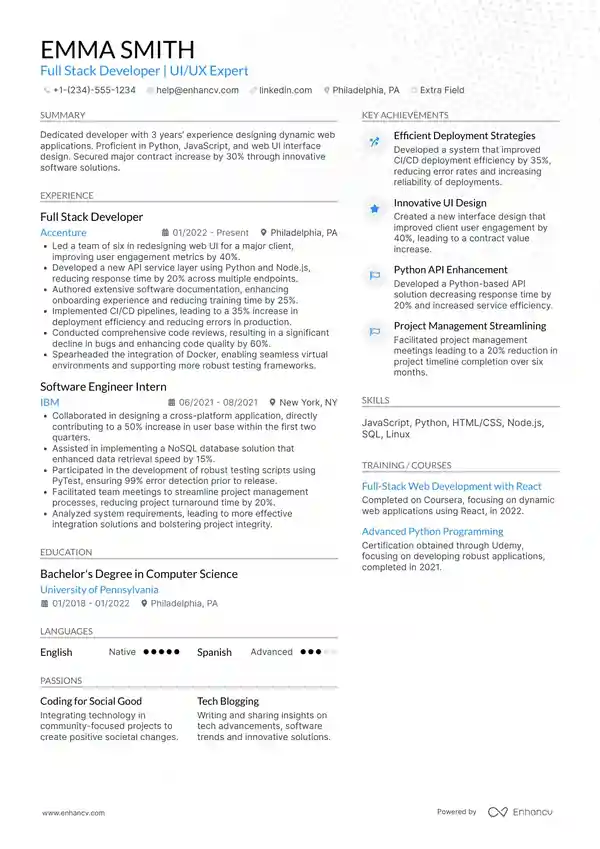
Junior Full Stack React Developer Resume — MERN Stack, End-to-End Ownership 2026
A junior full stack resume has one job a pure front-end resume doesn't: prove you can own a feature from database to browser, not just style a component. Here's the exact structure, quantified about me samples, and the MERN-stack keyword list that gets junior full stack resumes shortlisted, plus a free AI builder that extracts your old resume in seconds.
- Why junior full stack resumes are judged on breadth AND end-to-end ownership
- The 6-section anatomy every junior full stack resume needs
- 8 ready-to-edit about me / objective samples — fresher through 2 years
- The exact MERN, REST API, JWT and deployment keyword list ATS bots scan for
- How to write a full-stack project bullet that shows the whole pipeline, not just one layer
- Where GitHub, live deployment and API documentation links belong
- How to quantify full-stack achievements — API latency, DB queries, deployment uptime
- How to upload your old resume and let AI extract it into this template
01 Why Junior Full Stack Resumes Get Screened Differently
A junior full stack React developer resume carries a burden a pure front-end or pure back-end resume doesn't: it has to prove range without looking shallow in any single layer. Recruiters hiring for "full stack" roles are specifically checking whether a junior candidate has actually connected a front-end to a real back-end and a real database — not just consumed a mock API in a React tutorial.
This changes what "proof" looks like. A front-end-only resume can lean entirely on UI polish; a junior full stack developer resume template needs at least one project where you can point to the database schema, the API endpoints you wrote, and the React components that consumed them — the full round trip. That end-to-end line is what separates a full stack resume from a front-end resume with a Node.js line added at the bottom.
For the broader React and general developer templates beyond this junior full-stack-focused guide, see React Developer Resume Template, Software Developer Resume Template, and Technical Resume Template. To prep for the technical round once your resume clears screening, see Node.js Interview Questions and Tricky JavaScript Questions 2026.
02 The 6-Section Junior Full Stack Resume Anatomy
Whether you're a fresher with one solid MERN project or a developer with a year or two shipping full-stack features, the section order below is what both recruiters and ATS software expect to see, on a clean single-column layout.
Note that the skills section is explicitly split by layer rather than one merged list — this is the single biggest visual signal to a recruiter that you understand the stack as layers, not just a pile of buzzwords. For the mechanics of each section, see Projects Section Guide and Resume Work Experience.
03 8 About Me / Objective Samples for Junior Full Stack Developers
Each sample below names both a front-end and a back-end technology, plus one quantified proof point and a forward-looking intent line. Swap in your real numbers and stack before using any of these.
For the underlying writing formula behind lines like these, see Career Objective for Resume and Resume Objective Examples.
04 MERN, REST APIs, JWT — The Full Stack Keyword List
Full stack resumes are scanned across two distinct vocabularies at once — front-end and back-end — so ATS keyword matching depends on covering both sides explicitly rather than letting one dominate. Split your skills by layer instead of one long comma-separated line.
| Category | Keywords to Include |
|---|---|
| Front-End | React.js, Hooks, Redux/Context API, Tailwind CSS, HTML5, CSS3, JavaScript (ES6+) |
| Back-End | Node.js, Express.js, REST APIs, GraphQL, JWT Authentication, OAuth |
| Database | MongoDB, Mongoose, MySQL, PostgreSQL, Firebase |
| Deployment & DevOps | Git, GitHub, Vercel, Netlify, Render, Docker (basics), CI/CD (basics) |
| Real-Time & Extras | Socket.io, WebSockets, Postman, Swagger/API Documentation |
| Soft Skills | Cross-Layer Debugging, Agile/Scrum, Code Review |
05 Writing a Full-Stack Project Bullet That Shows the Whole Pipeline
The single most common mistake in junior full-stack resumes is writing a project bullet that only describes the front-end, then tacking "and a Node.js back-end" onto the end without any detail. A strong bullet touches all three layers in one sentence.
✓ Strong Full-Stack Bullet Structure
- Name the database and schema decision (e.g. "designed a 5-collection MongoDB schema")
- Name the API layer and its scale (e.g. "built 12 REST endpoints with Express")
- Name the front-end consumption (e.g. "consumed via React with React Query caching")
- Close with one quantified outcome tying it together
✗ Weak Full-Stack Bullet Patterns
- "Built a full stack app using React and Node.js" — no detail on either layer
- Only describing UI components, with the back-end mentioned once as a tech-list item
- No database or schema mention at all
- No quantified outcome tying the layers together
Example: "Designed a 5-collection MongoDB schema and built 12 REST endpoints with Express, consumed by a React front-end with JWT-protected routes — reduced average page load from 3.1s to 1.4s across 200+ test users."
Already Have an Old Full Stack Resume?
Upload your existing PDF, DOCX or scanned copy — AI extracts every detail into this ATS-safe junior full stack template in seconds.
06 Where GitHub & Deployment Links Belong
✓ Do This
- Put GitHub and a live deployment link in the contact header
- Link each project to both its repo and its live, working deployment
- Include an API documentation link (Postman collection or Swagger) if you built one
- Make sure the deployed back-end is actually running, not asleep on a free-tier host
✗ Avoid These Habits
- Linking a GitHub repo that only shows front-end code with no back-end folder
- Sending a deployment link where the API times out or the free-tier server is spun down
- Claiming "REST API" with no way for a recruiter to verify it exists
- Burying links at the bottom instead of the contact header
07 Quantifying Full Stack Achievements Without Inflating Them
Full stack work produces metrics across every layer — API response time, query performance, deployment uptime, concurrent users — giving you more honest quantification options than a single-layer resume, as long as every number stays defensible in an interview.
✓ Strong, Verifiable Metrics
- API response time (e.g. "cut average response time to under 200ms")
- Database query performance (e.g. "reduced query time via indexing by 50%")
- Users or test load handled (e.g. "handled 200+ concurrent test users")
- Deployment reliability (e.g. "99.5% uptime over 3 months on Render")
- Number of endpoints or schema tables/collections built
✗ Avoid These Habits
- Quoting a load-test number from a script you never actually ran
- Rounding a small performance gain up to sound more impressive
- Claiming production-scale numbers for a college or bootcamp project
- Listing a metric you can't explain the measurement method behind
More on this discipline: How to Quantify Resume Achievements (India) and Resume Action Verbs for India. Freshers building their very first full stack resume should also read How to Write a Resume with No Work Experience and Curriculum Vitae for Fresh Graduate.
08 Build This Template with Free AI Extraction
You don't have to fill this template field by field from scratch. If you already have an old full stack resume — even a scanned copy or a messy Word export — ResumeEra's free builder extracts it automatically.
Choose Method
Pick "Upload Existing Resume" if you have an old file, or "Start From Scratch" if this is your first resume.
Upload File
Digital PDF, scanned PDF, DOCX, JPG or PNG are all accepted — no need for a clean digital copy.
AI Extraction
Raw text is pulled from your file, then structured into the correct full stack resume fields automatically.
Continue to Editor
Review the extracted data, split your skills by front-end/back-end/database layer, then download — no sign-up, no fee.
For the full mechanics of this AI extraction flow across all templates, see ResumeEra.xyz Review 2026 and Free Resume Builder — No Hidden Fee.
09 Mistakes That Get Junior Full Stack Resumes Rejected
✓ Do This
- Name your database and API layer explicitly, not just "back-end"
- Link every project to a working repo and a live, running deployment
- Split skills into front-end / back-end / database categories
- Keep dates in a consistent Month YYYY format throughout
- Proofread every claimed endpoint count and metric before submitting
✗ Never Do This
- Don't call yourself "full stack" with only front-end proof to show
- Don't use a decorative, multi-column template that breaks ATS parsing
- Don't leave a back-end deployment asleep or timed out when a recruiter checks it
- Don't list a database you've never actually designed a schema for
- Don't submit without checking every claimed number is accurate
Further reading: 11 ATS Formatting Mistakes | Resume Proofreading Tips | How to Explain Employment Gaps | Full Resume Checklist
10 FAQs — Junior Full Stack React Developer Resume
11 Summary — Build a Resume That Proves End-to-End Ownership
A junior full stack React developer resume succeeds by proving the "full stack" claim with specifics at every layer — a named database schema, a named API layer, a named front-end consuming it, and a live link a recruiter can actually click through. Use the 6-section anatomy with skills split by layer, pick the about me sample closest to your experience level, and write at least one project bullet that touches all three layers in a single sentence.
If you already have an old resume sitting in a folder — even a scanned one — upload it and let AI extract it directly into this template, so you spend your time strengthening your end-to-end project story instead of retyping your history from scratch.
Ready to Build Your Full Stack Developer Resume?
Start from scratch or upload your old resume for instant AI extraction — 100% free, no sign-up, no hidden fee.