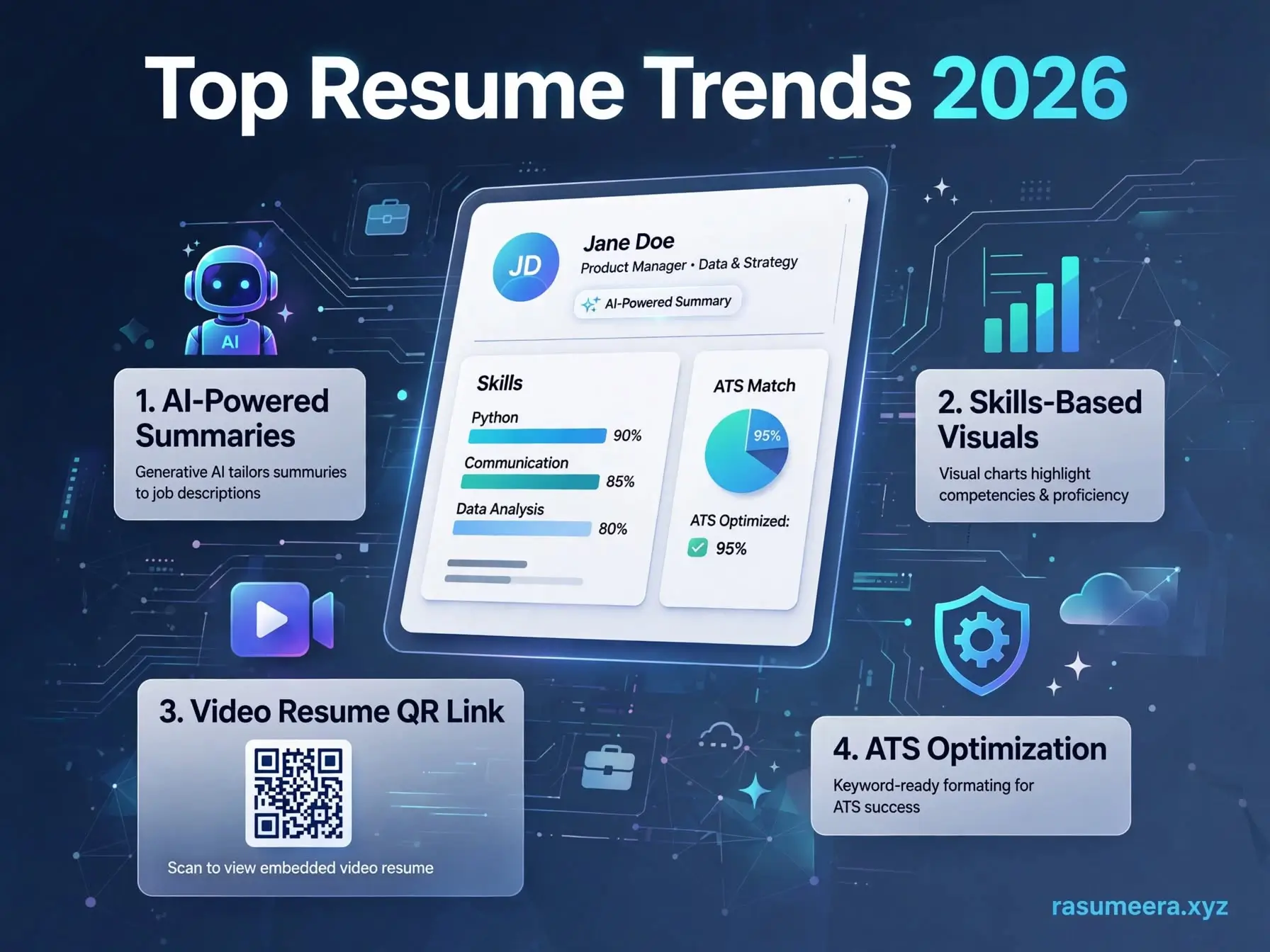
Recruiters in India are screening resumes faster and with more automation than ever before. In 2026, a Naukri or LinkedIn application is first read by an ATS, then scanned by a recruiter for 6 to 8 seconds before a decision is made. That means your resume format, keywords, and layout decide whether you get a call from TCS, Infosys, or a startup in Bengaluru. Based on hiring patterns from Indian IT, BFSI, and consulting firms, plus feedback from recruiters handling bulk hiring on Darwinbox, Zoho Recruit and Taleo, this guide breaks down the exact resume trends that matter for 2026. You will learn which formats pass ATS, how long your resume should be, what design elements help or hurt, and how to position hybrid work, skills, and achievements for both freshers and experienced professionals applying in India.
Why Resume Expectations Are Changing for 2026
Three shifts are forcing resume changes in India. First, ATS parsing has become stricter. Companies like Wipro, HDFC Bank, Reliance and mid-size startups now use automated parsers that reject resumes with tables, text boxes, headers, footers and images. A creative double-column design that looked good in 2022 now often returns a blank profile in the recruiter dashboard. Second, hybrid and remote work is now a permanent filter. Recruiters actively search for keywords like managed distributed team, handled virtual collaboration, worked across time zones, and used tools like Slack, Jira, Asana and Microsoft Teams. If your resume does not signal remote readiness, you lose visibility. Third, skills are replacing degrees as the primary filter, especially for roles in data, cloud, AI, digital marketing and product management.
For Indian job seekers, this creates a clear pressure. Freshers competing on Naukri and LinkedIn face 300 to 800 applicants per entry-level posting in cities like Hyderabad, Pune and Gurugram. Experienced professionals with 3 to 8 years of experience are judged on measurable impact, not just responsibilities. Recruiters in 2026 want to see outcomes, tools, and adaptability in one clean document that works equally well as a PDF for email, a Word file for Naukri uploads, and a plain-text parse for ATS. The old objective statement, long paragraphs, and photo-based headers no longer help. What helps is a concise professional summary, a skills matrix aligned to the job description, and bullet points that prove value with numbers.
- Tighter ATS rules: Simple single-column layouts, standard fonts and clear headings are mandatory for parsing on Naukri, LinkedIn Easy Apply and company portals.
- Hybrid work signals: Phrases like led hybrid team of 8, coordinated remote delivery, and async collaboration are now searched keywords.
- Skills-first screening: Recruiters filter by tools and certifications before reading experience, especially for IT and analytics roles.
- Shorter attention spans: Recruiters spend less than 10 seconds on initial scan, so hierarchy and white space matter more than decoration.
- Multi-format need: You need an ATS-optimized Word version, a polished PDF for hiring managers, and a LinkedIn-aligned summary.
Understanding these shifts helps you choose the right format and content before you design anything. The trends below show exactly what to implement.
The Resume Formats That Will Dominate in 2026
Format is not just about appearance. It determines how an ATS reads your history and how a recruiter interprets your career story. In 2026, three formats lead the market in India, while functional-only and heavily designed formats are losing ground.
Reverse-Chronological Still Leads But Hybrid Is the New Standard
Reverse-chronological remains the default expected by 80 percent of Indian employers and every major ATS. It lists your most recent role first, with company name, location, designation and dates, followed by achievements. Recruiters prefer it because it shows growth clearly and parsers read it without errors. For experienced professionals with a stable career path in the same domain, this is still the safest choice. Keep dates in MMM YYYY format, avoid abbreviations for company names, and use consistent bullet alignment.
However, the strategic hybrid format is now the most recommended for 2026. It keeps the reverse-chronological work history but adds a strong skills and highlights section at the top. This section groups your core competencies into 3 to 4 clusters such as Product Management, Data & Analytics, or Cloud & DevOps, with 3 to 5 keywords in each. Below that, you retain the chronological experience with impact bullets. This hybrid approach satisfies both the ATS keyword scan and the human need for a clear timeline. For Indian recruiters hiring for cross-functional roles, this format makes it easy to map you to the job description in one view. Avoid putting the skills section in a sidebar or table, use a simple horizontal list or bullet groups instead.
Skills-First Format for Freshers and Career Switchers
If you are a fresher from a Tier 2 or Tier 3 college, or an experienced professional switching from support to development, sales to product, or operations to data science, a skills-first layout works better. It opens with a targeted professional summary, then a detailed skills matrix, followed by projects, internships, certifications and then a brief work history. The focus is on transferable skills and proof of work, not just job titles.
- Group skills by relevance to the target role, for example Programming: Python, SQL, Java | Tools: Power BI, Tableau, Excel | Cloud: AWS EC2, S3
- Support each skill cluster with a project or internship bullet, such as Built sales dashboard in Power BI reducing reporting time by 30% for college fest sponsorship data
- Include certifications with issuing authority and year, such as Google Data Analytics Certificate 2025, AWS Cloud Practitioner 2024
- Keep work history concise if it is not directly relevant, but do not hide it, ATS expects a timeline
Recruiters at startups and product companies in Bengaluru and Mumbai now actively prefer this format for fresher hiring drives because it surfaces job-ready skills quickly. Do not use a pure functional format that removes dates and companies entirely, that is flagged as a red flag by both ATS and recruiters in India.
One-Page vs Two-Page: What Indian Recruiters Actually Prefer
The one-page rule still applies for freshers and professionals with under 4 years of experience. If you have less than 4 years, force yourself to fit everything on one page by trimming older internships and focusing on recent, relevant achievements. Use 10 to 11 pt font, 0.6 inch margins, and tight but readable line spacing. For experienced candidates with 5 to 12 years of experience, a clean two-page resume is now fully accepted and often expected, especially in IT, BFSI and consulting where you need space for multiple roles, projects and tech stacks.
The key is not length but density. A two-page resume with repetitive duties is worse than a sharp one-page resume with quantified wins. If you go to two pages, page one must contain your summary, key skills, and your most recent 2 roles with strong metrics. Page two can hold earlier experience, education, certifications and volunteer work. Never leave a second page with only 2 to 3 lines, adjust spacing to balance the pages. For Naukri uploads, always keep the file under 500 KB and name it as FirstName_LastName_Resume_2026.pdf.
Design and Layout Trends That Pass ATS in India
Minimalist, single-column, and navigation-friendly layouts dominate 2026. The best-performing templates on ResumeEra.xyz and those recommended by Indian recruiters share the same principles: no tables, no text boxes, no columns that split content, no header/footer for critical info, and no images or icons that replace text. ATS like Taleo, Greenhouse, Lever, Darwinbox and Zoho Recruit read resumes top to bottom, left to right. Anything placed in a text box or header is often ignored, which means your contact details or skills can disappear.
- Fonts: Use Calibri, Arial, Garamond or Helvetica at 10.5 to 11 pt for body, 13 to 14 pt bold for name, 11 to 12 pt bold for section headings. Avoid decorative fonts.
- Headings: Use standard headings like Professional Summary, Work Experience, Education, Skills, Projects, Certifications. Creative headings like My Journey confuse ATS.
- Bullets: Use simple round or dash bullets. Start each bullet with an action verb and include a metric where possible.
- White space: Keep 1.0 to 1.15 line spacing and clear gaps between sections. Dense blocks are skipped during 6-second scans.
- File formats: Always keep both PDF and Word .docx versions. Naukri and many Indian company portals parse Word more accurately, while PDF is better for email and LinkedIn.
Color is minimal in 2026. A single accent color for your name and section dividers in dark blue or charcoal is acceptable. Avoid full background colors, skill bars, pie charts and progress circles, they cannot be parsed and they waste space. If you want visual appeal, use subtle horizontal lines to separate sections and bold text to highlight keywords. For digital adaptability, add a LinkedIn URL and portfolio or GitHub link as plain text, not as a QR code. Recruiters in India now expect clickable links that work on mobile.
Another major trend is role-specific tailoring. Instead of one generic resume, top candidates maintain a master resume and create 2 to 3 tailored versions for different job families. For example, a B.Tech graduate may have one version for Software Developer roles emphasizing Java and DSA, and another for Data Analyst roles emphasizing SQL, Python and Power BI. This tailoring improves keyword match rates on Naukri search and ATS filters by 40 to 60 percent.
Content Trends: What to Write Differently in 2026
Content expectations have shifted from duties to outcomes. Recruiters no longer want to read responsible for managing team or worked on client projects. They want to see what you changed, built, or improved, with numbers. The STAR and XYZ formulas work well: Accomplished X by doing Y resulting in Z, or Situation Task Action Result condensed into one bullet.
- Professional summary: Replace objective with a 3 to 4 line summary tailored to the role. Include years of experience, core domain, top 3 skills, and one standout achievement. Example: Data Analyst with 3 years in BFSI, skilled in SQL, Power BI and Python, built risk dashboard that cut reporting time by 35% for 12 branches.
- Skills matrix: Add a dedicated skills section with 12 to 18 keywords grouped logically. Mirror exact phrases from the job description, such as Business Analysis, Stakeholder Management, Agile, not just generic terms.
- Experience bullets: Write 4 to 6 bullets per role, each with verb + task + result. Use metrics like revenue, cost saved, time reduced, CSAT improved, tickets resolved.
- Hybrid work proof: Add bullets like Coordinated with 6-member distributed team across Delhi and Hyderabad using Jira and daily standups to deliver release 2 weeks early.
- Certifications and projects: For freshers, projects carry more weight than CGPA. Include 2 to 3 academic or personal projects with tech stack, link, and outcome.
Keyword optimization must be natural. Copying the entire job description into white text is detected and penalized. Instead, integrate 8 to 12 relevant keywords organically into your summary, skills and experience. For example, if a Naukri posting for a Digital Marketing Executive asks for SEO, SEM, Google Analytics, Meta Ads and content strategy, ensure those exact terms appear in your skills and at least one bullet proves you used them. Indian recruiters also search for domain terms like GST, KYC, MIS reporting, NACH, UPI, depending on the industry, so include domain-specific vocabulary.
Finally, add a small section for tools and platforms. Listing tools like SAP, Salesforce, Zoho CRM, Tally, Figma, or ServiceNow helps you appear in filtered searches. Keep this section text-based and comma-separated for easy parsing.
Comparison: 2026 Resume Formats at a Glance
Choosing the right format depends on your experience level, career continuity and target role. Use this comparison to decide quickly before you start writing.
| Format | Best For | ATS Compatibility | Recruiter Preference in India |
|---|---|---|---|
| Reverse-Chronological | Experienced professionals with stable growth in one domain | Excellent, parsers expect this structure | High, default choice for IT, BFSI, consulting |
| Hybrid / Combination | Most candidates in 2026, especially 2 to 10 years experience | Excellent if kept single-column without tables | Very High, balances skills and timeline |
| Skills-First | Freshers, career switchers, freelancers with gaps | Good, must retain dated work history section | High for entry-level and startup hiring |
| Functional Only | Not recommended in 2026 | Poor, hides timeline and confuses parsers | Low, seen as hiding gaps |
| Creative / Infographic | Designers only as portfolio supplement | Very Poor, graphics not parsed | Low for ATS roles, okay for direct email to design heads |
If you are unsure, start with hybrid. It gives you the keyword visibility of a skills format and the trust of a chronological timeline, which is exactly what Indian ATS and recruiters look for in 2026.
Step-by-Step: Build a 2026-Ready Resume for Naukri and LinkedIn
Follow this sequence to create a resume that works on Naukri, LinkedIn Easy Apply and direct company portals without rework.
- Collect your master data: Gather all roles, projects, internships, certifications, tools and achievements with dates and metrics in one document. This becomes your source file.
- Pick your format: Choose reverse-chronological if you have 4+ years in one track, hybrid for most cases, skills-first if you are a fresher or switching domains.
- Write a targeted summary: Draft a 3 to 4 line summary that mirrors the target job title and includes your top 3 skills and one quantified win. Tailor this for each application.
- Build the skills matrix: Create 3 to 4 skill clusters with 12 to 18 keywords taken directly from 3 to 5 similar job descriptions on Naukri and LinkedIn. Keep it as plain text.
- Rewrite experience bullets with metrics: Convert duties into achievements using action verbs. Add numbers for scale, time, money or quality. Add one bullet per role showing hybrid or collaboration tools.
- Format for ATS: Apply single-column layout, standard headings, simple bullets, no tables or text boxes, and save as both .docx and PDF. Test parsing by uploading to Naukri and checking the auto-filled profile.
- Add links and contact: Place mobile number, professional email, city, LinkedIn URL and portfolio or GitHub link at the top. Ensure links are clickable and not shortened.
- Proof and tailor: Run spell check, check date consistency, and tailor the top half of page one for each role in under 10 minutes by swapping keywords and reordering bullets. Keep file name professional and file size under 500 KB.
After building, upload the Word version to Naukri for better parsing and send the PDF version to recruiters and hiring managers via email and LinkedIn messages. Keep your LinkedIn headline and About section aligned with your resume summary to create a consistent story.
Common Mistakes That Get Resumes Rejected in 2026
Even strong candidates get filtered out due to avoidable formatting and content errors. Indian recruiters report these as the most frequent reasons for rejection before the interview stage.
- Using tables, columns and text boxes: These elements break parsing. Your skills or experience may not appear in the recruiter search at all.
- Putting key info in header or footer: Many ATS ignore headers and footers, so contact details placed there become invisible.
- Adding photo, age, gender or full address: Not required in India for most corporate roles and can trigger bias or ATS errors. Only city and contact are needed.
- Generic summary and keyword stuffing: A vague summary like seeking challenging role and repeating keywords without proof reduces credibility.
- Long paragraphs instead of bullets: Dense paragraphs are skipped during the initial scan. Use concise bullets with clear verbs.
- Not tailoring for each role: Sending the same resume to a Business Analyst and a Product Manager role lowers match rate. Tailor skills and top bullets.
- Outdated sections: Objective statements, hobbies without relevance, and listing school marks from 10th and 12th for experienced candidates waste space.
- File issues: Sending .jpg, .png or heavily designed PDF, or a file named resume_final_final.pdf, creates a poor impression and parsing failure.
Recruiters in India now search resumes like a database. If your resume does not contain the exact skill phrase they filter for, you will not appear in the shortlist, no matter how good your experience is. Match the language of the job description precisely.
Fixing these mistakes alone can double your shortlist rate on Naukri and LinkedIn without changing your experience. Review your resume against this list before every application.
Frequently Asked Questions
What is the best resume format for 2026 in India?
The hybrid format is the best for most candidates in 2026. It combines a skills matrix at the top with a reverse-chronological work history, which satisfies both ATS keyword filters and recruiter preference for a clear timeline. Freshers and career switchers should use a skills-first hybrid that emphasizes projects and certifications, while experienced professionals with stable careers can use pure reverse-chronological.
Is a one-page resume still required for freshers in 2026?
Yes, freshers and candidates with under 4 years of experience should keep their resume to one page. Recruiters expect conciseness at this stage. Include summary, skills, 2 to 3 projects or internships, education and certifications. A two-page resume is acceptable only for 5+ years of experience where you need space for multiple roles and achievements.
Will a creative or infographic resume pass ATS in India?
No, creative resumes with graphics, skill bars, icons and multiple columns usually fail ATS parsing on platforms like Naukri, Darwinbox and Zoho Recruit. The parser cannot read text inside images or charts, so your skills may be lost. Use a clean, single-column, text-based layout for ATS and keep a creative version only as a portfolio supplement for design roles.
Should I submit PDF or Word resume on Naukri and LinkedIn?
Keep both. Upload the Word .docx version on Naukri and company portals for the most accurate ATS parsing, and send the PDF version via email and LinkedIn messages for better visual consistency. Always test by uploading and checking how the portal auto-fills your profile. Keep file size under 500 KB and use a professional file name.
How do I show hybrid or remote work experience on my resume?
Add specific bullets that mention distributed collaboration and tools. For example, Led hybrid team of 5 across Mumbai and remote locations, coordinated sprint planning on Jira and daily standups on Microsoft Teams, delivered project 15% ahead of schedule. Also include tools like Slack, Zoom, Asana, Trello and Google Workspace in your skills or tools section.
How many keywords should I include for ATS in 2026?
Include 12 to 18 highly relevant keywords grouped in your skills matrix and repeated naturally in experience bullets. Use exact phrases from the job description, such as SQL, Power BI, Stakeholder Management, or Digital Marketing, SEO, Google Analytics. Avoid stuffing 30+ keywords without proof, it looks spammy and can be penalized.
Do I need to tailor my resume for every job application?
Yes, light tailoring is essential in 2026. Maintain a master resume and spend 10 minutes per application to adjust your summary, reorder skills, and prioritize the top 2 to 3 bullets to match the job description. This improves your ATS match score and shows the recruiter you understand the role, which significantly increases shortlist chances on Naukri and LinkedIn.
Resume trends for 2026 in India point to one clear direction: clarity beats creativity, skills beat seniority, and proof beats promises. A single-column hybrid resume with a targeted summary, keyword-rich skills matrix, and metric-driven bullets will pass ATS on Naukri and impress recruiters at TCS, Infosys, startups and consulting firms alike. Build your master resume now, keep both Word and PDF versions ready, and tailor the top half for each role you apply to. With the right format and content, your resume becomes a searchable, mobile-friendly profile that works as hard as you do. Explore templates and build your 2026-ready resume today at https://resumeera.xyz.