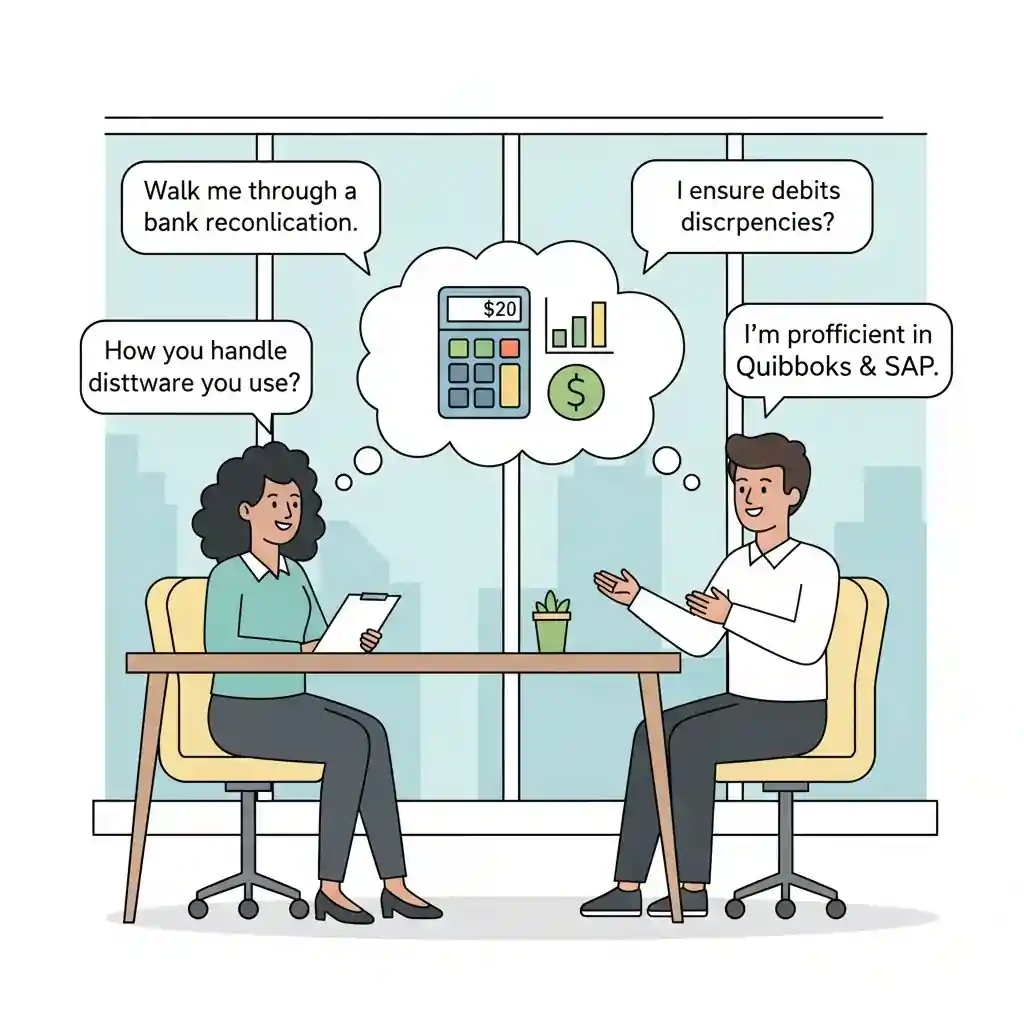
Preparing for an accountant interview in India in 2026 means competing with thousands of B.Com, M.Com, CA Inter, CA Final and MBA Finance candidates who know Tally Prime, GST filing and Advanced Excel. Recruiters on Naukri and LinkedIn now filter resumes through ATS like Taleo, Zoho Recruit and Naukri Resdex before you even get a call, so your answers must match what is on your resume and what Indian companies actually test. Whether you are a fresher applying for Accounts Executive roles at 3-4 LPA or an experienced accountant targeting Senior Accountant or Finance Manager roles at 8-15 LPA, interviewers will check three things: your grasp of accounting fundamentals, your hands-on knowledge of Indian taxation and compliance, and your ability to handle real-world scenarios like reconciliation mismatches, audit objections or month-end closing pressure. This guide covers 50+ most asked accountant interview questions in India for 2026 with practical sample answers, role-wise expectations, and a 7-day preparation plan to help you answer confidently and align your resume for ATS success on ResumeEra.xyz.
Why Accountant Interviews in India Are Different in 2026
Indian accountant interviews have changed sharply in the last two years. Companies are no longer satisfied with theoretical definitions. A recruiter at a mid-size manufacturing firm in Pune or a Big 4 audit team in Gurugram will ask you to explain how you actually filed GSTR-3B, reconciled ITC as per GSTR-2B, or closed books in Tally Prime or SAP. With MCA mandating e-invoicing for businesses above 5 crore turnover and faceless assessments becoming common, practical compliance knowledge is now tested at every level.
For freshers, the focus is on fundamentals and willingness to learn tools. Interviewers expect you to explain golden rules of accounting, journal entries, and basic GST concepts clearly, even if you have only done an articleship or a 3-month internship. For experienced candidates with 3-7 years of experience, the questions shift to Ind AS, audit handling, MIS reporting, and cost control. Recruiters on Naukri and LinkedIn also scan your resume for exact keywords like GST, TDS, Tally Prime, MS Excel, SAP FICO, Zoho Books, and Income Tax before shortlisting, which is why your interview preparation must go hand-in-hand with resume optimisation.
Another shift is the use of ATS and skill tests. Most Indian companies use an ATS to parse resumes and many add a pre-interview Excel test or Tally practical test. You may be asked to prepare a bank reconciliation statement, create a pivot table, or pass a journal entry on the spot. Your answers should therefore be specific, with Indian examples, figures, and tool names, not generic textbook definitions.
- Compliance heavy: GST, TDS, TCS, PF, ESI and Income Tax provisions specific to India are asked in almost every round.
- Tool driven: Tally Prime, Busy, Marg, SAP, Oracle, Zoho Books and Advanced Excel are treated as core skills, not add-ons.
- Scenario based: Interviewers use real cases like vendor payment mismatch, GST notice, or audit query to test judgement.
- Resume linked: Every skill you mention on your resume, from GSTR-9 filing to finalisation of accounts, will be cross-questioned.
Top 50+ Interview Questions and Answers for Accountant Jobs in India
Below are the most frequently asked accountant interview questions in India for 2026, grouped by category. Use the sample answers as a structure and replace with your own experience, figures and employer names for authenticity.
A. Basic Accounting and Fundamentals - For Freshers and Entry Level
Q1. What are the three golden rules of accounting?
Ans: Personal account - Debit the receiver, credit the giver. Real account - Debit what comes in, credit what goes out. Nominal account - Debit all expenses and losses, credit all incomes and gains. I apply these rules for every journal entry in Tally.
Q2. What is double entry system?
Ans: Double entry means every transaction affects two accounts with equal debit and credit. For example, if we purchase machinery for Rs. 50,000 cash, we debit Machinery and credit Cash. This keeps the accounting equation balanced.
Q3. What is the difference between accrual and cash basis of accounting?
Ans: In cash basis, income and expense are recorded when cash is received or paid. In accrual basis, they are recorded when earned or incurred, irrespective of cash flow. Indian companies under Companies Act 2013 follow accrual basis.
Q4. What is a trial balance and why is it prepared?
Ans: Trial balance is a statement listing all ledger balances to check arithmetical accuracy of debits and credits. If it does not tally, it indicates errors in posting or totalling before final accounts preparation.
Q5. Explain debit and credit with an example.
Ans: Debit is left side and credit is right side of an account. For salary paid Rs. 30,000, we debit Salary Expense and credit Bank. Expense increases on debit, liability and income increase on credit.
Q6. What is the accounting equation?
Ans: Assets = Liabilities + Capital. This equation always holds true. Any transaction will keep both sides balanced. For example, taking a loan increases cash asset and loan liability equally.
Q7. What is the difference between provision and reserve?
Ans: Provision is created for known liability where amount is uncertain, like provision for doubtful debts, and charged to profit and loss. Reserve is appropriation of profit for future needs, like general reserve, created after profit calculation.
Q8. What are fictitious assets?
Ans: Fictitious assets are deferred revenue expenditures not representing tangible assets, like preliminary expenses or discount on issue of shares. They are written off over years and shown on asset side temporarily.
Q9. What is depreciation and its methods?
Ans: Depreciation is reduction in value of fixed asset due to use and time. Common methods are Straight Line Method and Written Down Value Method as per Companies Act and Income Tax Act. I have applied WDV for tax and SLM for books.
Q10. What is Bank Reconciliation Statement?
Ans: BRS is a statement prepared to reconcile bank balance as per cash book with passbook. Differences arise due to cheques issued but not presented, direct deposits, bank charges or interest not recorded. I prepare BRS weekly in Excel.
B. GST, Taxation and Indian Compliance Questions
Q11. What is GST and what are its types in India?
Ans: GST is destination-based indirect tax. Types are CGST and SGST for intra-state, IGST for inter-state, and UTGST for union territories. I have filed GSTR-1 and GSTR-3B for intra and inter-state supplies.
Q12. What is the difference between GSTR-1, GSTR-3B and GSTR-9?
Ans: GSTR-1 is monthly or quarterly outward supply return, GSTR-3B is summary return for tax payment, and GSTR-9 is annual return consolidating yearly data. I reconcile GSTR-1 with books and GSTR-3B before filing GSTR-9.
Q13. How do you reconcile GSTR-2B with books?
Ans: I download GSTR-2B and compare with purchase register in Excel using VLOOKUP. I flag mismatches like supplier not filed, wrong GSTIN or ITC ineligible under Section 17(5) and follow up with vendors before claiming ITC.
Q14. What is Input Tax Credit and when can it not be claimed?
Ans: ITC is credit for GST paid on purchases used for taxable supplies. It cannot be claimed for personal use, exempt supplies, motor vehicle for passenger, or if supplier has not filed return and it does not appear in GSTR-2B.
Q15. What is e-invoicing and e-way bill applicability?
Ans: E-invoicing is mandatory for businesses with turnover above Rs. 5 crore, where invoices are reported to IRP and IRN is generated. E-way bill is required for movement of goods above Rs. 50,000 in value. I generate both through Tally Prime and NIC portal.
Q16. What is TDS and what are common TDS sections you have handled?
Ans: TDS is tax deducted at source while making payment. I have handled Section 194C for contractors at 1% or 2%, 194J for professional fees at 10%, 194H for commission and 192 for salary, and filed Form 26Q and 24Q quarterly.
Q17. What is the due date for TDS payment and return filing?
Ans: TDS must be deposited by 7th of next month, except March where it is 30th April. Quarterly TDS returns are due on 31st July, 31st October, 31st January and 31st May for Q4. Late filing attracts fee under Section 234E.
Q18. What is TCS and how is it different from TDS?
Ans: TCS is tax collected by seller from buyer at sale, like on scrap, timber or foreign remittance under LRS. TDS is deducted by payer. Both are deposited to government and reflected in Form 26AS and AIS for the deductee.
Q19. Explain reverse charge mechanism under GST.
Ans: Under RCM, recipient pays GST instead of supplier for notified goods and services like advocate fees, GTA, or import of services. I create RCM liability in GSTR-3B and claim ITC if eligible in same month.
Q20. How do you handle a GST notice for ITC mismatch?
Ans: I first verify GSTR-2B, purchase invoices and payment proof within 180 days. I prepare reconciliation, collect vendor declarations, and reply on GST portal with supporting documents. If ITC is ineligible, I reverse with interest in DRC-03.
C. Tally, Excel and ERP Tool-Based Questions
Q21. What is your proficiency in Tally Prime?
Ans: I have worked on Tally Prime for voucher entry, GST configuration, cost centres, bank reconciliation, inventory with godowns, and generation of GSTR-1, e-invoice and balance sheet. I also handle data backup and user security.
Q22. How do you pass a GST purchase entry in Tally?
Ans: I select purchase voucher, choose supplier ledger with GSTIN, select stock items with HSN, apply CGST, SGST or IGST ledger at correct rate, and ensure e-way bill details if needed. Tally auto-populates GST reports.
Q23. Which Excel functions do you use most as an accountant?
Ans: I regularly use VLOOKUP and XLOOKUP for reconciliation, SUMIFS and COUNTIFS for MIS, Pivot Table for ageing, IF and IFS for logic, and PMT, NPV for finance. I also use Power Query for cleaning bank statements.
Q24. How do you do ageing of debtors and creditors in Excel?
Ans: I export ledger, calculate days due using TODAY minus due date, use IF to bucket into 0-30, 31-60, 61-90 and 90+ days, then create pivot with conditional formatting to highlight overdue for follow-up.
Q25. What is your experience with SAP or other ERP?
Ans: I have worked on SAP FICO for posting park and post, vendor invoice via MIRO, asset accounting and GL display FAGLL03. In Zoho Books, I handled bank feeds, recurring invoices and GST filing integration.
Q26. How do you handle payroll accounting?
Ans: I process salary with components like basic, HRA, PF, ESI, PT and TDS, pass journal for salary payable, PF payable and TDS payable, and reconcile Form 24Q with payroll register and challans.
Q27. How do you prepare MIS reports?
Ans: I prepare monthly MIS with profit and loss, budget vs actual variance, cash flow, debtor and creditor ageing, and KPI like gross margin and working capital. I automate it with Excel pivots and charts for management review.
Q28. What is the use of cost centres in Tally?
Ans: Cost centres help track expense and income branch-wise or project-wise without creating separate ledgers. For example, I track marketing expenses for Mumbai and Delhi centres separately to analyse profitability.
Q29. How do you ensure data accuracy in accounting software?
Ans: I use voucher approval levels, restrict back-dated entries, take daily backup, reconcile ledgers monthly, and run exception reports for duplicate entries or negative stock to catch errors early.
Q30. Can you explain HSN and SAC codes?
Ans: HSN is for goods classification and SAC for services. Correct HSN or SAC with GST rate is mandatory on invoices and GSTR-1. For example, accounting services use SAC 9972 at 18% GST.
D. Advanced Accounting, Audit and Financial Reporting
Q31. What are Ind AS and how are they different from AS?
Ans: Ind AS are converged with IFRS and applicable to larger companies, while AS are for smaller entities. Ind AS involves fair value, expected credit loss and detailed disclosures. I have prepared Ind AS compliant notes for revenue and leases.
Q32. What is revenue recognition as per Ind AS 115?
Ans: Revenue is recognised when control of goods or services transfers to customer in five steps: identify contract, performance obligation, transaction price, allocate price and recognise as obligation satisfied. This avoids early booking.
Q33. How do you handle audit queries and statutory audit preparation?
Ans: I prepare audit schedules for debtors, creditors, loans, fixed assets with supporting invoices, bank statements and confirmations. For queries, I provide workings, explain variance and pass rectification entries if needed before finalisation.
Q34. What is deferred tax asset and liability?
Ans: Deferred tax arises due to timing difference between book profit and tax profit, like depreciation difference. DTA is created when tax profit is higher now, DTL when book profit is higher. It is accounted as per AS 22 or Ind AS 12.
Q35. How do you do stock valuation?
Ans: Stock is valued at lower of cost or net realisable value as per AS 2. I use FIFO or weighted average for cost, include purchase cost and conversion cost, and provide for obsolete stock after physical verification.
Q36. What is the difference between internal audit and statutory audit?
Ans: Internal audit is continuous review for management to improve controls and is done by internal team. Statutory audit is annual independent audit required under Companies Act to give true and fair view to shareholders.
Q37. How do you prepare cash flow statement?
Ans: I prepare cash flow under indirect method as per AS 3, dividing into operating, investing and financing activities. I start from net profit, adjust for non-cash items like depreciation, and changes in working capital.
Q38. What is working capital and how do you manage it?
Ans: Working capital is current assets minus current liabilities. I manage it by speeding debtor collection, negotiating supplier credit, controlling inventory and forecasting cash flow to avoid shortage for operations.
Q39. Explain capital budgeting techniques you know.
Ans: I use NPV, IRR, Payback Period and Profitability Index to evaluate projects. For example, I calculated NPV for new machinery by discounting future cash flows at WACC and compared with initial investment.
Q40. What is consolidation of financial statements?
Ans: Consolidation combines financials of holding and subsidiary after eliminating inter-company transactions and unrealised profit. It is required when holding controls more than 50% voting power, as per Ind AS 110.
Q41. How do you account for bad debts and provision for doubtful debts?
Ans: Bad debts are written off by debiting bad debts and crediting debtor. Provision is estimated on ageing, like 5% for 90+ days, by debiting provision expense and crediting provision account, shown as deduction from debtors.
Q42. What is the importance of notes to accounts?
Ans: Notes explain accounting policies, contingent liabilities, related party transactions and break-up of figures. They give clarity to users and are mandatory under Schedule III of Companies Act for true disclosure.
E. Behavioural and Situational Questions for Accountants
Q43. Tell me about yourself for an accountant role.
Ans: I am a B.Com graduate with 2 years of experience in GST filing, Tally Prime and finalisation. At my last firm in Jaipur, I handled 40 clients for GSTR-1 and 3B, reduced reconciliation time by 30% using Excel, and assisted in statutory audit. I am looking for a senior role to handle MIS and compliance independently.
Q44. How do you handle tight month-end closing deadlines?
Ans: I prepare a closing checklist, pre-close recurring entries, coordinate with stores and HR for data by 28th, and work with a tracker. At year-end, I closed books in 3 days by starting reconciliations a week early.
Q45. What will you do if you find a major error by your senior?
Ans: I will recheck the entry with documents, discuss privately with senior with evidence, and suggest correction as per accounting standards. If unresolved, I will escalate through proper channel to protect compliance and audit integrity.
Q46. How do you ensure confidentiality of financial data?
Ans: I follow need-to-know access, password protect files, avoid sharing data on personal email or WhatsApp, and lock systems. I also ensure physical vouchers are filed securely and only authorised persons access Tally.
Q47. Describe a time you resolved a reconciliation mismatch.
Ans: Our GSTR-2B showed Rs. 1.2 lakh less ITC than books. I traced to a supplier who filed GSTR-1 with wrong GSTIN. I contacted them, they amended via GSTR-1A, and ITC was reflected next month, avoiding reversal with interest.
Q48. Why should we hire you over other accountants?
Ans: I bring both compliance accuracy and process improvement. I not only file GST and TDS on time but also automated BRS and ageing reports in Excel, saving 10 hours monthly, and have zero late fees in last 18 months.
Q49. Where do you see yourself in 5 years?
Ans: I aim to grow as Finance Manager handling finalisation, budgeting and team leadership, while completing CA or CMA. I want to lead audit and MIS for a growing Indian company and contribute to cost optimisation.
Q50. Do you have questions for us?
Ans: Yes. Could you share the ERP you use, the size of the finance team, and key priorities for this role in the next 6 months, like GST litigation, automation, or branch accounting, so I can align quickly.
Q51. How do you keep updated with changes in GST and Income Tax?
Ans: I follow CBIC and Income Tax notifications, read updates on ClearTax and Taxmann, attend webinars by ICAI, and track due date calendars. I also review AIS and GST portal advisories weekly for new validations.
Q52. What salary do you expect?
Ans: Based on my 3 years of experience handling GST, TDS and finalisation for 15 clients and market standards on Naukri for similar roles in Hyderabad, I expect 6 to 6.5 LPA, but I am open to discussion as per company structure and growth scope.
Role-Wise Comparison: What Interviewers Expect at Different Levels
Not every accountant role is tested the same way. A fresher for Accounts Assistant will not be asked about Ind AS 115, just as a Finance Manager will not be asked only golden rules. Use this table to tailor your preparation as per the job description on Naukri or LinkedIn.
| Role Level | Experience | Key Focus Areas | Tool Expectation |
|---|---|---|---|
| Fresher / Accounts Executive | 0-1 year | Journal entries, BRS, basic GST and TDS, Excel basics | Tally Prime, MS Excel, GST portal |
| Accountant / Senior Accountant | 2-5 years | GST reconciliation, TDS filing, finalisation, MIS, audit support | Tally Prime, Advanced Excel, Zoho Books, SAP basics |
| Finance Manager / Chief Accountant | 5+ years, CA / CMA preferred | Ind AS, budgeting, cash flow, internal controls, team handling | SAP FICO, Oracle, Power BI, Advanced Excel |
| CA Articleship / Audit Assistant | Pursuing CA | Standards, audit procedures, CARO, tax audit | Audit tools, Excel, Tally, Winman |
For example, if you apply for a Senior Accountant role in Bangalore at 7 LPA, the interviewer will expect you to explain how you handled GSTR-9C, prepared audit schedules, and presented variance analysis to management, not just definitions. Match your stories to the level.
Step-by-Step 7-Day Preparation Plan to Crack Your Accountant Interview
Follow this practical plan used by many Indian candidates who cleared interviews through Naukri and campus drives. It balances revision, practical practice and resume alignment.
- Day 1 - Resume and JD Mapping: Print the job description, highlight keywords like GST, TDS, Tally, MIS, and ensure each appears in your resume with proof like GSTR-1, 3B, 9, TDS 26Q. Update your ResumeEra.xyz resume for ATS.
- Day 2 - Revise Fundamentals: Revise golden rules, journal entries, ledger, trial balance, depreciation, BRS and accounting equation. Write 20 entries without seeing notes to build speed.
- Day 3 - Master GST and Tax: Revise GST types, ITC rules, GSTR-1, 3B, 2B reconciliation, e-invoice, e-way bill, TDS sections 194C, 194J, 192 and due dates. Practice one reconciliation in Excel with sample data.
- Day 4 - Tools Practice: Spend 3 hours on Tally Prime - create company, pass purchase, sale, payment, contra, journal with GST, and generate balance sheet. Then practice VLOOKUP, Pivot Table and ageing in Excel.
- Day 5 - Advanced Topics as per Role: If experienced, revise Ind AS 115, AS 22 deferred tax, cash flow, stock valuation and audit schedules. Freshers can revise final accounts format as per Schedule III.
- Day 6 - Mock Interviews: Record yourself answering 15 questions from each section above. Practice STAR method for behavioural questions and keep answers within 90 seconds with Indian examples and numbers.
- Day 7 - Documents and Final Check: Prepare file with degree, payslips, Form 16, GST challans you filed, and two MIS samples. Research company on LinkedIn, prepare two smart questions to ask, and test your Excel and Tally speed once more.
Common Mistakes Indian Candidates Make in Accountant Interviews
Recruiters in India report the same errors repeatedly, even from technically strong candidates. Avoiding these will set you apart immediately.
- Giving textbook definitions without Indian context: Saying GST is goods and services tax is not enough. Mention CGST, SGST, IGST, GSTR-2B and e-invoicing threshold of 5 crore to show practical exposure.
- Not mentioning exact forms and sections: Vague answers like I handle GST filing fail. Specify GSTR-1, GSTR-3B, GSTR-9, GSTR-9C, TDS 24Q, 26Q, 194C, 194J to pass ATS and interview screening.
- Inflating Tally or Excel skills: Writing expert in Excel but failing to explain VLOOKUP or pivot in interview leads to rejection. Mention only what you can demonstrate live.
- Ignoring reconciliation and BRS: Many freshers skip BRS and ITC reconciliation. Interviewers always ask how you match GSTR-2B with books or cash book with bank statement.
- Not quantifying impact: Instead of I handled accounts, say I handled monthly closing for 12 clients, filed 30 GSTR-3B per month with zero late fees and reduced debtor days from 65 to 42.
- Poor communication on behavioural questions: Rambling for 5 minutes on tell me about yourself loses attention. Keep it to 90 seconds: education, experience, achievement, and why this role.
- Not asking questions at the end: Saying no questions shows low interest. Ask about ERP used, team size, or reporting structure to show seriousness.
How to Align Your Resume with Interview Answers for ATS and Recruiters
Indian ATS like Naukri Resdex, Zoho Recruit and Taleo scan for exact accounting keywords before a human sees your resume. If your resume says handled taxation but you cannot explain TDS sections in interview, you lose trust. Alignment is critical.
First, mirror the job description language. If the JD says required skills: Tally Prime, GST, TDS, MS Excel, finalisation, use those exact phrases in your work experience and skills section, not synonyms like accounting software. Second, add proof points. Under experience, write Filed GSTR-1 and GSTR-3B for 25 clients monthly, reconciled GSTR-2B with purchase register using VLOOKUP, reduced mismatch by 95%, instead of responsible for GST.
Third, structure your resume for quick reading. Use clear headings like Professional Summary, Key Skills, Work Experience, Education, Certifications. List tools in a separate skills block: Tally Prime, Busy, SAP FICO, MS Excel (VLOOKUP, Pivot Table), Zoho Books, GST Portal, Income Tax Portal. This helps both ATS and interviewers to ask structured questions.
Tip for Indian job seekers: Create your accountant resume on ResumeEra.xyz using an ATS-friendly template, then test it by uploading to Naukri and LinkedIn. Check if all keywords are parsed correctly and your GST and Tally experience appears in the preview. Update your LinkedIn headline to Accountant | Tally Prime | GST | TDS | Advanced Excel | Location to attract recruiter searches.
Finally, prepare a one-page annexure of your best work - sample BRS, ageing report, or MIS chart with figures masked - to show in interview if asked. This practical evidence often converts an interview into an offer, especially for experienced roles.
Frequently Asked Questions About Accountant Interviews in India
What are the most common interview questions for fresher accountants in India?
Freshers are asked golden rules of accounting, double entry, journal entries, trial balance, BRS, depreciation, basic GST and TDS, and Tally and Excel basics. Interviewers also ask about your B.Com project, internship, and why you chose accounting as a career.
How should I answer tell me about yourself for an accountant job?
Keep it to 90 seconds. Start with education, then experience with tools and compliance like Tally Prime and GST filing, add one achievement with numbers, and end with why you fit this role. Example: B.Com 2023, 1 year internship handling 20 clients for GSTR-3B, reduced errors by 25%, seeking growth in finalisation.
Is GST knowledge mandatory for accountant jobs in 2026?
Yes. Almost every Indian accountant job now requires GST knowledge including GSTR-1, GSTR-3B, GSTR-2B reconciliation, e-invoice and e-way bill. Not mentioning GST forms, ITC rules and HSN on your resume or interview is seen as a major gap by recruiters.
What Excel skills are tested in accountant interviews?
Recruiters test VLOOKUP or XLOOKUP, SUMIFS, Pivot Table, IF, conditional formatting, and ageing or reconciliation tasks. Many companies give a live Excel test with bank statement or purchase data to check speed and accuracy before the HR round.
How much salary can a fresher accountant expect in India in 2026?
Fresher Accounts Executive roles offer 2.5 to 4 LPA in Tier 2 cities and 3.5 to 5 LPA in metros like Mumbai, Delhi and Bangalore. With Tally, GST and Advanced Excel plus 1 year experience, you can target 4.5 to 6 LPA. CA Inter or articleship candidates often get higher.
What is the difference between Tally Prime and SAP for interview answers?
Tally Prime is widely used by SMEs and CA firms in India for bookkeeping, GST and inventory, while SAP FICO is used by large corporates for integrated finance, controlling and audit trails. Mention which you have used and give examples like voucher entry in Tally versus MIRO and FAGLL03 in SAP.
How do I explain a career gap in an accountant interview?
Be honest and brief. Mention the reason like preparing for CA, family responsibility or upskilling, then show what you did to stay updated like online GST course, Excel practice or freelance bookkeeping. End with your readiness to contribute from day one.
What documents should I carry for an accountant interview in India?
Carry updated resume, degree certificates, payslips or internship letter, Form 16, PAN and Aadhaar, and a file with sample workings like BRS or MIS with sensitive data masked. Also carry GST challans or TDS acknowledgement you filed if you have permission to share.
With the right mix of fundamentals, Indian compliance knowledge and hands-on tool practice, you can answer any accountant interview question with confidence in 2026. Focus on specific examples from your articleship, internship or job, use exact terms like GSTR-2B, TDS 194J and Tally Prime, and quantify your impact wherever possible. Keep your resume and LinkedIn aligned with what you say in the interview, practise reconciliation and Excel tasks until you are fast, and prepare two thoughtful questions for the interviewer. Build your ATS-optimised accountant resume on ResumeEra.xyz today and walk into your next interview ready to prove you can close books accurately and on time.