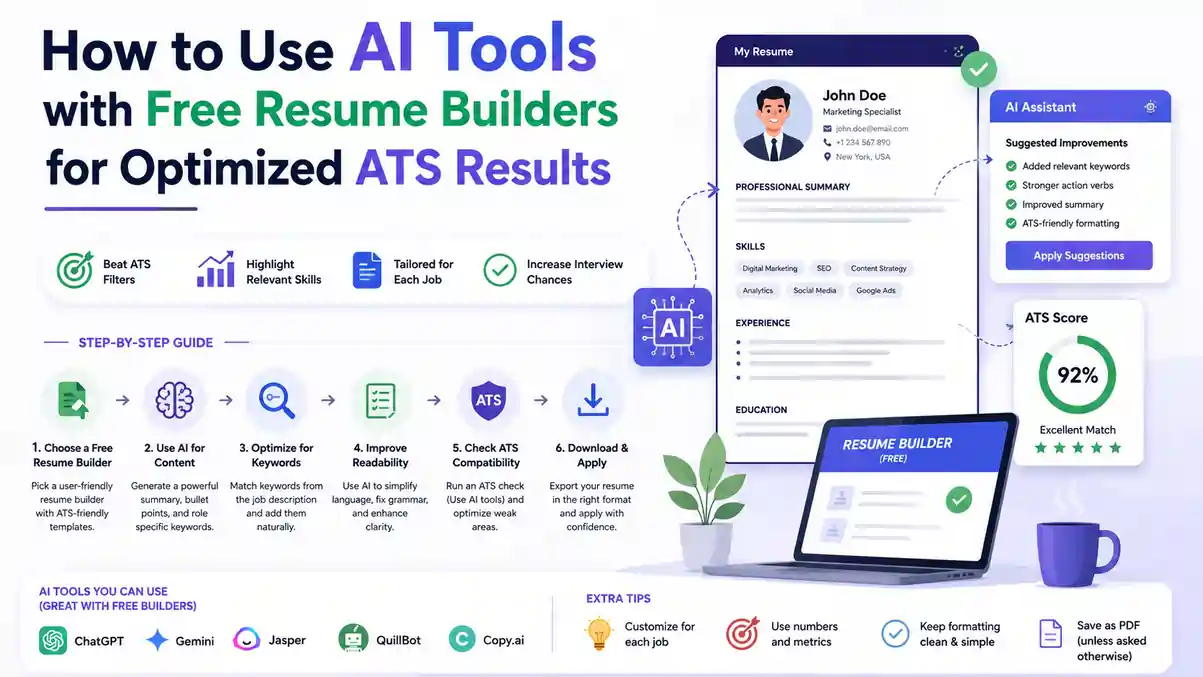
Getting shortlisted for interviews in India now depends heavily on how well your resume passes the Applicant Tracking System. Most large companies, IT firms, consultancies, and even mid-sized startups use an ATS to filter applications before a recruiter ever sees them. If your resume is not formatted correctly or misses the right keywords, it can be rejected automatically, even if you are qualified. Free resume builders that include AI tools can help you solve this problem without spending money on paid services. When used correctly, these tools help you match your resume to the job description, improve your language, fix formatting issues, and increase your chances of clearing the ATS scan on portals like Naukri, LinkedIn, Indeed, and company career pages. This guide explains exactly how to use AI tools inside free resume builders to create an ATS-optimized resume for the Indian job market.
Why ATS Screening Is Critical for Indian Job Applications
In India, a single job posting on Naukri or LinkedIn can receive 500 to 2000 applications within a few days, especially for popular roles like software engineer, business analyst, digital marketing executive, or customer support associate. Recruiters cannot manually check every resume. To manage this volume, companies use ATS software such as Taleo, Workday, Greenhouse, Lever, SAP SuccessFactors, and Zoho Recruit. These systems scan, parse, and rank resumes based on keywords, skills, experience, education, and formatting.
For freshers applying through campus placements or off-campus drives, ATS is equally important. Many mass recruiters like TCS, Infosys, Wipro, Accenture, and Cognizant use automated screening for their initial shortlist. If your resume uses images, tables, text boxes, or fancy fonts, the ATS may fail to read it. Similarly, if you write "managed a team" but the job description says "team leadership" or "people management", the system may not count it as a match. This is where AI tools inside resume builders become useful. They help you identify the exact terms recruiters and ATS are looking for and suggest how to include them naturally.
An ATS does not judge your talent. It checks for relevance and readability. It looks for standard headings like Work Experience, Education, Skills, and Projects. It checks if your skills match the job requirements. It also checks for consistency in dates, proper file format, and clear structure. A well-optimized resume does not guarantee a job, but it ensures your profile reaches the human recruiter. Without passing this first digital filter, even a strong profile for a role in Bangalore, Hyderabad, Pune, or Gurgaon may never get viewed.
How AI Features in Free Resume Builders Improve ATS Results
Free resume builders like the one available at https://resumeera.xyz now include AI assistance to make your resume more targeted and error-free. Unlike a simple template where you fill in blanks, an AI-enabled builder analyzes what you have written, compares it with job market data, and gives specific suggestions. This is particularly helpful for Indian job seekers who may be confused about what to write in the summary, how to describe projects, or which skills to highlight for different roles.
What AI Actually Does Inside a Resume Builder
AI tools inside a resume builder perform several practical tasks. First, they analyze the job description you paste and extract important keywords, including hard skills like Python, SQL, Tally, GST, Digital Marketing, AutoCAD, and soft skills like communication, stakeholder management, and problem-solving. Second, they review your existing content and point out missing keywords or weak phrasing. For example, if you wrote "worked on sales", the tool may suggest "achieved 18% sales growth in 6 months by managing 12 retail accounts in Mumbai region" to make it more achievement-oriented and keyword-rich. Third, they help with grammar, sentence clarity, and action verbs. Fourth, they check formatting for ATS compatibility, warning you if you use columns, graphics, or headers and footers that ATS cannot parse. The better builders also suggest an appropriate resume length and structure based on your experience level, whether you are a fresher with 0-1 years of experience or a professional with 8+ years.
Keyword Matching vs Keyword Stuffing
One of the biggest misunderstandings is that adding more keywords will automatically improve your ATS rank. AI tools help you avoid this mistake by focusing on keyword matching, not keyword stuffing. Keyword stuffing means repeating the same skill 10 times or adding a long list of skills you do not actually possess. Indian recruiters and ATS are now smart enough to detect this. If you apply for a data analyst role and simply list "Python, Python, Python, SQL, Tableau" without showing where you used them, your resume will look spammy and may be flagged.
Proper keyword matching means placing relevant terms naturally within your work experience, projects, and skills sections. For instance, if the job description for a business analyst at a fintech company in Pune asks for "requirements gathering, SQL, stakeholder communication, and Agile", your experience bullets should reflect these terms in context. An AI tool will suggest adding a bullet like "Gathered business requirements from 5 stakeholders and documented user stories in Jira for Agile sprints, using SQL for data validation". This shows real usage rather than just listing words. The tool also helps you maintain the right keyword density, typically 2-4% for primary skills, which is ideal for ATS without looking forced to a human reader.
Content Suggestions for Summary and Experience Sections
The professional summary and work experience sections carry the most weight in ATS ranking. Many Indian job seekers, especially freshers, struggle to write a strong summary. AI tools generate tailored summaries based on your target role. For a fresher BCA graduate applying for a support engineer role, it might suggest: "BCA graduate with hands-on experience in Windows troubleshooting, networking fundamentals, and customer support through academic projects and 3-month internship at a local IT service centre in Nagpur. Seeking an entry-level support role to apply technical and communication skills." For an experienced professional, it will emphasize years of experience, domain expertise, and measurable achievements.
For work experience, AI suggests action verbs and quantified results. Instead of "Responsible for handling clients", it will propose "Managed portfolio of 35 SME clients across Delhi NCR, resolving queries within 24 hours and improving retention by 15%". It also helps convert academic projects into strong experience points for freshers. If you did a final year project on e-commerce website development, it will help you frame it as: "Developed responsive e-commerce website using HTML, CSS, JavaScript and MySQL, implementing payment gateway integration and admin dashboard, tested with 50+ users". This kind of specific, skill-linked description is exactly what ATS looks for.
How to Choose the Right Free Resume Builder for ATS Results
Not all free resume builders are equally effective for ATS. Some offer attractive designs that look good to the eye but fail ATS scans because they use heavy graphics, two-column layouts, or non-standard fonts. When selecting a builder for the Indian job market, focus on ATS performance rather than just visual appeal.
A good builder should offer clean, single-column templates with standard headings. It should allow you to download your resume in PDF or DOCX without watermarks or paywalls, as many companies in India still prefer DOCX for better parsing. It should include a keyword analysis feature where you can paste the job description and get a match score or list of missing skills. It should also provide content suggestions that you can edit, not just auto-fill everything without your control. The builder at https://resumeera.xyz, for example, provides ATS-friendly templates, keyword guidance, and free download options that suit both freshers and experienced candidates.
Check if the builder lets you customize sections for Indian requirements. For example, many Indian recruiters expect details like Date of Birth, Languages Known, or Declaration for government jobs, but these are not needed for private sector MNCs. A flexible builder lets you add or remove such sections based on the role. Also check if it supports adding Naukri-specific keywords, LinkedIn headline suggestions, and cover letter integration. Avoid builders that force you to use infographics for skills, such as progress bars or pie charts, because ATS cannot read them. A simple bullet list like "Skills: Java, Spring Boot, REST APIs, MySQL" is far more effective.
Features to Check Before You Start
Before you start building, verify these five features: First, ATS-friendly templates with no tables or text boxes. Second, job description matching and keyword suggestion. Third, grammar and clarity check for bullet points. Fourth, option to export as ATS-readable PDF and DOCX. Fifth, ability to create multiple versions for different job titles without starting from scratch. If you are applying for both "Software Developer" and "Full Stack Developer" roles, you will need slightly different keyword sets, and a good builder lets you duplicate and tailor quickly. Also ensure the builder does not lock essential features like PDF download behind a payment, as many students and freshers in India need completely free access.
Step-by-Step Process to Create an ATS-Optimized Resume Using AI Tools
Follow this structured process to get the best results from a free resume builder with AI support. This method works for both freshers from Tier 2 and Tier 3 colleges and experienced professionals targeting mid-career switches.
- Collect 2-3 Target Job Descriptions: Go to Naukri, LinkedIn, or the company career page and copy 2-3 job descriptions for the exact role you want. For example, if you want a digital marketing executive role in Ahmedabad, collect descriptions that mention SEO, Google Ads, Meta Ads, content writing, and analytics. Paste them into a document and highlight common repeated skills. These are your primary keywords.
- Choose an ATS-Friendly Template: Open your free resume builder and select a simple, single-column template. Choose standard fonts like Arial, Calibri, or Garamond with font size 10-11 for body text and 13-14 for headings. Avoid templates with sidebars, icons, or photo placeholders unless applying for roles where a photo is specifically required.
- Enter Your Core Details Accurately: Fill in your contact information, including phone number, professional email, city and state, LinkedIn profile link, and portfolio or GitHub link if relevant. For Indian numbers, use +91 format. Ensure your email is professional, not casual. Add your location as "Pune, Maharashtra" rather than full address for privacy and ATS clarity.
- Use AI to Draft Your Professional Summary: Enter your target role, years of experience, and top 3-4 skills, then let the AI suggest a summary. Edit it to make it specific to you. For example, change a generic suggestion to include your actual domain, like "2 years of experience in B2B sales for industrial equipment in Chennai" instead of just "experienced sales professional". Keep it to 3-4 lines.
- Build Experience Bullets with Keywords and Numbers: For each job or internship, add 3-5 bullets. Start each bullet with an action verb like Developed, Managed, Analyzed, Coordinated, or Implemented. Use the AI suggestion to insert keywords naturally and add numbers. For a fresher, convert internships and projects: "Completed 2-month internship at XYZ Pvt Ltd, Kolkata, where I assisted in auditing financial statements for 8 clients using Tally and MS Excel, reducing reconciliation errors by 12%".
- Optimize the Skills Section with Exact Terms: Create a dedicated Skills section and list both technical and relevant soft skills exactly as they appear in job descriptions. If the description says "MS Excel" do not write "Excel" alone. If it says "Goods and Services Tax (GST)" include both forms. Group skills logically: Technical Skills, Tools, Languages, Certifications. This helps both ATS and recruiters scan quickly.
- Run the ATS and Readability Check: Use the builder's checker or paste your resume text into a plain text viewer to see if all content is parsed correctly. Check for missing keywords flagged by the AI, spelling errors, inconsistent date formats, and proper heading names. Ensure dates are in a consistent format like "June 2022 - Present" and headings are standard like "Work Experience" not "My Journey".
- Export, Test, and Tailor for Each Application: Download as both PDF and DOCX. Test by uploading to Naukri or applying via a company portal to see if details auto-fill correctly. For each new application, duplicate your resume and adjust the top 5-6 keywords to match that specific job description. This tailoring takes 10 minutes with AI help but can double your shortlist rate.
This step-by-step approach ensures you are not blindly trusting automation. You remain in control, while the AI handles keyword research, phrasing, and formatting checks that would otherwise take hours of manual work.
Manual vs AI-Assisted Resume Building: A Detailed Comparison
Understanding the difference between manual writing, AI-assisted building, and fully auto-generated resumes helps you choose the right balance. Manual writing gives you full control but often misses ATS nuances. Fully auto-generated resumes may sound polished but can include inaccurate or exaggerated claims. AI-assisted building, where you provide facts and the tool refines them, offers the best outcome for most Indian job seekers.
| Feature | Manual Resume (Word/Google Docs) | AI-Assisted Free Builder | Fully Auto-Generated Resume |
|---|---|---|---|
| ATS Formatting Accuracy | Low to medium, depends on your design skills. Risk of using tables and columns that ATS cannot read. | High, uses tested single-column templates and warns about unreadable elements. | Medium, sometimes uses complex layouts that look modern but fail parsing. |
| Keyword Optimization | Manual research needed, easy to miss important terms from job description. | Automatic extraction of keywords from job description with suggestions for natural placement. | Often over-optimizes with repeated keywords, leading to stuffing. |
| Time Required | 4-6 hours for a fresher, longer for experienced with multiple roles. | 45-90 minutes including tailoring for a specific job. | 10-15 minutes but needs heavy editing for accuracy. |
| Content Quality | Authentic but may lack strong action verbs and quantified achievements. | Balanced, improves your original points with better language and metrics. | May invent achievements or use vague phrases not linked to your real work. |
| Cost for Indian Job Seekers | Free but no guidance. | Free with guidance, download without payment on platforms like https://resumeera.xyz. | Often free to create but charges for download or PDF export. |
| Best For | Senior professionals who know ATS rules well. | Freshers, mid-level professionals, and anyone applying via Naukri and LinkedIn. | Quick draft when you need ideas, but not for final submission. |
For most applications in India, the AI-assisted approach is the most practical. It saves time, improves accuracy, and keeps your resume truthful. Recruiters in cities like Bangalore and Hyderabad have noted that resumes which clearly show relevant skills in context get shortlisted faster than those with just long skill lists. The table above shows why relying solely on manual methods or fully automated content is less effective than a guided, editable AI workflow.
ATS Formatting Rules You Must Follow
Even the best content will fail if formatting confuses the ATS. Follow these rules strictly. Use standard section headings: Contact Information, Professional Summary, Work Experience, Education, Skills, Projects, Certifications. Do not use creative headings like "Where I Worked" or "What I Know". The ATS is programmed to look for exact standard phrases.
Stick to a single-column layout. Two-column resumes often cause the ATS to read content out of order, mixing your skills with your experience. Avoid images, logos, charts, and icons. Do not place important information in headers or footers, as many ATS ignore them completely. For work experience, use a clear structure: Job Title, Company Name, Location, Dates, then bullet points. For example: "Software Engineer | Infosys | Pune | July 2021 - Present".
Use common fonts and avoid excessive styling. Bold and italics are acceptable sparingly, but avoid underlines and text boxes. Save your file with a professional name like "Rahul_Sharma_Resume_Business_Analyst.pdf" instead of "Resume1.pdf" or "MyCV_final.pdf". When applying through Naukri or company portals, prefer DOCX if the portal mentions ATS parsing, as some older Indian ATS parse DOCX more accurately than PDF. Always keep the file size under 500 KB and ensure the text is selectable, not an image scan.
Recruiters in India often use the Naukri Resdex or similar databases where ATS parsing determines your search ranking. A clean, keyword-rich resume is more likely to appear in recruiter searches for terms like "Java Developer with 2 years experience in Pune" even before you apply.
Finally, be consistent with date and location formats. If you write "Jan 2023" in one place, do not write "January 2023" elsewhere. Consistency helps the ATS correctly calculate your total experience, which is a key filter for many Indian employers who set minimum experience criteria like "2-4 years" or "5+ years".
Common Mistakes That Cause ATS Rejection
Many qualified candidates in India get rejected not due to lack of skills but due to avoidable resume errors. Avoid these common mistakes when using any resume builder.
- Using Fancy Templates with Tables and Graphics: Templates with design elements, skill bars, and side columns may look attractive but are unreadable for most ATS. The system may skip your entire skills section if it is inside a table or text box.
- Copying the Job Description Word-for-Word: Some candidates paste the entire job description into their resume in white hidden text to trick the ATS. Modern systems detect this and recruiters treat it as dishonest. Instead, integrate keywords naturally with real examples.
- Ignoring the Job Location and Domain: Applying for a "Sales Manager - Healthcare" role in Mumbai with a generic sales resume that does not mention healthcare, pharma, or medical devices will rank low. Tailor your domain keywords for each industry.
- Writing Long Paragraphs Instead of Bullets: ATS and recruiters both prefer bullet points. A paragraph like "I was responsible for many things including managing clients and making reports and handling team meetings" is hard to parse. Break it into bullets with clear verbs and results.
- Not Updating Skills as per Indian Market Needs: Listing outdated skills like "MS Office 2007" or missing in-demand skills like "Advanced Excel, Power BI, or GST Filing" for accounting roles reduces your match score. Keep your skills current with what Naukri job postings actually ask for in 2024-2025.
- Spelling Mistakes and Inconsistent Abbreviations: Writing "Managment" instead of "Management" or using "HR" in one place and "Human Resources" in another without consistency can cause misses. Use the exact term from the job description at least once, then you can use the abbreviation.
- Adding Unnecessary Personal Details: For private sector jobs, details like father's name, religion, marital status, or full home address are not needed and can clutter parsing. Focus on professional details. For government jobs, follow the specific format requested in the notification.
- Submitting the Same Resume for Every Job: Sending one generic resume to 50 companies on Naukri without tailoring is the biggest reason for low response rates. Even small changes, like reordering skills to match the job priority, can improve your ATS score significantly.
Fixing these mistakes alone can increase your interview calls. Many freshers from colleges in Indore, Coimbatore, or Lucknow have seen better results after switching from a heavily designed resume to a simple ATS-friendly version built with proper keyword placement.
Tailoring Your Resume for Naukri, LinkedIn and Corporate ATS Portals
Different platforms in India have slightly different requirements. On Naukri, your resume headline, key skills, and summary are searchable separately. Ensure your Naukri profile headline matches your resume summary keywords. If your resume says "Business Analyst | SQL | Power BI | Agile", your Naukri headline should reflect the same. Naukri's ATS gives high weight to the "Key Skills" field, so list your top 15-20 skills there exactly as in your resume.
On LinkedIn, the algorithm also acts like an ATS when recruiters search. Your LinkedIn headline, About section, and Experience bullets should be consistent with your resume. If you use AI to optimize your resume for "Digital Marketing Specialist with SEO and Google Analytics", update your LinkedIn headline similarly. This consistency builds trust when the recruiter cross-checks.
For corporate career portals, such as those of HDFC Bank, Reliance, or product companies, the ATS may ask you to fill details manually after uploading your resume. If your resume is well-formatted, the auto-fill will be accurate, saving you time and ensuring data consistency. Always check the preview after uploading. If the portal jumbles your experience, your formatting needs fixing. For fresher drives that use Google Forms or Taleo, keep a plain text version of your resume ready to copy-paste without formatting loss.
For experienced professionals, create 2-3 resume versions. For example, a mechanical engineer with experience in both design and production should have one resume focused on "Design Engineer - AutoCAD, SolidWorks, GD&T" and another for "Production Engineer - Lean Manufacturing, Quality Control, SAP PP". Use the AI tool to quickly rephrase and reorder content for each version. This targeted approach works far better than one broad resume trying to cover everything.
- How to Use AI Tools with Free Resume Builders for Optimized ATS Results
- How to Use AI Tools with Free Resume Builders for Optimized ATS Results
- Decoding ATS Compatibility: Using Free Builders to Beat the Bots
- Browse All B ATS Templates →
Frequently Asked Questions
Can a free resume builder really create an ATS-friendly resume?
Yes, if it uses clean, single-column templates and follows ATS formatting rules. The best free builders, including https://resumeera.xyz, provide templates tested for ATS parsing, allow PDF and DOCX downloads, and include keyword suggestions. The key is to choose a simple template and avoid graphics, tables, and text boxes. A free builder with AI keyword help can be as effective as paid services when you tailor the content to each job description.
How do AI tools identify the right keywords for ATS?
AI tools scan the job description you provide and extract frequently mentioned skills, tools, qualifications, and action phrases. They compare these with your current resume and highlight missing terms. For example, if a job for an HR executive in Delhi repeatedly mentions "payroll, compliance, recruitment, and HRMS", the tool will flag if your resume lacks these. It also suggests where to place them naturally, such as in experience bullets or the skills section, rather than just listing them.
What is the ideal keyword density for an ATS resume in India?
There is no fixed percentage, but aim to include each primary skill 2-3 times in context across your resume. For a Java developer role, mention Java in your summary, in 1-2 experience bullets where you used it, and in your skills list. This creates natural density without stuffing. Avoid repeating a keyword more than 4-5 times unless you have genuinely used it in multiple projects. Recruiters and ATS both penalize unnatural repetition.
Should freshers use AI tools differently from experienced candidates?
Yes. Freshers should use AI to convert academic projects, internships, volunteer work, and certifications into strong experience bullets with relevant keywords. For example, frame your final year project with tools and outcomes. Experienced candidates should use AI to quantify achievements, align past roles with the target job's terminology, and optimize for senior-level keywords like "team leadership, budget management, or P&L responsibility". Both groups benefit from tailoring for each application.
Is PDF or DOCX better for ATS in India?
Both can work if properly formatted, but DOCX is often safer for older ATS used by some Indian companies and consultancies. PDF is widely accepted on Naukri, LinkedIn, and modern corporate portals. The best practice is to keep both versions ready. When a portal does not specify, upload PDF. If you notice auto-fill errors after uploading PDF, try DOCX. Always ensure the text is selectable and not an image, and keep formatting simple in both formats.
How often should I update my resume for ATS optimization?
Update your resume for every distinct job title you apply to. If you are applying for similar roles with the same keywords, one version is enough. But if you switch between roles like "Content Writer" and "SEO Executive", tailor the keywords accordingly. Also update your resume every 3-4 months with new skills, tools, or certifications you acquire, especially in fast-changing fields like IT, digital marketing, and finance. Regular updates also improve your ranking on Naukri's database.
Do recruiters in India actually use ATS for all jobs?
Most medium and large companies do, especially for roles advertised online. Startups with fewer than 20 employees may check resumes manually, but even they often use lightweight ATS or Naukri's built-in filters. Government jobs may have their own screening criteria, but private sector hiring across IT, BFSI, manufacturing, and services relies heavily on ATS. Even when a recruiter checks manually, an ATS-friendly resume is easier to read quickly, so it benefits you in both scenarios.
Can I use the same AI-optimized resume for Naukri, LinkedIn Easy Apply, and company websites?
You can use the same core resume, but make small tweaks for each platform. For Naukri, ensure your key skills field matches your resume. For LinkedIn Easy Apply, keep your resume concise to 1 page for freshers and 1-2 pages for experienced, as recruiters often view it on mobile. For company websites, follow the specific instructions on file format and size. The core content can remain the same if it is already keyword-optimized for your target role.
Creating an ATS-optimized resume with free AI tools is not about tricking the system. It is about presenting your real skills and experience in the language that both the ATS and the recruiter understand. Start with a clear, simple template, use AI to match your content to the job description, quantify your achievements, and keep your formatting clean. For Indian job seekers competing in a crowded market, this practical approach saves time and significantly improves your chances of getting shortlisted. Build your tailored resume today on https://resumeera.xyz, test it on Naukri and LinkedIn, and refine it with each application. Small, consistent improvements in keywords and clarity will help your resume move from the ATS filter to the interview table.