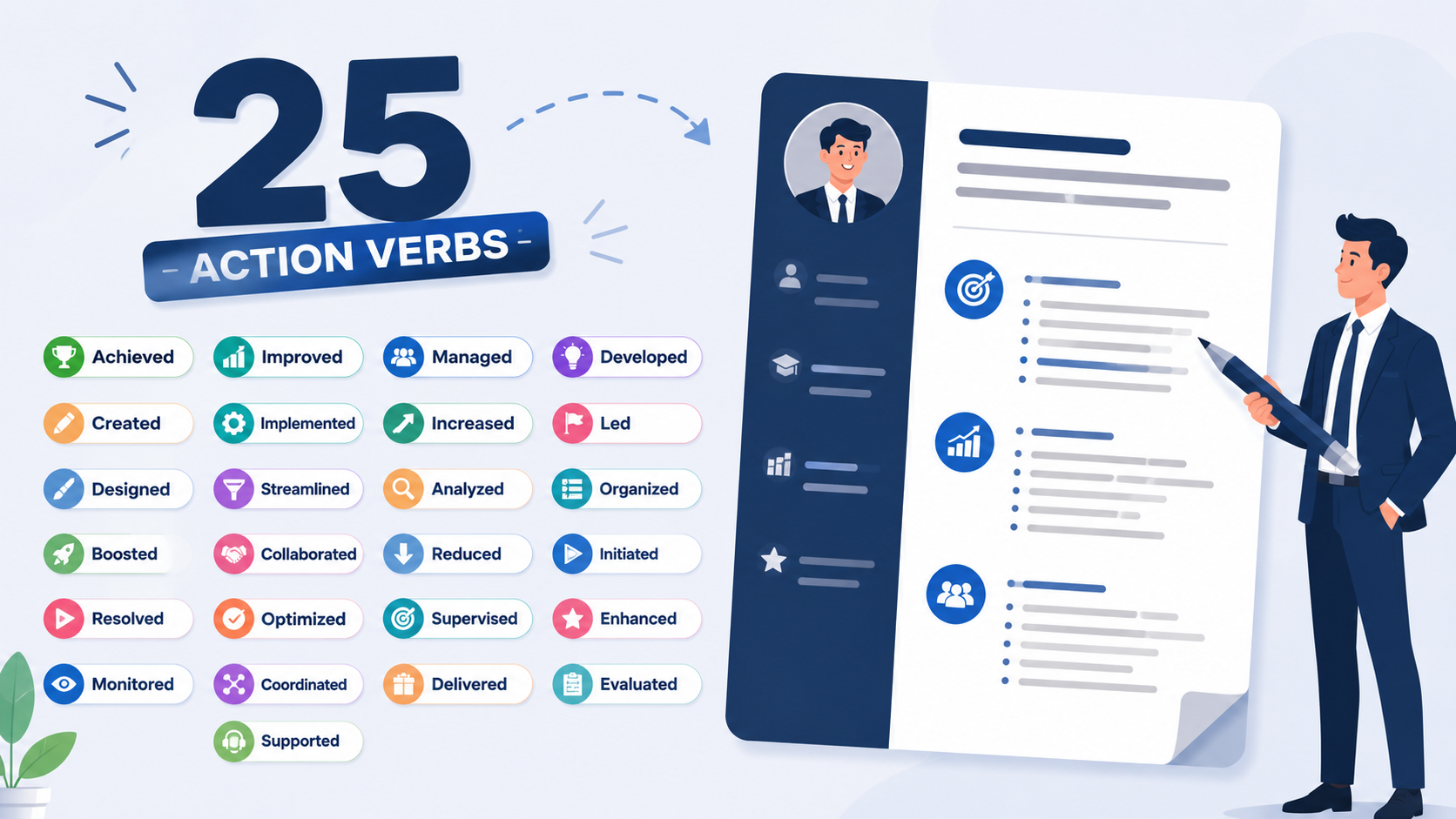
25 Resume Action Verbs That Make Your Experience Stand Out
A strong resume action verb turns a routine job duty into a clear statement of ownership and impact. Instead of saying you were “responsible for” a task, show what you led, built, improved, resolved, or delivered—and support it with evidence.
Recruiters and hiring managers skim resumes quickly, especially for high-volume roles. Clear action verbs make every bullet easier to scan, while numbers, tools, and outcomes show why your work mattered. This guide explains how to choose the right resume action verb, write better achievement bullets, maintain ATS-friendly language, and tailor your wording for Indian job applications.
Table of Contents
- Introduction: Why Resume Language Matters
- Why Resume Action Verbs Work
- The Achievement-Bullet Formula
- 25 Resume Action Verbs Recruiters Notice
- How to Choose the Right Verb
- Before-and-After Resume Examples
- Action Verbs by Career Level and Role
- How to Add Metrics and Proof
- ATS-Friendly Resume Language
- Common Mistakes to Avoid
- A 15-Minute Rewrite Process
- Final Checklist
- Frequently Asked Questions
- Summary
Introduction: Why Resume Language Matters
Many resumes describe work without showing contribution. Lines such as “Responsible for customer support,” “Worked on reports,” or “Involved in onboarding” explain a duty, but they do not show what the candidate actually did, how much they handled, or what improved as a result.
A precise resume action verb fixes that problem at the start of the bullet. It gives the sentence momentum and helps the reader identify your role. “Resolved 180 monthly tickets with 98% CSAT” is more useful than “Responsible for handling customer queries” because it names the action, volume, and quality standard.
The goal is not to make every bullet sound dramatic. The goal is to write clearly and truthfully. A junior professional can use “executed,” “tested,” “documented,” or “resolved” when those verbs accurately represent their work. A manager may use “led,” “orchestrated,” or “negotiated” when they genuinely owned broader outcomes.
Good verbs support the rest of your resume. They make the experience section easier to read, reinforce the claims in your professional summary, and prepare you to explain achievements in an interview.
Why Resume Action Verbs Work
Simple principle: Start each achievement bullet with a clear action, then add context, a measurable result, and business impact. This turns passive job descriptions into evidence of capability.
They show ownership
Passive phrases blur your contribution. “Was involved in a website launch” could mean anything from attending meetings to building the product. “Launched a responsive job-search landing page that improved completed applications by 18%” gives the reader a far clearer picture.
They improve scanning
Recruiters often read the beginnings of bullets first. When the first word is “Led,” “Automated,” “Resolved,” or “Increased,” the eye immediately sees the kind of work you performed. A well-chosen resume action verb creates an easy pattern across the page.
They encourage measurable writing
Action verbs naturally lead to better questions: What did I launch? How many users did it serve? How quickly did it happen? What changed? That process helps you identify real metrics, such as revenue, volume, cost, turnaround time, defect rate, retention, or customer satisfaction.
They work with ATS keywords
Applicant tracking systems look for role-specific terms, tools, qualifications, and experience—not flashy words alone. Use verbs alongside standard job keywords. For example, “Automated monthly MIS reporting using Power BI and SQL, reducing cycle time by 60%” contains both a strong action and relevant searchable terms.
The Achievement-Bullet Formula
Use this structure for most experience bullets. It is flexible enough for technical, sales, finance, HR, operations, marketing, service, and leadership roles.
Template: Action verb + what you did + how or with whom + measurable result/impact.
Duty-based version: Responsible for employee onboarding and orientation.
Achievement-based version: Launched a three-step onboarding workflow for 70 new hires, reducing average ramp time by 10 days through standardised documentation and manager check-ins.
You do not need every element in every sentence. A short bullet can still be strong: “Executed 120 test cases for a payment feature before release.” Add the result when it is known and relevant: “Executed 120 test cases for a payment feature, identifying 14 pre-release defects.”
25 Resume Action Verbs Recruiters Notice
The following action words are useful because they are clear, widely understood, and adaptable. Choose the verb that reflects your actual level of ownership. Do not use a more senior-sounding word simply because it appears impressive.
Leadership and Ownership
- Led: Directed a team, initiative, project, or delivery process.
- Spearheaded: Initiated and drove a new programme or change.
- Orchestrated: Coordinated several teams or functions toward a shared result.
- Mentored: Guided juniors or peers to improve skills and output.
- Championed: Advocated for a valuable change and built support for it.
- Mobilised: Brought stakeholders together to act on a plan.
Execution and Results
- Delivered: Completed a project, service, or output to the required standard.
- Launched: Released a product, feature, campaign, workflow, or initiative.
- Executed: Carried out defined work accurately and reliably.
- Accelerated: Increased speed, adoption, processing, or time-to-market.
- Reduced: Lowered cost, time, risk, waste, defects, or backlog.
- Increased: Grew revenue, users, engagement, quality, or reach.
Problem-Solving and Optimisation
- Resolved: Closed an issue, dispute, customer case, or service interruption.
- Diagnosed: Identified a root cause using data, testing, or investigation.
- Optimised: Made a process, system, campaign, or workflow more effective.
- Automated: Replaced manual work with tools, scripts, or systems.
- Rectified: Corrected errors, gaps, defects, or non-compliance.
- Stabilised: Improved reliability, consistency, or performance under pressure.
Collaboration and Communication
- Coordinated: Kept tasks, people, priorities, and timelines aligned.
- Facilitated: Guided meetings or discussions toward decisions and next steps.
- Negotiated: Reached workable terms with vendors, clients, or partners.
- Partnered: Worked across teams to deliver a shared outcome.
- Advised: Gave leaders, clients, or teams practical recommendations.
- Influenced: Changed a decision or behaviour using data, insight, or trust.
- Presented: Explained complex information clearly to an audience.
These verbs are not mandatory. Words such as “built,” “created,” “analysed,” “designed,” “tested,” “documented,” “trained,” “reviewed,” and “implemented” are equally useful when they describe your work more accurately.
How to Choose the Right Verb
Before selecting a resume action verb, identify your real contribution. Ask yourself whether you initiated the work, owned delivery, helped execute it, improved it, or supported someone else. The answer determines the correct verb.
| If you did this | Consider these verbs | Example |
|---|---|---|
| Managed people, a budget, or end-to-end delivery | Led, directed, orchestrated, managed | Led a 12-member field-sales team across West India. |
| Started a new initiative | Spearheaded, launched, introduced, established | Spearheaded a referral programme that generated 180 qualified leads. |
| Performed detailed technical or operational work | Executed, tested, analysed, built, configured | Executed 120 regression test cases for a payments release. |
| Improved a system or process | Optimised, automated, streamlined, reduced | Automated MIS reporting in Power BI, reducing cycle time by 60%. |
| Fixed a problem | Resolved, diagnosed, rectified, stabilised | Diagnosed API timeout issues and stabilised checkout response time. |
| Worked across teams | Coordinated, partnered, facilitated, influenced | Coordinated product, design, and engineering teams to launch a new flow. |
Use “assisted” or “supported” when that is the honest description. These are not weak words when accompanied by scope and proof. For example, “Supported the campus recruitment team by scheduling 90 interviews and maintaining a 100% document-completion rate” clearly shows useful responsibility.
Before-and-After Resume Examples
Rewrite duties into achievement statements by identifying the action, result, and business value. The examples below show how one line can become more specific without becoming longer.
Before: Responsible for social media marketing.
After: Launched a weekly content-testing plan across Instagram and LinkedIn, increasing organic reach by 140% in three months.
Before: Worked on customer queries.
After: Resolved 200+ monthly customer tickets across email and chat while maintaining 98% CSAT.
Before: Helped with recruitment activities.
After: Coordinated interview schedules, offer documentation, and onboarding for 45 hires across sales and operations.
Before: Handled monthly reports.
After: Automated monthly MIS reporting using Excel macros and Power BI, cutting preparation time from three days to one day.
Before: Worked on website development.
After: Built responsive React and PHP pages for a career platform, improving mobile page-load time by 35% through asset and query optimisation.
Before: Participated in sales growth initiatives.
After: Partnered with distributors on territory plans that increased weighted distribution by 28% and reduced returns by 15%.
Notice that not every strong bullet requires a large revenue figure. Time saved, number of cases handled, pages delivered, defects prevented, people trained, and processes improved are all useful proof points.
Action Verbs by Career Level and Role
Freshers and interns
Freshers should focus on work they actually completed in projects, internships, student organisations, volunteering, or part-time jobs. Useful verbs include built, analysed, created, tested, documented, coordinated, presented, and executed.
Example: Built a Java CRUD application using Spring Boot and MySQL, implementing user authentication and role-based access for a final-year project.
Individual contributors
Professionals who own a specific function can use verbs such as delivered, optimised, automated, resolved, designed, improved, analysed, and executed. Emphasise quality, volume, speed, technical capability, and outcomes.
Example: Optimised campaign targeting and landing-page copy, increasing qualified leads by 32% while reducing cost per lead by 18%.
Managers and leaders
Senior candidates should show scope before detail. Use led, orchestrated, spearheaded, negotiated, mentored, mobilised, and influenced when these accurately describe your work. Include team size, budget, geography, portfolio, or cross-functional reach.
Example: Orchestrated a 12-person product squad across design, engineering, analytics, and support to deliver four retention features that raised 90-day retention from 23% to 32%.
Role-specific direction
| Role area | Useful action verbs | Evidence to add |
|---|---|---|
| Software and IT | Built, engineered, automated, deployed, debugged, stabilised | Performance, uptime, release speed, defects, users, tools. |
| Sales and business development | Generated, converted, negotiated, expanded, secured, increased | Revenue, pipeline, deals, conversion rate, territory, accounts. |
| Marketing | Launched, grew, optimised, created, analysed, increased | Leads, traffic, engagement, CAC, conversion, campaign reach. |
| Finance and accounting | Reconciled, audited, streamlined, reduced, forecasted, rectified | Accuracy, closing time, savings, audit findings, portfolio size. |
| HR and recruitment | Coordinated, sourced, onboarded, facilitated, reduced, mentored | Time-to-hire, offers closed, joining rate, employee volume. |
| Operations and supply chain | Streamlined, improved, monitored, reduced, coordinated, implemented | Turnaround time, stockouts, cost, SLA, locations, orders. |
| Customer support | Resolved, retained, escalated, documented, improved, advised | Ticket volume, CSAT, response time, first-contact resolution. |
How to Add Metrics and Proof
A resume action verb becomes much more persuasive when it is followed by evidence. You do not need to force a percentage into every bullet, but your strongest bullets should show scale or outcome.
Metric types to look for
- Growth: revenue added, leads generated, users acquired, engagement increased, retention improved.
- Efficiency: time saved, shorter cycle times, faster releases, reduced manual effort.
- Quality: CSAT, accuracy, defect reduction, compliance, delivery against SLA.
- Volume: tickets, applications, projects, accounts, campaigns, branches, orders, or reports handled.
- Scope: team size, budget, geography, customer segment, product portfolio, or number of stakeholders.
For a deeper process on converting duties into outcomes, link readers to how to quantify resume achievements in India. It is especially useful when you know your work made a difference but have not yet collected the numbers.
Use honest measures only. If the data is not available, write the scope clearly: “Coordinated weekly reporting for five regional sales teams” is credible and informative.
ATS-Friendly Resume Language
Action verbs are helpful, but they do not replace role keywords. An ATS-friendly bullet combines a clear verb with the terminology employers use in the job description.
Less specific: Improved reports.
ATS-friendly: Automated monthly MIS reporting using Power BI, SQL, and Excel, reducing reporting cycle time by 60%.
The second version includes terms a hiring team may expect for an analytics role: MIS, Power BI, SQL, Excel, and reporting. It also remains easy for a human recruiter to understand.
Formatting rules that protect readability
- Use standard section headings such as Experience, Skills, Education, and Professional Summary.
- Keep bullets in plain text with a single clear action per line.
- Use standard fonts and avoid placing key text in graphics or text boxes.
- Keep verb tense consistent: use past tense for completed roles and present tense for current responsibilities.
- Use common, professional English rather than slang, vague jargon, or invented titles.
For more practical advice, add internal links to the resume keywords for ATS in India, the ATS resume checklist before you apply, and the ATS-friendly resume guide.
Common Mistakes to Avoid
Using inflated verbs
“Spearheaded” is appropriate when you started and drove an initiative. It is not the best choice if you were one of several contributors. Match the verb to your real responsibility to avoid uncomfortable follow-up questions in interviews.
Repeating the same verb
Five bullets beginning with “Managed” make a resume feel flat. Vary your wording where the work was genuinely different: led a team, streamlined a process, negotiated a vendor agreement, mentored juniors, and improved a workflow.
Writing action with no result
A verb alone does not prove impact. “Launched a campaign” is a start; “Launched a campaign that generated 850 registrations at 21% lower cost per lead” tells the fuller story.
Using passive openers
Phrases such as “Responsible for,” “Worked on,” “Helped with,” and “Was involved in” can hide your role. Replace them with the action you took. When you truly supported someone else, say so directly and explain the scope.
Adding jargon instead of clarity
Fancy language can make a bullet harder to understand. Prefer “Automated invoice reconciliation” over a vague phrase such as “leveraged synergistic operational enhancements.” Clear wording is more credible and more ATS-friendly.
Forgetting the job description
The same project can be framed differently for different roles. A developer applying for backend work may emphasise APIs, database performance, and reliability. For frontend work, the same person may foreground responsive UI, accessibility, and page speed.
A 15-Minute Rewrite Process
- Copy three weak experience bullets into a separate document.
- Underline the actual action you took in each one.
- Choose the most accurate resume action verb—not the most impressive-sounding one.
- Add scale: people, cases, projects, reports, regions, users, or transactions.
- Add outcome: time saved, quality improved, revenue influenced, risk reduced, or speed increased.
- Check the vacancy and add one relevant tool or skill where it fits naturally.
- Read each bullet aloud and remove any word you cannot explain in an interview.
Example rewrite: Start with “Worked on inventory reporting.” Identify the action: you built a tracker. Add method: Excel and weekly vendor data. Add outcome: fewer stockouts. The finished bullet might read: “Built a weekly inventory tracker in Excel using vendor data, reducing stockout incidents by 18% during internship.”
Once the experience section is stronger, align the same outcomes with your opening statement. You can guide readers to how to write a resume summary in India and resume objective vs resume summary for the next step.
Final Checklist
- Does every experience bullet begin with an accurate action word?
- Have I replaced “responsible for” and “worked on” where a clearer action exists?
- Does each verb reflect my real level of ownership?
- Have I added a number, scope indicator, tool, or measurable outcome to the strongest bullets?
- Have I varied my verbs without using unnecessary synonyms?
- Are the most important job-description keywords present naturally?
- Is tense consistent across current and previous roles?
- Can I explain every achievement and metric in an interview?
- Is the resume readable in a plain-text, ATS-friendly format?
Frequently Asked Questions
What is a resume action verb?A resume action verb is a word at the beginning of a bullet point that explains what you did, such as led, built, automated, resolved, analysed, or delivered. It makes your contribution clearer than passive phrases.
Do action verbs help with ATS screening?They help readability, but ATS matching depends mainly on relevant job titles, skills, tools, certifications, and industry terms. Use a clear resume action verb alongside genuine keywords from the job description.
Which resume action verbs are best for freshers?Freshers can use built, created, analysed, tested, documented, executed, coordinated, presented, and assisted. Use projects, internships, academic work, volunteering, and part-time jobs as evidence.
Should every bullet begin with a different verb?No. Vary verbs when the action changes, but do not force awkward synonyms just to avoid repetition. Accuracy and clarity matter more than variety.
Is “managed” a good resume action verb?Yes, when you managed people, accounts, projects, budgets, or processes. Be specific about the scope: managed a team of eight, a ₹20 lakh budget, 35 client accounts, or a monthly reporting process.
Can I write “helped” or “assisted” on a resume?Yes, especially for internship and junior roles, when that reflects your responsibility. Make it stronger by adding context and scale, such as “Assisted with 90 interview schedules during a five-week campus hiring drive.”
How do I write resume bullets when I do not know the numbers?Use credible scope indicators: number of projects, customers, locations, reports, team members, product lines, tickets, or tools. Do not invent percentages or financial figures.
Should I use present tense or past tense?Use present tense for current ongoing responsibilities and past tense for completed work or previous jobs. Keep each role internally consistent.
Can I use a resume action verb in my professional summary?Yes. A professional summary can say, for example, “Automated monthly MIS reporting, reducing cycle time by 60%.” However, keep the summary concise and reserve detailed evidence for the experience section.
How many action verbs should I use on a resume?Most experience bullets should begin with a clear action, so the total depends on your resume length. Focus on quality: each verb should be accurate, specific, and followed by useful context or proof.
Summary
The right resume action verb makes your experience section clearer, more direct, and easier to scan. Start with an honest action word, explain the work, add tools or scope where relevant, and finish with a measurable result or practical impact.
Use leadership verbs for genuine ownership, execution verbs for reliable delivery, optimisation verbs for improvements, and collaboration verbs for cross-functional work. Avoid passive openings and inflated claims. Rewrite three bullets today, quantify what you can, and tailor the language to the job description before applying.
Related Resumeera Guides
- How to write resume work experience
- How to present resume achievements
- Key skills for a resume
- How to tailor your resume for every application
- Resume proofreading tips before applying
Use sample metrics and examples only as models. Replace them with accurate, interview-ready facts from your own experience.