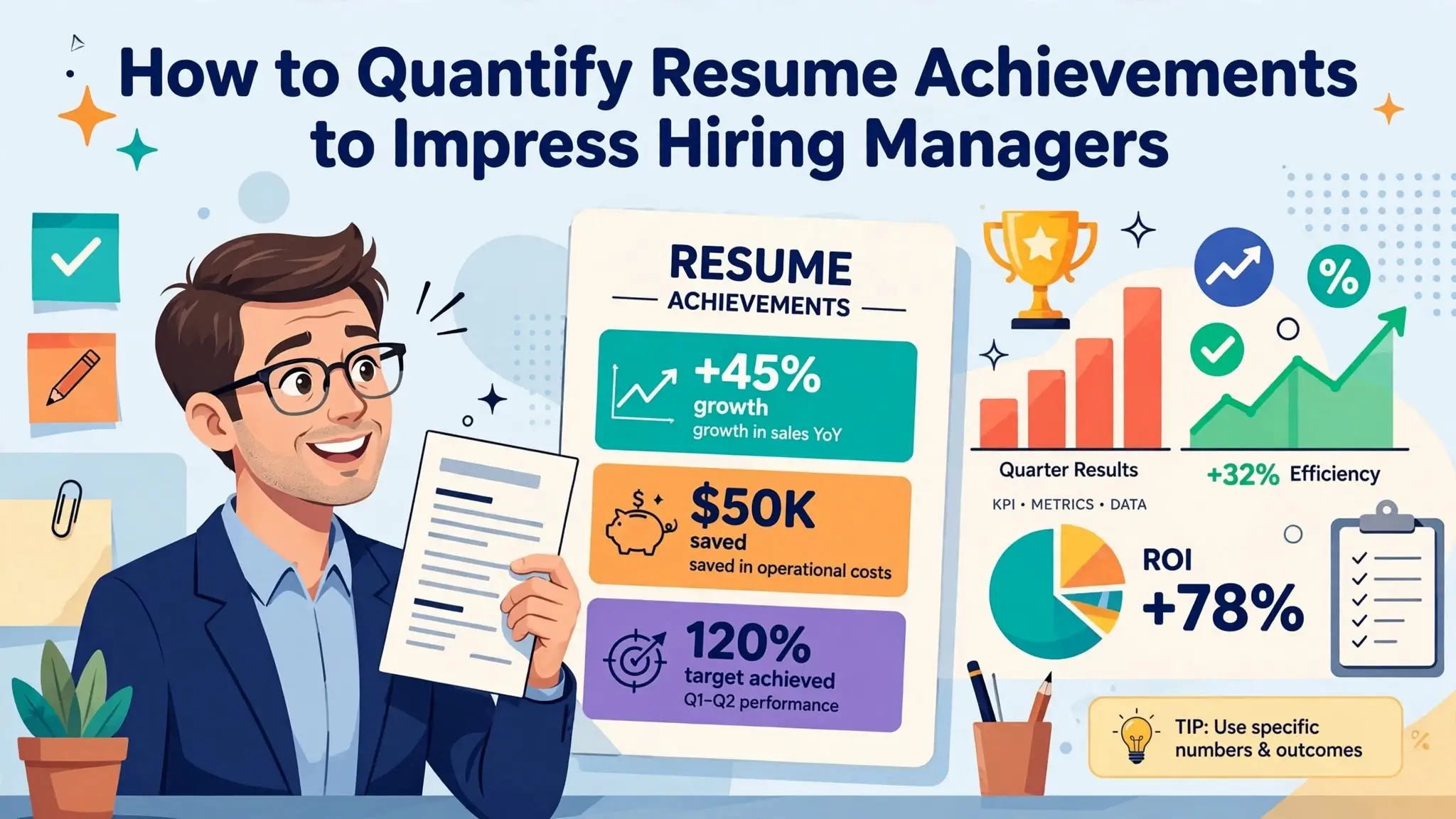
How to Quantify Resume Achievements to Impress Hiring Managers
Your work is solid, but your CV sounds like a job description. Shift the focus to resume achievements that show impact. Put numbers to your wins, add timeframes, and give just enough context so a busy hiring manager can see the result at a glance.
Build a Resume That Leads With Proof
Use ResumEra's free builder to structure quantified achievements the way recruiters scan for them.
1. Why Numbers Beat Duties on Your Resume
In India's crowded job market, recruiters skim in seconds. They stop when they see outcomes: revenue, costs, speed, quality, adoption. This guide shows the exact formula, with examples you can adapt in minutes.
Duties are interchangeable. Results aren't. Resume achievements make your past feel predictive: if you moved a metric before, you're likely to move it again. That's the leap a hiring manager wants to make fast.
Most applicants list tasks and a few soft phrases, then call them resume accomplishments. The problem is nobody can tell whether those lines changed anything. Numbers fix that — even small ones. For the foundational structure this sits inside, see our guide on how to write resume work experience.
2. The 4-Step Formula to Quantify Resume Achievements
Here's the simple workflow that turns generic bullets into measurable achievements: pick the outcome, choose a metric, anchor it in time, then add just enough context to prove your role.
Step 1: Pick outcomes that hiring managers track
Start with the business levers for your role. Sales? Revenue, win rate, ACV. Operations? Turnaround time, SLA adherence, defects. Product? Activation, retention, NPS. Finance? Days to close, ageing, variances. Tech? Uptime, latency, incidents resolved.
Now match your recent work to one or two of those levers. Don't try to show everything. Strong resume achievements repeat a theme: you grow, you save, or you speed things up.
Step 2: Choose resume metrics that show scale
Pick numbers that convey scope: volume handled, percentage change, rupee impact, or rank. Mention the tool or channel when it matters — CRM, Tally, SAP, UPI, Play Store, Naukri, or LinkedIn — so your resume metrics feel real and verifiable.
Step 3: Set the baseline and timeframe
"Improved" means little without a before and after. Add the starting point and the period: "from 72% to 88% in six weeks," "reduced AHT from 4:50 to 3:10 in Q3," "cut CAC by ₹220 per lead in 60 days." That's how results become credible, not lucky.
Step 4: Add just enough context to prove your role
State what you owned versus what the team owned. A single clause naming your specific contribution — "by automating three reconciliations" or "by rewriting the onboarding flow" — is enough to make the number believable without turning the bullet into a paragraph. Pair this with strong verbs from our list of 25 resume action verbs to keep the line tight.
3. Examples of Quantified Resume Achievements
- Increased qualified leads by 31% QoQ (from 1,450 to 1,900) by launching 2 new paid campaigns and tightening UTM tracking in GA4.
- Shortened monthly close by 6 days in Q2 FY25 by automating three reconciliations in Tally with Excel Power Query.
- Raised app rating from 3.8 to 4.4 and cut crashes 42% by prioritising top 5 issues from Firebase and releasing biweekly hotfixes.
- Negotiated vendor terms to save ₹18.6L annually while raising SLA compliance from 92% to 98% across two DCs.
Keep the language plain. Strong lines read like field notes describing professional achievements, not campaign slogans. If a number looks high, add quick context so it stays believable. For more on the writing style itself, see our full guide to writing resume achievements.
4. India-Specific Metrics That Impress
Different markets care about different proof points. Across tech, BFSI, FMCG, and services, the same patterns repeat in interviews. Use them to build your own resume examples that ring true locally.
| Function | Metrics Recruiters Look For |
|---|---|
| Sales & GTM | New logos, renewals, ACV growth, upsell %, collections cycle, churn |
| Marketing | CPL, MQL-to-SQL conversion, organic traffic growth, CAC payback, ROAS |
| Product & Growth | Activation %, D1/D7 retention, WAU/MAU, feature adoption, NPS |
| Operations & Supply | Fulfilment TAT, on-time delivery %, shrinkage, defects PPM, cost per order |
| Engineering & IT | Uptime, MTTR, incident count, deployment frequency, test coverage |
| Finance & HR | Days to close, DSO, ageing buckets cleared, offer-to-join ratio, attrition |
If you're missing data, talk to your manager or pull from tools. CRM, ERP, ticketing, and analytics systems almost always have what you need — you might just need to export and clean it. Pairing these metrics with the right vocabulary matters too; see ATS resume keywords for India for terms that pass automated screening alongside your numbers.
5. Where Quantified Achievements Belong on Your Resume
Even the strongest quantified line loses impact if it's buried in the wrong place. Recruiters read top-down and skim fast, so the placement of your resume achievements matters almost as much as the numbers themselves.
Lead your summary with your single best number
Your professional summary is prime real estate. Instead of a generic opening line, pull your single most impressive quantified achievement into the first sentence: "Operations professional who improved on-time delivery from 86% to 97% across 7 cities." This gives a recruiter a reason to keep reading before they even reach your work history. See our guide on writing a resume in 2026 for how the summary section fits into the overall structure.
Stack your strongest bullets under your most recent role
Recruiters weight recent experience more heavily than older roles, so your most detailed, most quantified achievements should sit under your current or most recent position. Older roles can carry one strong line each rather than a full list — this keeps the resume from feeling front-loaded with duties and back-loaded with vague filler.
Echo your top metric in your skills or achievements section
If your resume has a separate "Key Achievements" or "Highlights" section near the top, use it to repeat your two or three strongest quantified wins in short form. This creates a second touchpoint for the numbers that matter most, without repeating the exact same sentence used in your experience section. Our guide on structuring a key skills section covers a similar placement principle for skills, and the logic carries over directly to achievements.
6. Quick Fixes for Common Mistakes
Don't hide the numbers behind fancy design. An ATS-friendly resume needs clean formatting, standard headings, and no graphics that break parsing. Use a common font, save as PDF unless the job description asks for DOCX, and keep section titles simple — our ATS resume tips guide covers this side in detail.
A second mistake is vague bragging. A quantified resume should name the metric, the movement, and the period. If you partnered with others, say what you owned. That's confident, and it reads as honest. These same red flags are exactly what recruiters notice first — see the biggest resume red flags recruiters spot in India.
7. Sample Lines by Role and Level
Before you write, map your target role. Then draft your bullets in a scratchpad and cut anything that doesn't prove impact. A few focused resume writing tips go a long way: one outcome per line, past tense, numbers first when they're impressive.
- Software Engineer (Mid): Cut p95 latency from 820ms to 360ms in 8 weeks by shipping Redis caching and compressing payloads, lifting checkout conversion 2.1%.
- Product Manager (Senior): Grew WAU 44% and D28 retention from 12% to 19% in two quarters by simplifying onboarding and adding UPI autopay.
- Sales Executive (Entry): Hit 122% of quarterly target, opened 18 new logos in Mumbai, and lifted ACV 26% by sharpening demo flow and follow-ups.
- Finance Analyst (Mid): Reduced ageing >90 days by 38% in FY25 by implementing dunning cadence and reconciling 3 high-variance ledgers.
- Operations Lead (Senior): Brought on-time delivery from 86% to 97% in 4 months across 7 cities by reworking vendor SLAs and daily TAT huddles.
If you're converting a long CV into a two-page resume, prioritise scope lines and a handful of sharp bullets — see one page vs. two pages, explained for India. Keep a master file with your detailed CV achievements, but send a focused version tailored to the specific job description for each application.
Your bullets aren't carved in stone. Refresh them per job description, match verbs to the role, and keep stacking proof — that's how your story compounds into visible career success. If you're also switching industries at the same time, pair this with our career change resume tips for 2026. Freelancers and project-based professionals can adapt this same formula using our freelance resume guide.
Put This Formula Into Practice
Build a resume with quantified, recruiter-ready bullets in minutes — free, no sign-up.
8. Frequently Asked Questions
9. Summary
Turn duties into proof. Use the formula to write crisp, credible resume achievements that show scale, speed, savings, or growth. Aim for 3–5 per role and keep them updated.
- Numbers make your past feel predictive — duties alone don't.
- Follow the 4-step formula: pick the outcome, choose the metric, set the baseline and timeframe, then add context.
- Use India-specific metrics by function so your resume achievements feel locally credible.
- Keep formatting ATS-clean and avoid vague bragging without a number attached.
- Refresh your bullets per job description rather than reusing one static version everywhere.
If you want a second set of eyes, send a draft to a peer or a mentor and tighten the lines that matter most. Want a template built for these bullets from the start? Try ResumEra's free builder and start rewriting one section today.
Ready to Rewrite Your Resume?
Build a resume that leads with proof, not duties — free, in minutes.