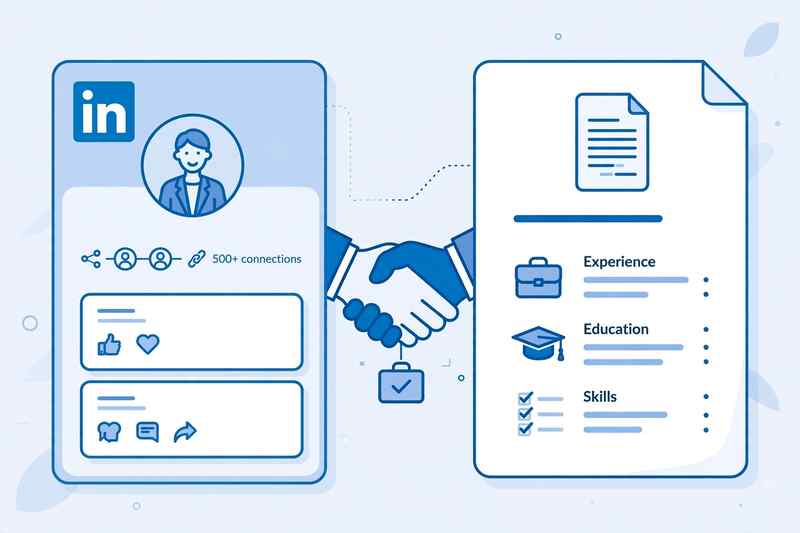
LinkedIn Profile vs
Resume:
Why You Need Both to Get Hired
Your resume gets you shortlisted. Your LinkedIn profile gets you found. In India's 2026 job market, relying on just one means missing half the opportunities.
Here is a scenario that plays out every day across India's job market: a candidate applies to 50 companies through Naukri with a solid resume and gets 3 callbacks. Another candidate with a comparable profile but a fully optimized LinkedIn gets 12 inbound messages from recruiters — without applying anywhere. The difference is not skill or experience. It is channel strategy.
Your LinkedIn profile and your resume are not the same document, and they are not interchangeable. They work as a system — each doing a specific job that the other cannot. Understanding this distinction is one of the highest-leverage things you can do for your job search in India in 2026.
Resume = inbound application tool. You control when and where it goes. LinkedIn = outbound discovery engine. Recruiters find you 24/7. You need both, and you need them aligned.
This guide explains exactly how these two tools differ, where they overlap, how to optimize each for India's hiring landscape, and — critically — how to make them work together so you never miss an opportunity from either direction.
The Fundamental Difference: Discovery vs Application
The biggest mistake Indian job seekers make is treating LinkedIn as a place to paste their resume. LinkedIn is a professional network and search engine. Your profile is a living, public document indexed by Google, LinkedIn's own recruiter tools, and increasingly, AI-powered hiring platforms. Your resume is a tailored, private document that you send for a specific role at a specific company.
- Public and permanently searchable
- First-person, conversational tone
- No page or character limit
- Includes recommendations, endorsements, posts
- One version for everyone who views you
- Updated continuously as your career grows
- Showcases personality, network, and soft proof
- Recruiters find you — you don't always apply
- Private — shared only when you choose
- Formal, concise, third-person implied
- Strict length limit (1–2 pages for most roles)
- No social proof or recommendations
- Tailored per application, per role
- Updated for specific applications
- Proves skills through metrics and outcomes
- You apply — the resume is your formal bid
Think of it this way: LinkedIn is your shop window — open day and night, visible to anyone who walks past. Your resume is the proposal you hand to a specific client after they've walked in. Both need to be excellent. But they serve entirely different moments in the hiring journey.
LinkedIn vs Resume: Complete Feature-by-Feature Breakdown
Here is a full side-by-side comparison across every dimension that matters for Indian job seekers:
| Dimension | LinkedIn Profile | Resume |
|---|---|---|
| Audience | LINKEDIN Anyone who searches — recruiters, peers, clients, potential partners |
RESUME Specific hiring manager or recruiter for a specific role |
| Discoverability | Indexed by Google, LinkedIn Recruiter, AI hiring tools | Not searchable — exists only when you send it |
| Tone | Conversational, first-person ("I led a team…") | Formal, concise, action-verb led ("Led a team of…") |
| Length | No limit — more detail generally helps | Strict: 1 page (fresher), 2 pages (6–10 yrs) |
| Customization | One profile, one version for everyone | Tailored per application with matched keywords |
| Social Proof | Recommendations, endorsements, follower count | None — only self-reported facts |
| Media / Portfolio | Can attach PDFs, images, links, videos, projects | Text-only (ATS compatibility required) |
| Skills | Listed + endorsed by others, ranked by votes | Self-declared, grouped by category |
| Activity Signal | Posts, articles, comments show active thinking | Static — shows only history, not current engagement |
| Photo | Essential — high-quality professional headshot | Avoid for private sector India; include only if requested |
| ATS Impact | No ATS involvement — human recruiter finds you | Must pass ATS (Applicant Tracking System) filters first |
| Update Frequency | Continuous — every new project, role, post | Per application cycle — tailored each time |
| India-Specific Use | Primary for MNC and tech hiring; growing in all sectors | Required for every formal application — Naukri, company portals, campus |
Anatomy of Each: What Goes Where
Understanding the structural components of each document prevents the most common error: filling one with the wrong kind of content. Here is what each section is for:
How to Optimize Your LinkedIn Profile for India's Job Market in 2026
Most Indian LinkedIn profiles are either empty or a copy-paste of a resume. Neither works well. Here is what actually gets you found and contacted by recruiters:
1. Write a Headline That Does More Than Your Job Title
LinkedIn's algorithm gives enormous weight to your headline. The default ("Software Engineer at Infosys") tells a recruiter nothing they couldn't infer. A better headline combines your role, your niche, your impact domain, and your target city or remote preference.
Software Engineer at Infosys
Backend Engineer (Java, Spring Boot) · Fintech & Payments Systems · Bangalore · Open to Senior/Lead Roles
2. Write an About Section That Humans Actually Read
Your About section is not a resume summary. Write in first person, with genuine voice. Open with your professional identity in one sentence. Follow with 2–3 specific outcomes you've driven. Mention your current focus and what problems you love solving. End with an open invitation to connect or a note that you are open to opportunities.
Sentence 1–2: "I'm a product manager with 6 years in B2B SaaS, focused on growth and monetization at early-to-mid stage startups across Bangalore and NCR."
Sentences 3–5: "In my last two roles, I led teams that drove 40% reduction in churn through better onboarding flows and 3× improvement in trial-to-paid conversion."
Close: "Currently exploring senior PM / Head of Product roles at Series A–B startups. Feel free to connect or reach out at [email] ✕."
3. Set Your Open to Work Signal Strategically
LinkedIn's "Open to Work" feature can be set to visible to all (green frame on photo) or visible only to recruiters. For active job seekers in India who aren't worried about their current employer seeing it — the green frame increases profile views by up to 2× in high-demand fields. For those in sensitive situations, the recruiter-only setting is safer.
When setting "Open to Work," always add specific job titles (not just broad categories), your preferred locations, and whether you are open to remote. LinkedIn uses this to match you with recruiter searches — vague settings mean fewer matches.
4. Build Skills Endorsements Strategically
LinkedIn's algorithm weights endorsed skills significantly higher than unapproved ones. Your top 3 skills (the ones visible without expanding the section) should be your most relevant and most-endorsed. Reorder them manually to put your primary technical or professional skill first.
Reach out to former colleagues and ask for mutual endorsements. Five genuine endorsements on "Python" or "Product Management" signal credibility that no resume line can match.
5. Get at Least 3 Recommendations
A recommendation written by a manager, client, or senior colleague is the closest thing to a reference letter that lives on your profile. Indian recruiters at MNCs increasingly scan recommendations before reaching out. Prioritize getting one from a direct manager and one from a peer or cross-functional colleague.
To get recommendations: write one for someone first — reciprocity is powerful and genuine. Alternatively, send a specific request: "Could you write a short recommendation about the X project and my role in delivering Y outcome?"
6. Post Content in Your Domain
This is the highest-leverage but most underused LinkedIn tactic in India. A single insightful post — a lesson learned, a breakdown of a project outcome, a take on an industry trend — can reach thousands of people in your sector and generate recruiter inbound without you applying for anything.
You do not need to post daily. Two to four posts per month on genuinely useful professional insights is enough to establish visibility. Comment thoughtfully on posts by leaders in your field for additional reach.
Optimizing Your Resume to Complement Your LinkedIn in 2026
Once a recruiter finds you on LinkedIn and is interested, they will ask for a resume — or they'll look for the one you've attached to the role you applied to. Your resume must validate what your LinkedIn profile promised. Here is how to make sure they work together, not against each other.
Always Include Your LinkedIn URL in Your Resume Header
This is non-negotiable. Your LinkedIn profile URL should appear in the header of every resume you send, right next to your phone number and email. Customize it first: go to LinkedIn settings and set a clean custom URL like linkedin.com/in/yourname — not the default string of random numbers.
Your Resume Summary Should Echo Your LinkedIn Headline — But Be Tighter
The first thing recruiters see on both documents should communicate the same core professional identity. If your LinkedIn headline says "Senior Data Analyst · E-commerce & Retail Analytics · Mumbai," your resume summary should open with something like: "Senior data analyst with 5 years in e-commerce retail analytics…" — consistent in identity, tighter in format.
Keep the Facts Identical Across Both
Job titles, company names, employment dates, and education must match exactly across LinkedIn and your resume. Recruiters cross-check both — discrepancies raise immediate red flags and are one of the top reasons candidates are disqualified before interviews. This is especially important for employment gaps, freelance periods, and short tenures.
A recruiter sees "Product Manager, Flipkart (2023–2025)" on your resume but "Associate PM, Flipkart (2022–2024)" on LinkedIn. That inconsistency alone can end your candidacy — especially at MNCs that do formal background verification.
ATS-Proof Your Resume Keywords from LinkedIn Job Search
Use LinkedIn's job search to find 3–5 postings for your target role. Look for the skills and keywords that appear consistently across them. These are the words the ATS will scan for in your resume. Include them naturally in your experience bullets and skills section — not stuffed artificially, but genuinely integrated.
How LinkedIn and Your Resume Work Together: The Full Hiring Journey
Understanding the sequence in which these two tools operate changes how you invest your time. Here is the typical path a hiring interaction takes in India's corporate sector:
Recruiter searches LinkedIn with filters
A recruiter at an MNC searches: "Senior Java Developer + Pune + 5 years + Spring Boot." Your keyword-rich headline, skills, and experience description determine whether you appear in the results — not your resume. This is why LinkedIn optimization comes first.
Recruiter reviews your full LinkedIn profile
If you appear in results, they spend 60–90 seconds scanning your profile. Your photo, About section, current role, and recommendations either build enough trust to reach out — or don't. This is why a complete, conversational LinkedIn profile matters enormously.
Recruiter sends InMail or requests your resume
The recruiter reaches out via LinkedIn InMail, WhatsApp (common in India), or email. They will ask for an updated resume. At this point, your resume must validate what your LinkedIn profile promised — same facts, same professional identity, but tighter and tailored.
Resume goes through ATS screening
Even with a recruiter referral, your resume typically enters a formal ATS. Your resume's keyword density, format cleanliness, and section headings determine whether it passes into the human review stage. A great LinkedIn gets you into the funnel — a great resume keeps you in it.
Interview panel cross-checks both
Before your interview, the panel reviews both your resume (which HR sent to them) and your LinkedIn profile (which they Google). Inconsistencies or a weak LinkedIn at this stage can reduce their confidence. A strong LinkedIn with posts, recommendations, and a clear professional brand reinforces the case your resume made.
Background verification
Post-offer, background verification companies cross-check employment dates and job titles against LinkedIn (the most common public source) and your resume. Any discrepancy here can delay or reverse an offer. Consistency is not optional.
India-Specific Context: Where LinkedIn Adoption Stands in 2026
LinkedIn's penetration and influence varies significantly across India's job market. Understanding which sectors rely heavily on it — and which don't yet — helps you prioritize correctly.
| Sector | LinkedIn Importance | What Matters Most |
|---|---|---|
| IT / Software / SaaS | ????? Critical | Technical skills, GitHub link, posts on domain, open-to-work signal |
| MNCs (all functions) | ????? Critical | Complete profile, recommendations from senior colleagues, headline |
| Startups / VC-backed | ???? High | Thought leadership posts, founder connections, side projects visible |
| Banking / BFSI | ??? Moderate-High | Certifications (CFA, FRM), company pedigree, clean profile |
| FMCG / Sales | ??? Moderate | Territory experience, company brands, measurable impact |
| Manufacturing / Core Engg | ?? Growing | Resume still primary; LinkedIn for senior leadership roles |
| Government / PSU | ? Low | Formal applications, prescribed forms dominate; LinkedIn is supplementary |
| Academia / Research | ?? Low-Moderate | Google Scholar, ResearchGate more relevant than LinkedIn |
If you're targeting government, PSU, or academic roles, your LinkedIn profile matters less than a well-structured CV or prescribed application form. However, even in these sectors, having a clean professional LinkedIn never hurts — some selection committees now Google candidates before final rounds.
Common Mistakes Indian Job Seekers Make With LinkedIn and Resume Together
These are the errors that most frequently derail an otherwise strong candidacy. Each one is avoidable once you understand the system.
- Copy-pasting your resume into LinkedIn Fix: LinkedIn rewards conversational, keyword-rich content. Rewrite every section in first person. The About section especially must feel human, not like a bullet-point dump.
- Not having a LinkedIn profile at all (or leaving it at 40% completion) Fix: At minimum, complete: photo, headline, About, current/recent experience, and 5+ skills. This is LinkedIn's "All-Star" threshold where profile views increase by up to 40×.
- Using a generic headline like "Looking for opportunities" or just your title Fix: Pack your headline with the role you want, your niche, top skill, and city. This is the single most important field for recruiter search visibility.
- Dates or job titles on LinkedIn don't match the resume Fix: Do a full audit. Open both documents side by side. Match every employer, title, and date range exactly. Discrepancies flag you as dishonest before the interview starts.
- No LinkedIn URL in the resume header Fix: Add your custom LinkedIn URL next to your email and phone. This gives reviewers an instant link to your fuller story and social proof.
- Resume optimized for keywords but LinkedIn profile completely barren Fix: Keywords need to exist on both. Recruiters use LinkedIn Recruiter to search for those same keywords — a keyword-stuffed resume that leads to an empty LinkedIn profile breaks trust immediately.
- No recommendations on LinkedIn after 3+ years of work experience Fix: Request 2–3 recommendations proactively. A profile with zero recommendations from a 7-year professional raises questions about their peer relationships and impact.
- Sending resume without checking if LinkedIn profile is up to date Fix: Every time you tailor a resume for a specific application, spend 5 minutes verifying your LinkedIn is consistent with it. Always send them as a matched pair.
Your Action Checklist: LinkedIn + Resume Together
Use this as your pre-application audit. Run through it once before every serious job search cycle:
LinkedIn Profile Checklist
- Professional photo (clear background, professional attire, smiling)
- Headline: role + niche + top skill + location (not just job title)
- Custom URL: linkedin.com/in/yourname — not the default random string
- About section: 150–300 words, first person, outcome-led, ends with CTA
- Open to Work set with specific job titles and preferred locations
- All roles listed with at least 2–3 bullet points each (not just company names)
- 5+ skills listed, top 3 in primary skills visible without expanding
- At least 3 endorsements per top skill
- At least 2 recommendations from managers, clients, or senior peers
- Education matches resume exactly — same degree, institution, year
- At least 1 item in Featured section (project PDF, article, or link)
- 500+ connections (network size affects your visibility in second-degree searches)
Resume Checklist (for LinkedIn Alignment)
- LinkedIn custom URL in the header (next to phone and email)
- Professional summary matches your LinkedIn headline in identity and niche
- All job titles, company names, and dates match LinkedIn exactly
- ATS keywords drawn from same LinkedIn job searches you targeted
- Saved as PDF with clean formatting — no tables, graphics, or text boxes
- Length: 1 page (fresher), 2 pages (experience) — no padding
- Each experience bullet: action verb + task + measurable result
- No photo, no date of birth, no marital status for private sector roles
Frequently Asked Questions: LinkedIn vs Resume
Is LinkedIn profile same as resume?
No. A LinkedIn profile is a public, permanently searchable professional brand. Your resume is a private, tailored document you send for a specific role. LinkedIn gets you discovered; a resume gets you shortlisted. Both are essential but serve completely different moments in the hiring journey.
Do I need both a LinkedIn profile and a resume in India?
Yes. In India's 2026 corporate job market, over 87% of recruiters check LinkedIn before or after receiving a resume. A strong LinkedIn drives inbound recruiter messages. A strong resume passes ATS and gets you into interview rounds. Relying on only one means missing a significant portion of available opportunities.
Should my LinkedIn profile say the same thing as my resume?
The facts must be identical — same employers, titles, dates, education. But the tone and depth should be different. LinkedIn is first-person, conversational, and richer in context. Your resume is formal, concise, and keyword-optimized for ATS. Never copy-paste one into the other.
How do I optimize my LinkedIn profile for Indian recruiters?
Key steps: (1) Write a keyword-rich headline with your role, niche, and city. (2) Set Open to Work with specific job titles. (3) Write an About section in first person with your top outcomes. (4) Get 3+ recommendations from managers or peers. (5) Publish posts in your domain 2–4 times per month. (6) Connect strategically with recruiters at target companies.
Can I use LinkedIn instead of sending a resume?
For informal conversations and referral-initiated discussions, sharing your LinkedIn URL may open a dialogue. But for formal applications — through company portals, Naukri, campus drives, or LinkedIn Easy Apply — you still need a dedicated resume. LinkedIn initiates; the resume formalizes.
What happens when a recruiter sees inconsistencies between LinkedIn and my resume?
Inconsistencies in job titles, dates, or company names between your LinkedIn and resume are one of the top reasons candidates are quietly disqualified without explanation. Recruiters and background verification companies cross-reference both. Audit both documents before every application cycle to ensure they match exactly.
How long should my LinkedIn About section be?
150–300 words is the ideal range. Write in first person. Open with your professional identity in 1–2 sentences. Follow with 2–3 specific outcomes or results. Mention your current focus and what opportunities you're open to. End with a soft call to action. Do not paste your resume summary here — LinkedIn's algorithm rewards original, readable content.
Should freshers in India prioritize LinkedIn or resume?
Both matter, but for campus placements and early-career applications in India, your resume is the primary document. LinkedIn becomes increasingly important from your first job search onward. As a fresher, invest first in a strong one-page resume. Simultaneously, build your LinkedIn with education, projects, certifications, and 2–3 peer or professor recommendations. The habit of maintaining both early pays off significantly within 1–2 years.
Build the Resume That Backs Your LinkedIn — Free
Once your LinkedIn is optimized, your resume needs to match its quality. ResumeEra builds ATS-ready, India-specific resumes in under 10 minutes — no sign-up, no hidden fees.
Create Your Free Resume