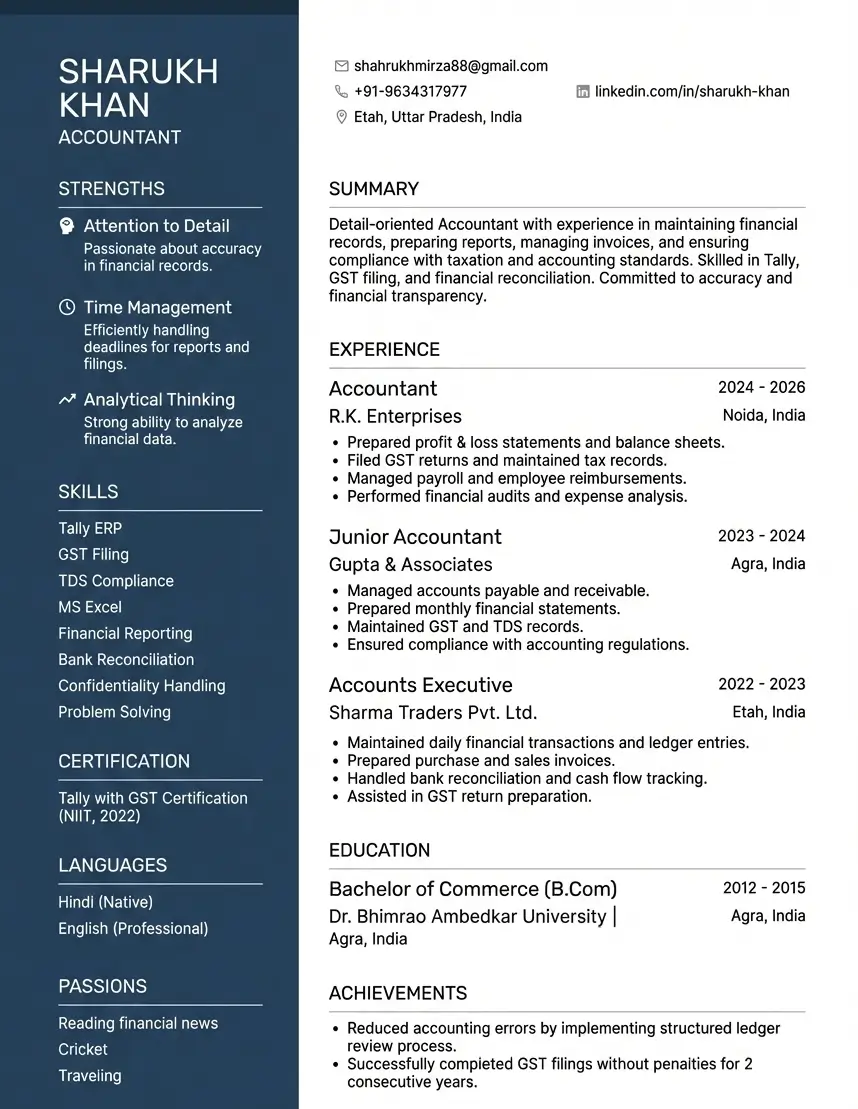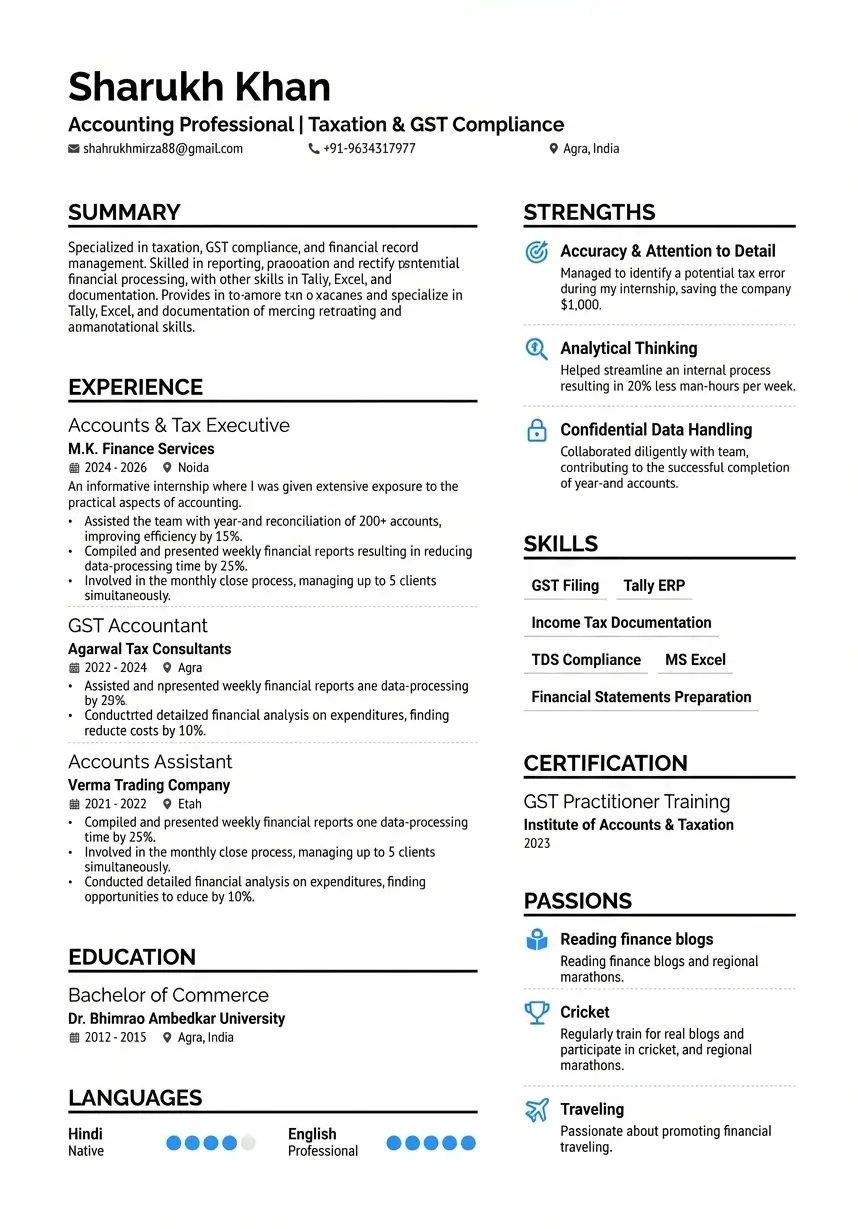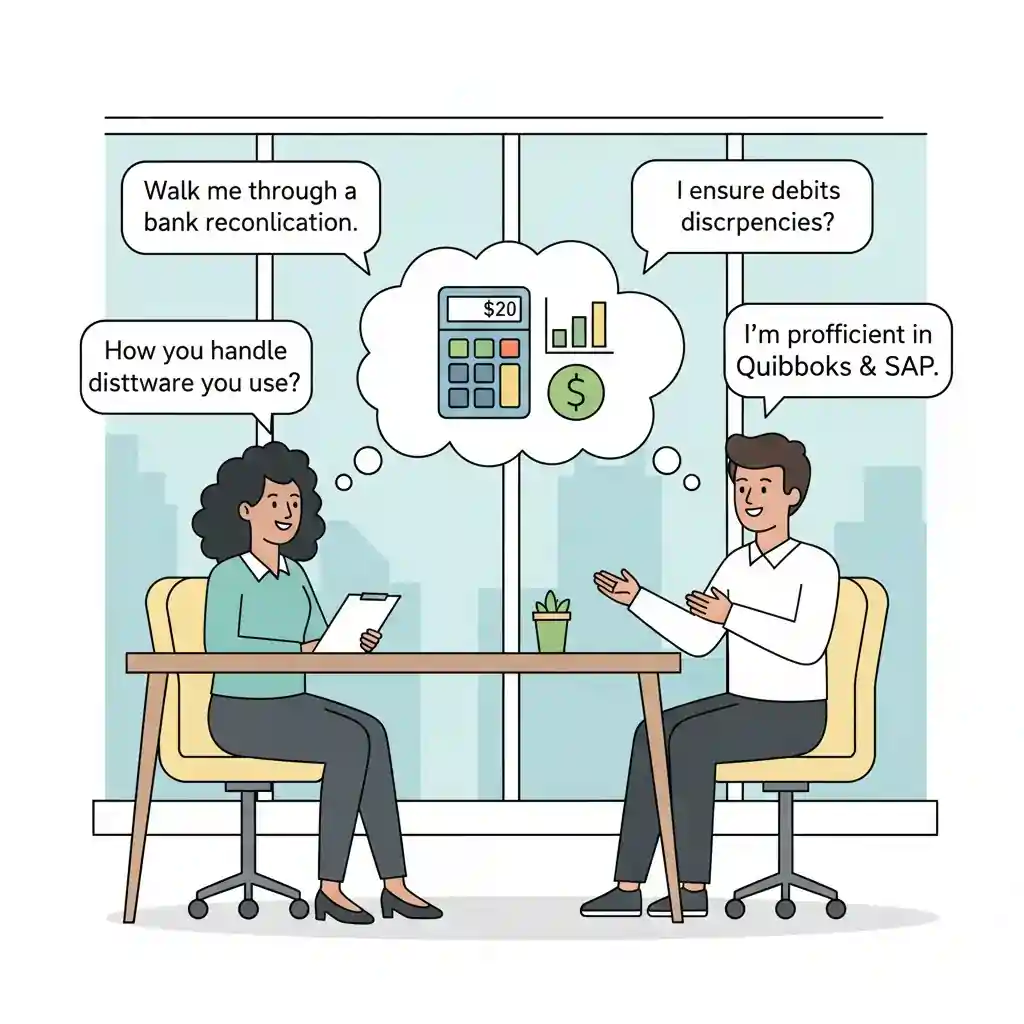
Landing an accounting job in India requires more than just a degree — it demands solid preparation for the interview questions and answers for accountant roles that recruiters ask every hiring season. Whether you are a fresher stepping into your first role or an experienced professional targeting a senior position, this guide covers everything you need. From basic bookkeeping to advanced GST compliance, these interview questions and answers for accountant positions will help you walk into any interview room with confidence. Before you start preparing, make sure your accountant resume format is also interview-ready — because first impressions start with your resume.
Table of Contents
1. Introduction
2. General & Behavioral Interview Questions
- Q1. Tell me about yourself as an accountant
- Q2. Why did you choose accounting as a profession?
- Q3. What are your strengths and weaknesses as an accountant?
- Q4. Where do you see yourself in 5 years?
- Q5. How do you handle work pressure during audits or tax season?
- Q6. Describe your work experience in accounting so far
- Q7. What motivates you in the accounting field?
- Q8. How do you manage accuracy under tight deadlines?
3. Basic Accounting Interview Questions
- Q9. What are the three main types of accounts?
- Q10. State the basic accounting equation
- Q11. What is double-entry bookkeeping?
- Q12. Difference between debit note and credit note
- Q13. What is working capital?
- Q14. Difference between depreciation and amortization
- Q15. Define trial balance and its purpose
- Q16. What is a journal entry? Give an example
- Q17. Accounts payable vs accounts receivable
- Q18. What is a ledger?
- Q19. Accrual accounting vs cash accounting
- Q20. Define balance sheet and its components
4. Technical & Advanced Interview Questions
- Q21. What are Indian Accounting Standards (Ind AS)?
- Q22. Explain the three financial statements and their connection
- Q23. What is GST? Explain CGST, SGST, and IGST
- Q24. What is a bank reconciliation statement (BRS)?
- Q25. What is contingent liability?
- Q26. What is bad debt and how is it treated?
- Q27. What is the quick ratio / acid test ratio?
- Q28. Can a profitable company go bankrupt? (Cash Flow vs Profit)
- Q29. What is deferred revenue?
- Q30. Define goodwill in accounting
- Q31. What is EBITDA?
- Q32. Gross profit vs net profit
- Q33. What are provisions and reserves?
- Q34. SLM vs WDV depreciation methods
- Q35. Internal audit vs external audit
5. Accounting Software & Technology Questions
- Q36. Which accounting software have you worked on?
- Q37. How do you use Tally for GST filing?
- Q38. Excel functions used in accounting
- Q39. How is AI and automation changing accounting?
- Q40. What is e-invoicing under GST?
- Q41. How do you generate MIS reports?
- Q42. Have you used any ERP system?
- Q43. How do you maintain data security in accounting systems?
6. Situational / Problem-Solving Questions (STAR Format)
- Q44. Describe a time you spotted a major error in a financial report
- Q45. How do you prioritize tasks during month-end closing?
- Q46. How do you handle a disagreement with a manager about financial figures?
- Q47. What would you do if a colleague was misreporting figures?
- Q48. How do you ensure compliance with changing tax laws?
7. Fresher Accountant Interview Questions
- Q49. What accounting concepts are you most confident about?
- Q50. Are you familiar with Tally?
- Q51. What accounting projects or internships have you done?
- Q52. How quickly can you learn new accounting software?
- Q53. How has your education prepared you for this role?
8. 5 Tips to Ace Your Accountant Interview
9. Common Mistakes to Avoid
10. Salary Negotiation Tips for Accountants
11. Frequently Asked Questions (FAQs)
12. Conclusion
Don’t let a weak resume decide your future.
Thousands of people are getting rejected — not because they’re bad, but because their resume doesn’t speak for them. Make a resume that actually gets shortlisted.
Your next job is closer than you think.
Start in 2 minutes.
No complicated forms. Just pick a template, fill details, And Apply.
Apply Now Your Job →Common & Behavioral Interview Questions
Common interview question and Behaviors interview question and andswer for accountat questions assess your personality, work ethic, and professional attitude. Interviewers use them to judge whether you are the right cultural fit for their team.
Q1. Tell me about yourself as an accountant.
Answer: Start with your educational background, then briefly cover your work experience and key skills. Example: "I am a B.Com graduate with 3 years of experience in accounts payable, GST filing, and monthly financial reporting. I have worked extensively with Tally Prime and Excel, and I am known for my accuracy and attention to detail. I am now looking for a role where I can contribute to a growing finance team." Keep your answer focused on professional achievements rather than personal details.
Q2. Why did you choose accounting as a profession?
Answer: Be genuine and specific. Example: "I have always been drawn to numbers and problem-solving. Accounting gives me the satisfaction of bringing financial clarity to a business. I enjoy the challenge of ensuring every figure balances correctly and that financial statements reflect the true picture of a company's health. It is a field where accuracy and integrity directly impact business decisions."
Q3. What are your strengths and weaknesses as an accountant?
Answer: Strengths: Highlight relevant skills — attention to detail, proficiency in Tally/Excel, deadline management, and knowledge of GST. Weakness: Choose a real weakness you are actively improving. Example: "My weakness is that I sometimes over-verify data which takes extra time, but I am working on building faster review checklists to improve my efficiency without compromising accuracy."
Q4. Where do you see yourself in 5 years?
Answer: Show ambition aligned with the company's growth. Example: "In 5 years, I see myself as a Senior Accountant or Finance Manager, leading a team and contributing to strategic financial planning. I plan to pursue my CMA certification in the next two years to strengthen my management accounting skills. I want to grow within an organization that values financial discipline and innovation."
Q5. How do you handle work pressure during audits or tax season?
Answer: "I prepare well in advance by organizing all necessary documents and creating a timeline before the audit period begins. I prioritize tasks by deadline and complexity, and I communicate proactively with the team to divide the workload. Staying calm under pressure comes from preparation — when my records are clean and updated throughout the year, the audit season becomes significantly less stressful."
Q6. Describe your work experience in accounting so far.
Answer: Mention specific responsibilities, software used, and achievements. Example: "In my current role, I handle daily bookkeeping, monthly bank reconciliation, GST return filing (GSTR-1, GSTR-3B), and preparation of P&L statements. I process around 200+ invoices per month and have reduced reconciliation time by 30% by creating standardized Excel templates. I also assist during statutory audits by preparing supporting schedules."
Q7. What motivates you in the accounting field?
Answer: "I am motivated by the impact of accurate financial reporting on business decisions. Knowing that my work helps management make informed investments and control costs gives me a strong sense of purpose. I also enjoy continuous learning in this field — tax laws, accounting standards, and technology are constantly evolving, and staying updated keeps me engaged and growing professionally."
Q8. How do you manage accuracy under tight deadlines?
Answer: "I use a combination of checklists, structured templates, and a priority-based task list to manage accuracy under pressure. I avoid multitasking during critical data entry or reconciliation work and always do a final review before submitting any report. I have learned that building good daily habits — such as updating ledgers the same day transactions occur — prevents last-minute errors during closing."
? Quick Tip: For more behavioral interview practice, check our guides on behavioral interview questions and common interview questions 2026.
Basic Accounting Interview Questions
These are the foundation questions every interviewer asks. Master these before your interview.
Q9. What are the three main types of accounts?
Answer: The three types of accounts in accounting are:
-
Personal Accounts — Accounts related to individuals, firms, or companies (e.g., debtors, creditors). Rule: Debit the receiver, Credit the giver.
-
Real Accounts — Accounts related to assets and properties (e.g., cash, machinery). Rule: Debit what comes in, Credit what goes out.
-
Nominal Accounts — Accounts related to expenses, losses, income, and gains (e.g., salary, rent). Rule: Debit all expenses/losses, Credit all incomes/gains.
Q10. State the basic accounting equation.
Answer: The fundamental accounting equation is:
Assets = Liabilities + Owner's Equity
This equation ensures that the balance sheet always balances. Every financial transaction affects at least two accounts and maintains this equation. For example, if a business takes a ₹5,00,000 loan, assets (cash) increase by ₹5,00,000 and liabilities (loan) also increase by ₹5,00,000.
Q11. What is double-entry bookkeeping?
Answer: Double-entry bookkeeping is the system where every financial transaction is recorded in at least two accounts — one account is debited and another is credited by an equal amount. This ensures the accounting equation stays balanced. For example, when a business sells goods worth ₹10,000 on credit: Debit Accounts Receivable ₹10,000 / Credit Sales ₹10,000. This system provides a complete and accurate financial picture and helps detect errors and fraud.
Q12. What is the difference between a debit note and a credit note?
| Feature | Debit Note | Credit Note |
|---|---|---|
| Issued by | Buyer | Seller |
| Purpose | To return goods or claim credit | To acknowledge return or reduce amount owed |
| Effect | Reduces amount payable | Reduces amount receivable |
| Example | Buyer returns damaged goods | Seller issues refund for returned items |
Q13. What is working capital?
Answer: Working Capital = Current Assets − Current Liabilities. It measures a company's short-term liquidity and operational efficiency. Positive working capital means the company can meet its short-term obligations. For example, if current assets are ₹15 lakhs and current liabilities are ₹10 lakhs, working capital is ₹5 lakhs — indicating good short-term financial health. Low or negative working capital signals potential cash flow problems.
Q14. What is the difference between depreciation and amortization?
| Feature | Depreciation | Amortization |
|---|---|---|
| Applies to | Tangible assets (machinery, vehicles) | Intangible assets (patents, goodwill) |
| Methods | SLM, WDV | Usually straight-line |
| Example | A machine depreciates over 10 years | A patent amortized over its legal life |
| Asset type | Physical assets | Non-physical assets |
Q15. Define trial balance and its purpose.
Answer: A trial balance is a bookkeeping worksheet that lists all ledger accounts and their debit or credit balances on a specific date. Its primary purpose is to verify that total debits equal total credits, confirming the mathematical accuracy of the accounting records. However, it does not guarantee the absence of all errors — it only checks arithmetic balance. It serves as the foundation for preparing final financial statements.
Q16. What is a journal entry? Give an example.
Answer: A journal entry is the first step of recording a financial transaction in the accounting system. It follows the double-entry system.
Example: When a company pays rent of ₹20,000:
-
Debit: Rent Expense ₹20,000
-
Credit: Cash/Bank ₹20,000
Each entry must include the date, accounts affected, amounts, and a brief narration explaining the transaction.
Q17. What is the difference between accounts payable and accounts receivable?
| Feature | Accounts Payable (AP) | Accounts Receivable (AR) |
|---|---|---|
| Meaning | Money owed by the company | Money owed to the company |
| Position | Liability on balance sheet | Asset on balance sheet |
| Example | Outstanding supplier invoice | Invoice raised on customer |
Q18. What is a ledger?
Answer: A ledger is the principal book of accounts that contains all the accounts of a business. After transactions are first recorded in the journal, they are transferred (posted) to the relevant ledger accounts. Each ledger account summarizes all debit and credit entries related to that specific account, making it easy to determine the closing balance. The ledger is the basis for preparing the trial balance and final financial statements.
Q19. What is accrual accounting vs cash accounting?
| Feature | Accrual Accounting | Cash Accounting |
|---|---|---|
| Revenue recorded | When earned | When cash is received |
| Expense recorded | When incurred | When cash is paid |
| Used by | Most companies (mandatory under Ind AS) | Small businesses, freelancers |
| Accuracy | More accurate | Simpler but less accurate |
Q20. Define balance sheet and its components.
Answer: A balance sheet is a financial statement that shows a company's financial position at a specific point in time. It has three main components:
-
Assets — Everything the company owns (current assets: cash, receivables; non-current assets: land, machinery)
-
Liabilities — Everything the company owes (current liabilities: payables, short-term loans; non-current: long-term debt)
-
Owner's Equity — The owner's share after subtracting liabilities from assets (share capital + retained earnings)
? Quick Tip: Always practice writing journal entries by hand before your interview — many interviewers ask candidates to demonstrate live.
Technical & Advanced Interview Questions
Technical interview questions separate average candidates from exceptional ones.
Q21. What are Indian Accounting Standards (Ind AS)?
Answer: Ind AS (Indian Accounting Standards) are a set of accounting standards issued by the Institute of Chartered Accountants of India (ICAI) under Section 133 of the Companies Act 2013. There are 29 Ind AS standards that align with International Financial Reporting Standards (IFRS). They govern how financial statements are prepared, ensuring consistency, transparency, and comparability. Mandatory for listed companies and large unlisted companies above certain thresholds.
Q22. Explain the three financial statements and how they connect.
Answer: The three core financial statements are:
-
Income Statement (P&L) — Shows revenue, expenses, and net profit/loss over a period
-
Balance Sheet — Shows assets, liabilities, and equity at a specific date
-
Cash Flow Statement — Shows cash inflows and outflows from operating, investing, and financing activities
Connection: Net profit from the income statement increases retained earnings on the balance sheet. The cash flow statement reconciles the opening and closing cash balance shown on the balance sheet.
Q23. What is GST? Explain CGST, SGST, and IGST.
Answer: GST (Goods and Services Tax) is a unified indirect tax on the supply of goods and services across India, replacing multiple earlier taxes. There are five tax slabs: 0%, 5%, 12%, 18%, and 28%.
| Type | Full Form | Levied by | Applicable On |
|---|---|---|---|
| CGST | Central GST | Central Government | Intra-state transactions |
| SGST | State GST | State Government | Intra-state transactions |
| IGST | Integrated GST | Central Government | Inter-state transactions & imports |
| UTGST | Union Territory GST | UT Administration | Transactions in Union Territories |
Q24. What is a bank reconciliation statement (BRS)?
Answer: A Bank Reconciliation Statement is a document that matches the cash balance in a company's books with the balance shown on its bank statement. Differences arise due to outstanding cheques, deposits in transit, bank charges, or errors. BRS is prepared monthly to detect discrepancies, prevent fraud, and ensure accurate cash reporting. The process involves starting with the bank balance, adding/subtracting timing differences to arrive at the book balance.
Q25. What is contingent liability?
Answer: A contingent liability is a potential obligation that may arise depending on the outcome of a future event — such as a pending lawsuit or a product warranty claim. It is recorded in financial statements only if the liability is probable and the amount can be reasonably estimated. If only possible but not probable, it is disclosed in the notes to accounts. Example: A company facing a ₹50 lakh lawsuit discloses it as a contingent liability.
Q26. What is bad debt and how is it treated?
Answer: Bad debt is the amount owed by a customer that is considered unrecoverable. It is treated as an expense:
-
Direct Write-off Method: Debit Bad Debt Expense / Credit Accounts Receivable when confirmed irrecoverable
-
Allowance Method: A provision for doubtful debts is created in advance: Debit Bad Debt Expense / Credit Provision for Bad Debts
Under Ind AS, the Expected Credit Loss (ECL) model is used to estimate and provision for bad debts proactively.
Q27. What is the quick ratio / acid test ratio?
Answer: Quick Ratio = (Current Assets − Inventory − Prepaid Expenses) / Current Liabilities
It measures a company's ability to meet short-term liabilities using only its most liquid assets, excluding inventory (which may not convert to cash quickly). A quick ratio of 1:1 or above is generally considered healthy. It is a stricter liquidity measure than the current ratio, making it especially useful for manufacturing companies with large inventory.
Q28. Can a profitable company go bankrupt? (Cash Flow vs Profit)
Answer: Yes. This is one of the most important accounting concepts. A company can show profit on paper (accrual basis) but still run out of cash. Example: If a company sells goods worth ₹1 crore on credit but customers don't pay for 6 months, the company shows profit but has no cash to pay salaries or suppliers. Cash flow measures actual money movement; profit measures accounting income. Always monitor both, especially during rapid growth phases.
Q29. What is deferred revenue?
Answer: Deferred revenue (also called unearned revenue) is money received by a company before it has delivered the related goods or services. It is recorded as a liability on the balance sheet because the company still owes the service. Example: A software company receives ₹1,20,000 annual subscription upfront — it recognizes ₹10,000 as revenue each month and the remaining amount stays as deferred revenue until the service is delivered.
Q30. Define goodwill in accounting.
Answer: Goodwill is an intangible asset that arises when a company is acquired for more than the fair value of its net identifiable assets. It represents the premium paid for brand reputation, customer relationships, employee expertise, and market position. Example: If a company's net assets are worth ₹5 crore but it is acquired for ₹7 crore, the ₹2 crore difference is recorded as goodwill. Under Ind AS 36, goodwill is tested for impairment annually rather than amortized.
Q31. What is EBITDA?
Answer: EBITDA = Earnings Before Interest, Taxes, Depreciation, and Amortization. It measures a company's core operational profitability, excluding the effects of financing decisions and non-cash charges. It is widely used in business valuation, comparing companies across industries, and assessing debt repayment capacity. Example: If a company has operating profit of ₹50 lakhs, adds back depreciation of ₹10 lakhs, EBITDA = ₹60 lakhs.
Q32. Difference between gross profit and net profit?
| Feature | Gross Profit | Net Profit |
|---|---|---|
| Formula | Revenue − Cost of Goods Sold | Revenue − All Expenses (including taxes) |
| Reflects | Production/trading efficiency | Overall business profitability |
| Position in P&L | Appears first | Appears at the bottom ("bottom line") |
Q33. What are provisions and reserves?
Answer: Provision is an amount set aside for a known future liability whose amount is uncertain (e.g., provision for bad debts, provision for tax). It is a charge against profit. Reserve is an appropriation of profit kept for specific or general future purposes (e.g., General Reserve, Capital Reserve). The key difference: provisions are mandatory for known liabilities; reserves are created at management's discretion from profits.
Q34. How do you calculate depreciation using SLM and WDV?
| Method | Formula | Key Feature |
|---|---|---|
| SLM (Straight Line) | (Cost − Scrap Value) / Useful Life | Equal amount each year |
| WDV (Written Down Value) | Opening Book Value × Depreciation Rate% | Higher in early years, decreases over time |
Example (SLM): Machine cost ₹1,00,000, scrap value ₹10,000, life 9 years → Depreciation = ₹10,000/year
Example (WDV): Book value ₹1,00,000, rate 20% → Year 1: ₹20,000; Year 2: ₹16,000
Q35. What is internal audit vs external audit?
| Feature | Internal Audit | External Audit |
|---|---|---|
| Conducted by | Company's own staff or internal team | Independent external auditors (CA firm) |
| Purpose | Operational efficiency, internal controls | Verify accuracy of financial statements |
| Frequency | Ongoing / quarterly | Annually |
| Report goes to | Management | Shareholders, regulators |
? Quick Tip: For more technical preparation, also read our 50 technical interview questions and answers.
Accounting Software & Technology Questions
Tally, Excel, and ERP proficiency are non-negotiable in most Indian accounting jobs.
Q36. Which accounting software have you worked on?
Answer: "I am proficient in Tally Prime and Tally ERP 9 for day-to-day bookkeeping, GST filing, and payroll management. I have also worked with MS Excel for financial modeling, MIS reports, and data analysis using VLOOKUP, SUMIF, and pivot tables. I have basic exposure to Zoho Books and have studied the fundamentals of SAP FICO through online training. I am a quick learner and can adapt to any accounting software within a short period."
Q37. How do you use Tally for GST filing?
Answer: In Tally Prime, GST filing involves:
-
Enabling GST in company features and setting the correct GSTIN
-
Recording sales and purchase vouchers with correct HSN codes and GST rates
-
Generating GSTR-1 (outward supplies) and GSTR-3B (monthly summary return) directly from the Gateway of Tally
-
Reconciling books with the GSTR-2A/2B portal data for Input Tax Credit (ITC) matching
-
Exporting the JSON file from Tally and uploading it on the GST portal
Q38. What Excel functions do you use regularly in accounting?
Answer: Key Excel functions for accountants include:
-
VLOOKUP / XLOOKUP — For matching data across sheets (e.g., reconciling vendor invoices)
-
SUMIF / SUMIFS — For conditional totals (e.g., total sales by region)
-
IF / Nested IF — For conditional logic in reports
-
Pivot Tables — For summarizing and analyzing large datasets
-
INDEX-MATCH — More flexible alternative to VLOOKUP
-
IFERROR — For handling errors in formulas
-
TEXT & DATE functions — For formatting financial data
Q39. How is AI and automation changing the accounting profession?
Answer: AI and automation are transforming accounting by handling repetitive tasks like data entry, invoice processing, and bank reconciliation. Tools like RPA (Robotic Process Automation) reduce manual errors and speed up month-end closing. However, automation elevates the accountant's role — professionals must now focus on financial analysis, strategic planning, and compliance advisory rather than manual bookkeeping. The key is to embrace technology as a tool that enhances accuracy and frees time for higher-value work.
Q40. What is e-invoicing under GST?
Answer: E-invoicing is a system under GST where B2B invoices are authenticated by the Invoice Registration Portal (IRP) and assigned a unique IRN (Invoice Reference Number) and QR code. It is mandatory for businesses with an annual aggregate turnover exceeding ₹5 crore. E-invoicing reduces tax evasion, enables real-time data sharing with the GST portal, and auto-populates GSTR-1 data, significantly reducing manual data entry.
Q41. How do you generate MIS reports?
Answer: MIS (Management Information System) reports are prepared to provide management with timely financial and operational data. The process involves:
-
Gathering data from Tally, ERP, or Excel
-
Organizing by department, cost center, or product line
-
Creating structured Excel dashboards with charts and KPIs (revenue, expenses, variance analysis)
-
Presenting in clear format: P&L summary, cash flow status, debtor/creditor aging
-
Sharing on a weekly or monthly schedule with senior management for decision-making
Q42. Have you used any ERP system?
Answer: "I have experience working on Tally Prime, which functions as an ERP system covering accounting, inventory, payroll, and GST compliance. I have also attended training sessions on SAP FICO modules, understanding how journal entries, vendor/customer master data, and financial reporting work within SAP. I am confident in learning any new ERP system quickly, as the core accounting principles remain the same across platforms."
Q43. How do you maintain data security in accounting systems?
Answer: Data security in accounting involves:
-
Using role-based access control — restricting user permissions in Tally/ERP to their designated tasks
-
Regular data backups on secure servers or cloud storage
-
Using strong passwords and enabling two-factor authentication
-
Keeping software and antivirus programs updated
-
Maintaining an audit trail of all changes made to financial data
-
Following company data security policies and never sharing login credentials
? Quick Tip: Even if you haven't used SAP, mention your willingness to learn it — many companies use SAP and value adaptable candidates.
Situational / Problem-Solving Questions
Use the STAR Format — Situation, Task, Action, Result — for all answers in situational interview question and answer section.
Q44. Describe a time you spotted a major error in a financial report.
Answer (STAR): "During quarterly closing at my previous job (S), I was reviewing the trial balance and noticed the depreciation figure was unusually low (T). I cross-checked the fixed asset register and found that 3 assets had not been depreciated for the quarter due to a data entry error in Tally (A). I corrected the entries, recalculated the correct depreciation, and updated the P&L before the report was submitted to management — preventing a ₹2.5 lakh misstatement (R)."
Q45. How do you prioritize tasks during month-end closing?
Answer (STAR): "I create a month-end checklist at the start of every month with deadlines for each task. I prioritize: (1) bank reconciliation, (2) expense accruals, (3) ledger reconciliation, (4) intercompany entries, and (5) financial statement preparation. I communicate with the team early if I anticipate delays and flag any unresolved issues to my manager by the 25th of the month, ensuring the closing is completed by the 3rd working day of the following month."
Q46. How do you handle a disagreement with a manager about financial figures?
Answer: "I would first re-examine my own figures to ensure I have not made an error. If I remain confident in my numbers, I would present my analysis calmly with supporting documentation — ledger entries, invoices, or calculations. I believe in resolving such disagreements through data, not opinion. If the disagreement persists, I would suggest involving a senior colleague or auditor for an objective review, as accuracy in financial reporting is a non-negotiable responsibility."
Q47. What would you do if you discovered a colleague was misreporting figures?
Answer: "I would first document what I found — specific entries, amounts, and dates — to ensure I have clear evidence. I would then approach my reporting manager or the internal audit team confidentially, following the company's whistleblower policy. I would not confront the colleague directly, as this could compromise the investigation. Financial integrity is fundamental to my role, and I would always prioritize accuracy and compliance over personal relationships."
Q48. How do you ensure compliance with changing tax laws?
Answer: "I subscribe to CBIC notifications and GST Council updates, follow ICAI's official publications, and regularly read finance news platforms. I also attend webinars on tax updates and have joined professional accounting forums. Within my organization, I maintain a compliance calendar with all filing deadlines and flag any regulatory changes to the CFO immediately upon notification. Staying proactive ensures we never miss a compliance requirement."
? Quick Tip: Practice all situational answers using the STAR format. See our situational interview questions guide and job interview questions for more examples.
Fresher Accountant Interview Questions
If you are applying for your first accounting job, expect these questions.
Q49. As a fresher, what accounting concepts are you most confident about?
Answer: "I am most confident in double-entry bookkeeping, journal entries, ledger posting, and preparation of trial balance. During my B.Com, I completed a project on preparing final accounts for a small trading firm, which gave me hands-on practice. I am also comfortable with basic Tally operations including voucher entry, ledger creation, and generating financial reports. I am eager to apply and expand this knowledge in a professional environment."
Q50. Are you familiar with Tally? Have you practiced it during your studies?
Answer: "Yes, I have practiced Tally Prime during my graduation. I can create companies, manage ledgers, pass different types of vouchers (payment, receipt, journal, sales, purchase), enable GST in Tally, and generate basic financial reports including trial balance and balance sheet. I have also self-studied Tally GST configuration through YouTube tutorials. I am ready to work on live data from day one."
Q51. What accounting projects or internships have you done?
Answer: Even if limited, present what you have done confidently. Example: "During my final year, I completed a 2-month internship with a CA firm where I assisted in data entry for GST returns, bank statement reconciliation, and organizing audit files. I also independently prepared the complete set of final accounts for a small retailer as my college project. These experiences taught me the importance of accuracy, deadlines, and professional documentation."
Q52. How quickly can you learn new accounting software?
Answer: "I am comfortable with technology and learn new software quickly. I taught myself Tally Prime through tutorials within 3 weeks during my studies. Given that all accounting software follows similar principles — chart of accounts, voucher types, and financial reporting — I am confident I can become productive on any new platform within 1–2 weeks with proper guidance and practice."
Q53. How has your education prepared you for this accounting role?
Answer: "My B.Com curriculum gave me a strong foundation in financial accounting, cost accounting, taxation, and business law. I studied topics like depreciation methods, final accounts preparation, GST basics, and income tax fundamentals. Apart from academics, I stayed current with real-world applications by following the ICAI website, studying GST council updates, and practicing Tally independently. I feel prepared to handle entry-level accounting tasks and am eager to learn further on the job."
? Quick Tip: If you're a fresher, build a strong foundation with our fresher resume format for India guide before applying.
5 Tips to Ace Your Accountant Interview
-
Research the company's financial health — Check their annual reports, recent news, and industry position. Knowing their revenue scale and business model shows genuine interest.
-
Revise key formulas and ratios — Quick ratio, current ratio, EBITDA, working capital, and depreciation calculations are commonly tested.
-
Practice Tally and Excel hands-on — Interviewers often ask for live demonstrations or describe specific tasks. Practice creating ledgers, passing vouchers, and generating GST reports.
-
Prepare 2–3 STAR examples — Have specific stories ready for behavioral questions about handling errors, meeting deadlines, and dealing with difficult situations.
-
Carry a complete document folder — Bring your resume, certificates (graduation, Tally certification, CA marksheets), and government ID. Being organized creates a strong impression.
Also read our 16 proven tips to ace your job interview to further boost your confidence.
Common Mistakes to Avoid in Accountant Interviews
-
Not knowing basic formulas — Not remembering the accounting equation or ratio formulas signals poor preparation
-
Being vague about Tally experience — Say exactly which features you have used; vague answers raise doubts
-
Skipping GST knowledge — In India, GST is mandatory knowledge for every accountant
-
Ignoring Ind AS updates — For experienced candidates, not knowing current accounting standards is a red flag
-
Failing to give concrete examples — Saying "I am hardworking" without an example is unconvincing
-
Not researching the company — Not knowing the company's industry or scale shows lack of seriousness
-
Weak numerical communication — Accountants must speak confidently using numbers, percentages, and ratios
-
Salary discussion too early — Avoid mentioning salary expectations before the interviewer brings it up
Salary Negotiation Tips for Accountants
-
Know your market value — Research salary ranges on Naukri, LinkedIn, and Glassdoor for your city, experience level, and role. Entry-level accountants in Delhi/Mumbai typically earn ₹2–3.5 LPA; senior accountants with 5+ years earn ₹5–10 LPA.
-
Highlight certifications — CA, CMA, or CPA certifications justify higher compensation. Always mention them during salary discussions.
-
Wait for the right moment — Never bring up salary expectations until the interviewer initiates the conversation or you have received a positive interest signal.
-
Use data to justify your ask — Quantify your contributions: "In my last role, I identified a ₹3 lakh tax saving through better ITC utilization — I believe my skills justify a salary of ₹X."
-
Consider the full package — Evaluate health insurance, PF contributions, annual bonus, and growth opportunities alongside the base salary.
You're Interview-Ready — Now Perfect Your Resume
Now that you're fully prepared with these interview questions and answers for accountant roles, the next step is making sure your resume is equally impressive. Use ResumeEra's free resume builder to create a professional accountant resume in minutes. Also explore our complete library of interview experience questions and tips and strengthen your application by checking our guide on 10 essential resume sections in 2026. Your dream accounting job is just one great interview away — go get it!
Free Resume To Download And Edit