How to Write a Resume Summary That Gets Recruiters' Attention
Recruiters spend an average of 6–8 seconds reviewing a resume. Your resume summary is what they see first. If it doesn't immediately communicate your value, your application goes into the rejection pile—regardless of how impressive the rest of your resume is.
In India's competitive job market, where thousands of applications flood hiring portals weekly, a well-crafted resume summary isn't optional—it's essential. Whether you're a fresher competing against other graduates or an experienced professional seeking advancement, your summary must work harder than any other section of your resume.
This guide covers exactly what you need to know: what a resume summary is, why recruiters notice it, how to write one from scratch, real examples for different career stages, ATS-friendly strategies, and the mistakes most people make.
? What's in This Guide
- What Is a Resume Summary?
- Why Your Resume Summary Matters to Recruiters
- How to Write a Resume Summary: Step-by-Step
- Resume Summary Examples for Freshers
- Resume Summary Examples for Experienced Professionals
- Making Your Resume Summary ATS-Friendly
- 7 Common Mistakes (And How to Avoid Them)
- Actionable Tips to Get Started Now
- Frequently Asked Questions
What Is a Resume Summary?
A resume summary is a 2–4 sentence overview placed at the top of your resume that highlights your professional identity, core strengths, and key accomplishments. It answers a simple question: Who are you professionally, and what value do you bring?
Definition (Featured Snippet)
A resume summary is a concise, tailored statement (typically 40–80 words) placed above your work experience that emphasizes your most relevant skills, achievements, and professional value to a specific employer.
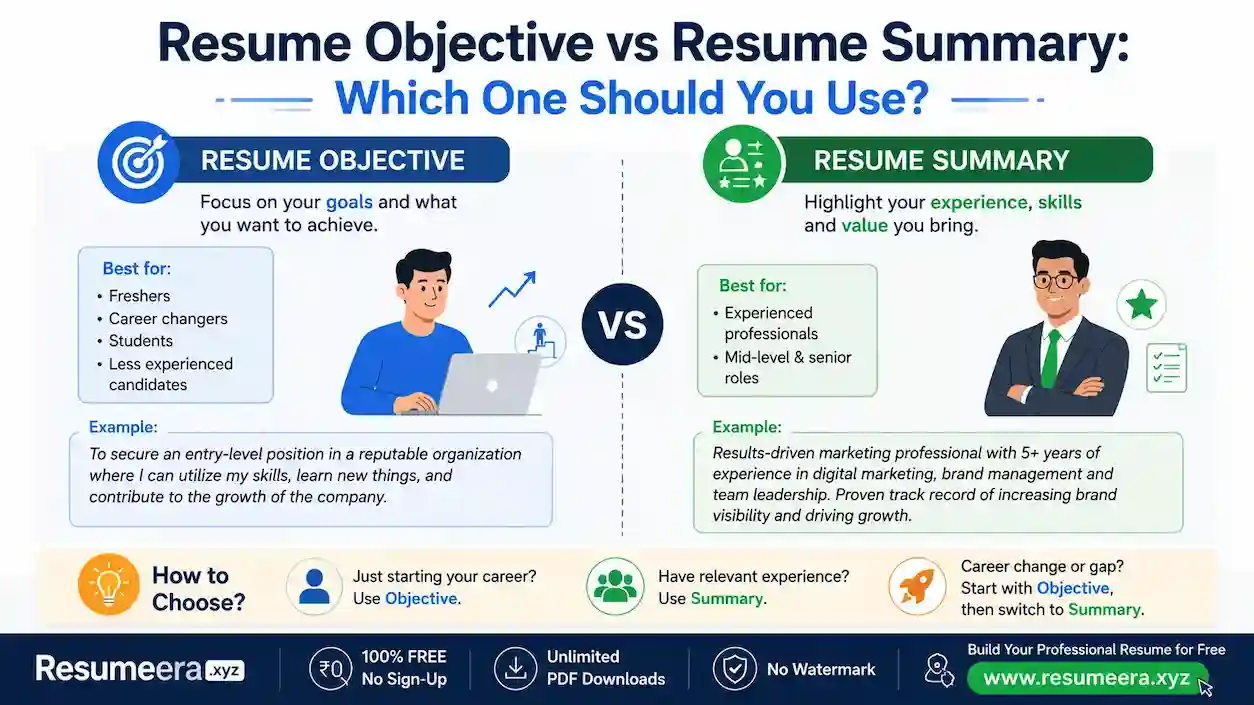
Unlike a career objective (which focuses on what you want), a resume summary focuses on what you've accomplished and what you offer. Think of it as your professional elevator pitch—a chance to frame your candidacy before the recruiter reads the details.
Summary vs. Objective: What's the Difference?
Recruiters prefer summaries because they demonstrate what you can do, not what you want them to do for you. A summary says "here's my proven track record." An objective says "here's what I need."
Why Your Resume Summary Matters to Recruiters
Here's the reality: recruiters aren't reading your resume closely. They're scanning it. Your resume summary is your chance to make them want to keep reading.
Three Reasons Recruiters Notice Your Summary
- It saves them time. A strong summary lets recruiters immediately understand your background without reading every detail. They can decide in seconds if you're worth learning more about.
- It shows self-awareness. A well-written summary proves you understand your own value proposition and can communicate it clearly—a rare skill.
- It demonstrates attention to detail. If your summary contains errors or vague language, recruiters assume the rest of your application does too. A polished summary signals professionalism.
Beyond human readers, your resume summary also serves a technical purpose: it helps you pass ATS (Applicant Tracking System) screening. More on that later.
How to Write a Resume Summary: Step-by-Step
Writing an effective resume summary follows a simple formula. Follow these steps to create one that works.
Step 1: Start with Your Professional Title or Role
Begin with your current or target position. Example: "Senior Marketing Manager," "Full-Stack Developer," or "MBA Finance Graduate." This immediately tells recruiters what level you're at.
Step 2: Add 2–3 Core Competencies Relevant to the Job
Don't list random skills. Pick the 2–3 most relevant to the job you're applying for. Instead of "good communication skills," be specific: "SEO optimization," "project management," "financial analysis."
Step 3: Include a Quantifiable Achievement
This is what sets a good summary apart. Numbers are memorable and credible. Instead of "improved sales," say "increased sales by 35% in Q3." Instead of "led a team," say "managed a cross-functional team of 12 across India."
Step 4: Tailor It for Every Application
Your resume summary should mirror the job description. If they emphasize "project management," mention it. If they need "data analysis," highlight it. This takes 2 minutes per application and dramatically improves your chances.
Step 5: Keep It Brief (50–80 Words Maximum)
Recruiters won't read a paragraph. Aim for 2–4 lines. Every word should earn its place. Remove filler language like "hardworking," "passionate," or "results-oriented."
Resume Summary Examples for Freshers
Freshers worry they don't have enough work experience for a summary. They're wrong. Your summary should focus on education, internships, projects, and transferable skills. Here are real examples across different fields.
Example 1: IT/Software Development Fresher
B.Tech Computer Science graduate with expertise in Java, Python, and full-stack web development. Completed 3 internships building scalable applications and 2 personal projects on GitHub with 500+ stars combined. Seeking entry-level developer role to contribute to innovative solutions.
Example 2: Commerce/Finance Fresher
MBA Finance graduate with 6-month internship in financial analysis and GST compliance. Proficient in Excel, Tally ERP 9, and financial modeling. Completed capstone project analyzing ₹500 crore investment portfolio. Seeking finance analyst role to leverage analytical skills.
Example 3: HR/Recruitment Fresher
BBA graduate with 6-month HR internship sourcing candidates, coordinating interviews, and managing onboarding for 50+ hires. Skilled in HRIS systems, candidate engagement, and recruitment planning. Seeking HR coordinator role to build strong teams and improve workplace culture.
Resume Summary Examples for Experienced Professionals
For experienced professionals, your resume summary should emphasize leadership, measurable results, and industry expertise. Here's how to position yourself for senior roles.
Example 1: Senior Sales Manager (8 Years Experience)
Sales Manager with 8 years driving revenue growth across FMCG and E-commerce. Led 15-person teams achieving 40% revenue increase and 15% market expansion. Expert in team development, complex negotiations, and customer retention. Seeking Regional Manager role to scale teams and drive profitability.
Example 2: Project Manager (6 Years Experience)
Certified Project Manager (PMP) with 6 years delivering 15+ IT projects worth ₹50+ crores, consistently on time and within budget. Skilled in Agile, SCRUM, and stakeholder management. Reduced project costs by 22% through process optimization and mentored 5 junior managers to promotion.
Example 3: Marketing Director (9 Years Experience)
Digital Marketing Director with 9 years building brands for startups and enterprises. Increased organic traffic by 200%, improved conversion rates by 35%, managed budgets up to ₹1 crore. Led 8-person team and mentored 3 promotions. Seeking VP role to drive marketing innovation and growth.
Notice the pattern: every experienced example includes specific numbers, years of experience, leadership metrics, and the outcomes they delivered. That's what sets senior profiles apart.
Making Your Resume Summary ATS-Friendly
Before a human recruiter reads your resume, it passes through an Applicant Tracking System (ATS). Your resume summary must be optimized for both humans and machines.
The ATS-Friendly Approach
- Use job description keywords: If the posting says "project management" and "SAP," use those exact terms in your summary. ATS scans for keyword matches.
- Use industry-standard terminology: Replace vague language with specific terms. Instead of "good with computers," say "Python," "SQL," or "Salesforce."
- Include both hard and soft skills: Mix technical skills (AWS, Excel, Figma) with professional skills (leadership, stakeholder management).
- Use recognizable acronyms: PMP, MBA, CPA, AWS, SEO—spell them out once, then use the acronym.
Formatting for ATS Compatibility
- Keep your summary to 2–4 simple lines
- Use clear, scannable language (not flowery prose)
- Place it immediately after your contact info
- Avoid special characters (©, ®, ™, etc.)
- Save and submit as .docx or .pdf based on the job posting
7 Common Mistakes (And How to Avoid Them)
Here's what goes wrong in most resume summaries—and how to fix it.
Mistake 1: Being Too Generic
Mistake 2: Focusing on What You Want, Not What You Offer
Mistake 3: Making Claims Without Evidence
Mistake 4: Using Outdated or Clichéd Language
Mistake 5: Using the Same Summary for Every Job
This is a major missed opportunity. Customizing your summary for each role takes 2 minutes and improves your ATS score and recruiter impression significantly. Your summary should reflect the specific job you're applying for.
Mistake 6: Overstuffing with Skills
Listing 15 skills in your summary defeats the purpose. Pick the top 2–3 most relevant to the specific job. Expand on skills later in a dedicated skills section.
Mistake 7: Including Personal Details
Your summary isn't the place for personal interests, hobbies, or life philosophy. Keep it professional and focused on your professional identity and accomplishments.
Actionable Tips to Get Started Now
The Achievement Formula
Example: "Senior software engineer with 5 years designing microservices. Led team that reduced API response time by 45%. Seeking architect role to drive technical innovation."
Use Strong Action Verbs
Replace weak verbs with powerful ones. Instead of "worked on," use: spearheaded, championed, optimized, transformed, accelerated, scaled, pioneered, launched, revolutionized, orchestrated.
Apply the "So What?" Test
After each statement, ask "So what?" If you can't answer with impact or proof, rewrite it.
Example: "I have leadership experience" → "So what?" → "I led a team of 15 and improved retention by 25%."
Get Feedback From Someone Else
Have a mentor, peer, or experienced professional review your summary. What seems clear to you might sound vague to others.
Use ResumeEra.xyz's Free Resume Builder
Don't waste time formatting. Use ResumeEra.xyz's free resume builder to create your entire resume with a professional summary at the top. No signup required, no login, unlimited PDF downloads, zero watermarks. It automatically formats your resume for ATS compatibility while keeping it visually appealing.
Frequently Asked Questions
What's the difference between a resume summary and a resume objective?
Summary: Highlights your accomplishments and what you bring to the employer. Best for all job seekers, especially experienced professionals. Objective: States what you want from the employer. Generally dated and less preferred, except for career changers.
How many words should my resume summary be?
Keep it to 50–80 words (2–4 lines maximum). Recruiters spend 6–8 seconds on your resume. Your summary needs to be instantly skimmable. If it's longer, it contains fluff—cut it.
Should I use the same resume summary for every job?
No. Tailor your summary for each role. Spend 2 minutes mirroring the job description's language and priorities. This improves both your ATS score and your appeal to recruiters reading manually.
Can freshers write a resume summary?
Yes, absolutely. Use your resume summary to highlight education, internships, projects, relevant coursework, and core competencies. It compensates for limited work experience and demonstrates professionalism.
What if I'm changing careers?
Focus on transferable skills. Example: "IT professional transitioning to product management with 5 years of technical expertise, customer feedback analysis, and cross-team collaboration. Seeking PM role to leverage tech background and user-centric mindset."
Do I need numbers in my resume summary?
Strongly recommended. Numbers make achievements concrete and memorable. "Increased revenue" is forgettable. "Increased revenue by 35%" is unforgettable. Use metrics whenever possible.
How do I write an ATS-friendly resume summary?
Use keywords from the job posting, industry-standard terminology, and clear formatting. Avoid graphics, special characters, and unusual fonts. Keep it simple, scannable, and keyword-rich without stuffing.
Should I include personal details in my resume summary?
No. Your summary is professional, not personal. Focus on your professional identity, skills, and achievements. Personal interests can go in a separate section if relevant to the role.
Final Takeaway: Your Resume Summary Is Your Professional Headline
Your resume summary is your chance to make a first impression when it matters most. In 50–80 words, you must convince a busy recruiter that you're worth an interview. Make every word count.
Remember the core principles:
- Focus on what you've accomplished, not what you want
- Include quantifiable results whenever possible
- Tailor for each job application
- Keep it short and scannable (50–80 words)
- Use ATS-friendly formatting with relevant keywords
- Follow examples as templates, not scripts
Ready to create a winning resume? Use ResumeEra.xyz's free resume builder to craft your entire resume with a professional summary at the top. No signup, no fees, unlimited downloads.
Start building your professional resume summary today and land that interview tomorrow. ?