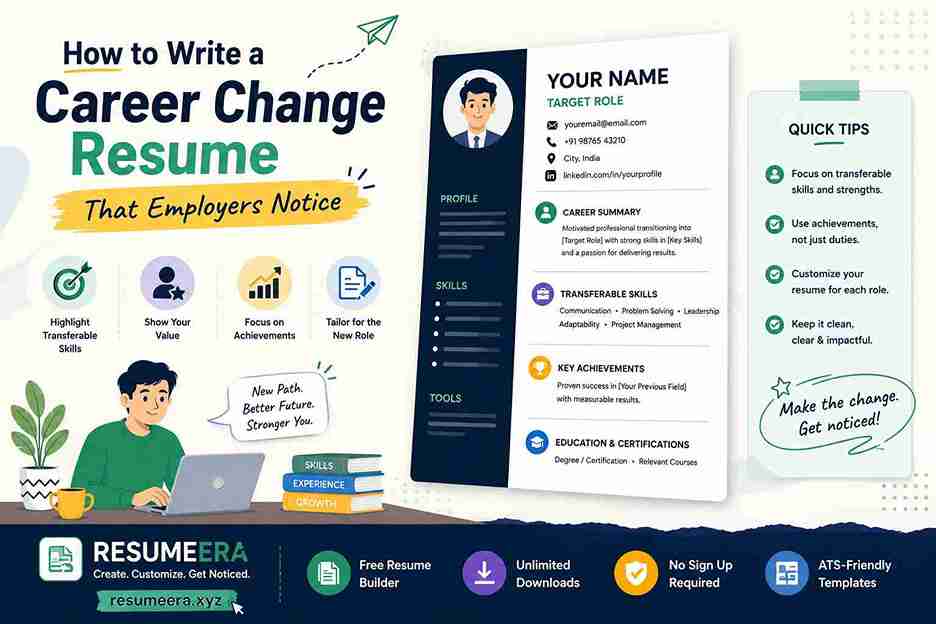
Switching fields is exciting—right up until you face a blank page. A career change resume has one goal: prove you can hit the ground running in a new role, even if your last job title says something else.
The playbook isn’t mysterious. You’ll frame your best wins in the language of the target job, keep the format clean for scanners and software, and back every claim with simple numbers. Do that, and hiring managers will look twice.
In 2026, more professionals than ever are pivoting industries. Hybrid (combination) formats that lead with transferable skills outperform pure chronological resumes for career changers by a significant margin in callback rates. Modern ATS systems use semantic matching and weight skills sections heavily, so a well-structured career transition resume can pass filters even when job titles do not match. The key is clarity, relevance, and evidence—not apology.
This complete guide expands proven strategies into a research-backed blueprint. You will learn exactly what a strong career change resume must prove, the best format and structure, how to write high-impact sections, tailor for ATS, avoid common pitfalls, and take clear next steps—with interlinked free resources from ResumeEra.
Table of Contents
- What a Career Change Resume Must Prove
- Format and Structure That Make Sense
- Write the Sections That Employers Scan First
- Tailor to the Job and ATS Without Guesswork
- Common Pitfalls and Quick Fixes
- Your Next Step: A Focused Career Change Resume
- Frequently Asked Questions
- Conclusion
What a Career Change Resume Must Prove
A strong career transition resume shows you understand the business problem, have done similar work in another context, and can produce results quickly. It connects past achievements to future needs without fluff.
Your resume for career switch should make it obvious which role you want and why you’re qualified. That means picking relevant wins, translating jargon, and trimming anything that distracts from the main story.
Hiring managers and ATS systems look for three signals:
- Relevance — Clear alignment between your past results and the target role’s requirements.
- Transferable skills — Evidence that competencies such as leadership, analysis, communication, project delivery, or process improvement already exist and can transfer.
- Impact — Quantified outcomes (percentages, dollars, time saved, volume) rather than vague adjectives.
Research consistently shows that 71% of hiring managers explicitly look for transferable skills when evaluating career changers, and hybrid formats that surface those skills early improve perceived fit. Avoid defensive language or lengthy explanations about why you are leaving your old field. Stay forward-focused and confident.
For a deeper dive into mapping skills across industries, see ResumeEra’s dedicated transferable skills on a resume guide and the comprehensive how to change careers for Indian professionals resource.
Format and Structure That Make Sense
Choose a format that sells your story. If your background spans different fields, a hybrid (combination) format is the strongest choice for most career changers in 2026. It looks like a classic career change CV but leads with a targeted summary and skills section. Then keep experience in reverse-chronological order so timelines stay transparent.
Why Hybrid Wins for Career Changers
- Chronological — Excellent ATS parse rates but foregrounds unrelated job titles, which can hurt first impressions.
- Functional — Skills-focused but often raises red flags with recruiters and scores poorly with many ATS systems.
- Hybrid / Combination — Best balance. Leads with summary + core competencies, then full dated work history. ATS parse accuracy remains high (typically 89–94%), while human readers see relevant skills first. Studies show hybrid formats deliver significantly higher callback rates for career changers.
Create a small skills block that reads like a focused transferable skills resume. Group hard skills by theme—tools, methods, domain—and list only what you can discuss in detail during an interview. Keep the entire document to one page when possible (or two only if the second page contains clearly relevant impact).
Recommended section order:
- Contact information
- Professional summary (career-change pitch)
- Core skills / Transferable competencies
- Professional experience (reframed bullets)
- Projects or relevant side work (optional but powerful)
- Education & certifications (most relevant first)
Explore detailed format comparisons and free templates on ResumeEra: combination resume format, career change resume format, and the full resume formats overview.
Write the Sections That Employers Scan First
Write a Career Change Resume Summary That Connects the Dots
Open with a tight 3–4 line pitch that names the target role and matches core keywords. Keep the tone of a professional resume: confident, specific, and honest about scope.
Strong example: “Operations analyst pivoting to data analytics; 3 years building KPI dashboards, SQL reporting, and cost models that cut processing time 22%.”
Formula that works: [Years / previous domain] + [key transferable strengths] + [target role] + [one quantified proof point]. Explicitly bridge the past to the future without apology.
More examples:
- “Customer success manager with 7 years leading client-facing teams and improving retention, transitioning into product operations roles where stakeholder management and process design deliver measurable impact.”
- “Former high-school educator with 8 years designing differentiated curricula and delivering complex content to diverse groups, now applying instructional design and performance measurement skills to Learning & Development.”
Prove Impact with Achievements
For each role, add 3–5 bullets that start with strong verbs, mention the context, and end with a number. If you need inspiration, scan vetted resume examples from your target field and mirror the structure, not the words. Try the quick STAR shortcut: Situation, Task, Action, Result—then compress it into one punchy line.
Bullet formula: Action verb + context/tools + quantified result
- Led a cross-functional team of 12 to launch a new service line, increasing customer satisfaction scores by 18% within six months.
- Built automated reporting dashboards in Excel and SQL that reduced monthly close time by 22% and eliminated 40 hours of manual work.
- Managed simultaneous delivery of 15+ client projects per quarter, coordinating design, content, and engineering stakeholders to meet 98% of deadlines.
Reframe old industry language into the vocabulary of the new field. A teacher’s “lesson planning” becomes “curriculum development and instructional design.” A retail manager’s “staff scheduling” becomes “workforce planning and resource allocation.”
For more on writing powerful achievement bullets and summaries, review resume achievements, profile summary resume, and career change resume tips 2026.
Tailor to the Job and ATS Without Guesswork
Most companies use software to parse and rank applications, so treat your document like an ATS resume. Mirror the job ad’s language in your summary, skills, and most recent bullets. Use standard headers (Summary, Skills, Experience, Education) and simple formatting so parsers read it correctly.
Practical ATS Rules for Career Changers
- Lift exact phrases from the posting where they fit naturally.
- Prioritize recency: place the most relevant wins near the top of each section.
- Save as PDF unless the employer specifically requests DOCX.
- Skip graphics, tables, icons, and multi-column layouts that can scramble parsing.
- Include 8–12 must-have skills from the job description and back each with evidence.
- Use full skill names (e.g., “Project Management” and “Agile”) rather than only abbreviations.
If you struggle to compare word-for-word requirements, use a trusted resume builder to line up the posting next to your draft and check for gaps. Modern ATS platforms rely increasingly on semantic matching, so a strong skills section and reframed bullets can compensate for mismatched job titles.
Master ATS optimization with these ResumeEra resources: ATS-friendly resume format for beginners, how to build an ATS-friendly resume, how to tailor your resume for every job application, and 5 ways to get your resume past ATS in 2026.
Common Pitfalls and Quick Fixes
Don’t bury the headline. If your title reads “Assistant Manager” but you want product roles, your job change resume should spotlight scope that matches product work—roadmaps, user research, launches, and cross-functional collaboration.
- Using a pure functional format that hides dates and raises recruiter suspicion.
- Leaving old industry jargon untranslated so the new audience cannot see the connection.
- Listing duties instead of results (“Responsible for…”).
- Writing a vague summary that never names the target role.
- Submitting one generic resume to every posting instead of tailoring.
- Overloading the page with every past job instead of focusing on the last 10–15 years of relevant impact.
- Apologizing for the career change in the summary or cover letter.
Watch your wording and length. Trim filler, avoid vague claims, and keep bullets skimmable. Sprinkle in practical resume tips like putting results first, using short verbs, and cutting any bullet that doesn’t support the target role.
Quick fixes that work:
- Numbers beat adjectives: percent, dollars, time saved, volume handled.
- One page is ideal unless you need a second for clearly relevant impact.
- Education and certifications matter; put the most relevant first.
- If you changed careers before or have side projects, include a brief projects section to bridge gaps.
Avoid the most common errors with ResumeEra’s avoid mistakes career change resume and career transition resumes mistakes to avoid guides. Also useful: adapt free resume templates for career changes.
Your Next Step: A Focused Career Change Resume
Here’s the bottom line: a career change resume that leads with a crisp summary, proves impact with numbers, and echoes the job ad gives you a real shot at interviews.
Open your draft, pick the target role, and start aligning your best wins to it. Build a skills matrix: list 10–15 requirements from several job postings in the new field, then map every past achievement that demonstrates those capabilities. Rewrite the top third of the resume so a recruiter sees relevance within six seconds.
Add a short projects or certifications section if you have completed relevant courses, freelance work, or volunteer initiatives in the new domain. Pair the resume with a concise cover letter that expands on one or two bridging stories.
If you want a head start and structure that saves time, try a clean template from ResumeEra and tailor it for each application. Start with the free resume builder no hidden fee, best resume builder India 2026, complete 2026 career change guide, and the main how to write a resume in 2026 resource.
Frequently Asked Questions
1. What is the best resume format for a career change in 2026?
The hybrid (combination) format is recommended for most career changers. It leads with a professional summary and a strong transferable skills section, then presents work history in reverse-chronological order. This gives you keyword density and narrative control while remaining ATS-friendly and transparent to recruiters.
2. How do I highlight transferable skills on a career change resume?
Create a dedicated skills or core competencies section near the top. Group skills by theme (e.g., Leadership, Analysis, Communication, Tools). Then rewrite experience bullets so each one demonstrates those skills with a quantified result. Translate old industry language into the vocabulary of the target field.
3. Should I use a functional resume when changing careers?
Generally no. Pure functional resumes can raise red flags with recruiters and parse poorly with many ATS systems. Hybrid format delivers the benefits of skills emphasis without the credibility or parsing drawbacks.
4. How long should a career change resume be?
One page is ideal for most professionals with under 10–12 years of experience. Use a second page only when the additional content is clearly relevant and high-impact. Focus on the last 10–15 years and roles that support the pivot.
5. Do I need a cover letter for a career change application?
Yes, especially when the job titles do not match. Use the cover letter to briefly explain the transition, highlight one or two bridging achievements, and show genuine interest in the new field. Keep it concise and forward-looking. Pair it with ResumeEra’s cover letter guide for 2026.
Conclusion
A career change resume succeeds when it makes the new role feel like a logical next step rather than a leap. Lead with a crisp, keyword-rich summary, surface transferable skills early, reframe past achievements with numbers and the language of the target field, and keep the document clean and ATS-compatible.
In 2026 the tools and templates available make this process faster than ever, but the strategy remains the same: relevance, evidence, and clarity. Open your current draft today, choose one target role, and rewrite the top third so any reader immediately sees why you belong in the new field.
Start with one tailored application this week. Consistency and continuous refinement turn a career switch from a risk into a competitive advantage. Your next role is closer than you think—build the resume that proves it.